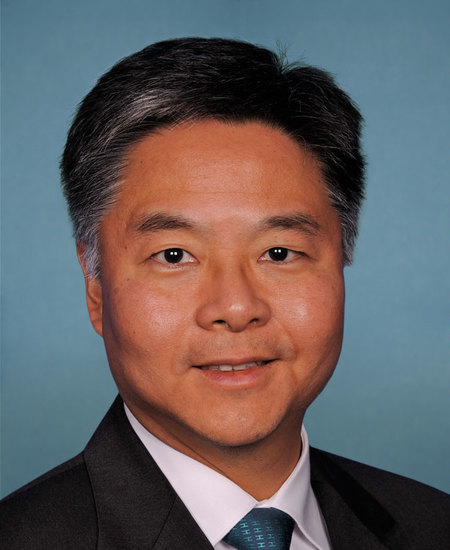
Photo of Ted Lieu
D United States House · District 36 · California On the 2026 ballot

Rep. Ted Lieu

Compare
Total votes
2,837
all sessions
Attendance
97%
85 missed
Near the chamber average
With party
98%
of cast votes
Near the chamber average
Bipartisan score
1%
crosses aisle rarely
Near the chamber average
Sponsored
2,328
bills & resolutions
Higher than 93% of chamber peers
Committees
3
assignments
2,328 bills and resolutions

Sponsored bills

Total
2,328
Primary
160
Co-sponsor
2,168
This page
2,328
matching current filters
Co-sponsor HR 5170
In committee · Indiana House · Co-sponsor
SERVE Act

Securing the Rights our Veterans Earned Act or the SERVE Act This bill provides eligibility for specified Department of Veterans Affairs benefits to former members of the Armed Forces who were separated or discharged (honorably or otherwise) by reason of sexual orientation or gender identity.

In committee Sep 21, 2021 1 co-sponsor
Co-sponsor HR 5302
In committee · Indiana House · Co-sponsor
U.S.-Israel Military Technology Cooperation Act

U.S.-Israel Military Technology Cooperation Act This bill modifies the required actions of the United States-Israel Defense Acquisition Advisory Group and requires the establishment of the United States-Israel Operations-Technology Working Group to address such operations and technology matters required of the group.

In committee Sep 20, 2021 1 co-sponsor
Co-sponsor HRES 647
In committee · Indiana House · Co-sponsor
Expressing the sense of the House of Representatives that the President and the Secretary of State should ensure that the Government of Canada does not permanently store nuclear waste in the Great Lakes Basin.

This resolution expresses the sense of the House of Representatives that Canada should not allow construction of a nuclear waste repository within the Great Lakes Basin and that the President and the Department of State should work with Canada to prevent such construction and craft a long-term solution for nuclear waste storage that does not threaten the Great Lakes.

In committee Sep 17, 2021 1 co-sponsor
Primary HR 5275
In committee · Indiana House · Lead sponsor
Accountability in Assignment Restrictions Act

Accountability in Assignment Restrictions Act This bill sets out a process through which Department of State employees may appeal assignment restrictions. These are restrictions on an employee's security clearance that preclude the employee from serving in certain diplomatic posts or working on certain issues in the United States to (1) prevent potential targeting and harassment by foreign intelligence services, and (2) lessen foreign influence or foreign preference security concerns. Specifically, the bill establishes the Assignment Restriction Appeals Panel to hear assignment restriction appeals from Foreign Service and civil service employees. Additionally, the State Department must annually report to Congress on its use of assignment restrictions, including the rationale for the restrictions, data about employees subject to restrictions in the previous year, and information about the appeals process.

In committee Sep 17, 2021 0 co-sponsors
Co-sponsor HR 4
Passed · Indiana House · Co-sponsor
John R. Lewis Voting Rights Advancement Act of 2021

John R. Lewis Voting Rights Advancement Act of 2021 This bill establishes new criteria for determining which states and political subdivisions must obtain preclearance before changes to voting practices may take effect. Preclearance is the process of receiving preapproval from the Department of Justice (DOJ) or the U.S. District Court for the District of Columbia before making legal changes that would affect voting rights. A state and all of its political subdivisions shall be subject to preclearance of voting practice changes for a 10-year period if 15 or more voting rights violations occurred in the state during the previous 25 years; 10 or more violations occurred during the previous 25 years, at least 1 of which was committed by the state itself; or 3 or more violations occurred during the previous 25 years and the state administers the elections. A political subdivision as a separate unit shall also be subject to preclearance for a 10-year period if three or more voting rights violations occurred there during the previous 25 years. States and political subdivisions that meet certain thresholds regarding minority groups must preclear covered practices before implementation, such as changes to methods of election and redistricting. Further, states and political subdivisions must notify the public of changes to voting practices. Next, the bill authorizes DOJ to require states or political subdivisions to provide certain documents or answers to questions for enforcing voting rights. The bill also outlines factors courts must consider when hearing challenges to voting practices, such as the extent of any history of official voting discrimination in the state or political subdivision.

Passed Sep 14, 2021 1 co-sponsor
Co-sponsor HR 4880
In committee · Indiana House · Co-sponsor
Veterans’ Prostate Cancer Treatment and Research Act

Veterans' Prostate Cancer Treatment and Research Act This bill requires the Department of Veterans Affairs (VA) to establish in its National Surgery Office an interdisciplinary clinical pathway for all stages of prostate cancer. Clinical pathways are health care management tools designed around research and evidence-based practices that provide direction for the care and treatment of a specific condition. The clinical pathway must include specified elements, such as a diagnosis pathway and a treatment pathway. The VA must consult with and incorporate feedback from (1) veterans who have received prostate cancer care at its medical facilities, and (2) experts in multidisciplinary cancer care and clinical research. Additionally, the VA must publish the clinical pathway on a public VA website and annually update the pathway as needed based on medical literature and evidence-based guidelines. The bill also requires the VA to submit a plan to establish a prostate cancer program using the comprehensive prostate cancer clinical pathway.

In committee Sep 9, 2021 1 co-sponsor
Co-sponsor HR 4811
In committee · Indiana House · Co-sponsor
Medicare Negotiation and Competitive Licensing Act of 2021

Medicare Negotiation and Competitive Licensing Act of 2021 This bill establishes several requirements relating to the prices of prescription drugs. Specifically, the bill requires the Centers for Medicare & Medicaid Services (CMS) to negotiate with pharmaceutical companies regarding prices for drugs covered under Medicare. (Current law prohibits the CMS from doing so.) If the CMS is unable to negotiate the price of a drug, such drug is subject to competitive licensing in order to further its sale under health insurance programs, notwithstanding existing government-granted exclusivities. The negotiated prices also apply to other federal health care programs, private health insurance, and the uninsured; pharmacies that charge more than the negotiated price for uninsured individuals are subject to civil penalties. Manufacturers must also comply with specified reporting requirements relating to prices and licensing, subject to civil penalties. The bill also institutes an excise tax on drugs for which the price spikes beyond a certain limit, subject to specified exemptions, as well as on drugs for which the price exceeds the negotiated price.

In committee Sep 8, 2021 1 co-sponsor
Co-sponsor HR 4315
In committee · Indiana House · Co-sponsor
Fair COLA for Seniors Act of 2021

Fair COLA for Seniors Act This bill bases cost-of-living adjustments for certain benefits available through federal and military retirement programs, Social Security, and specified programs for veterans on a price index that tracks the spending patterns of older consumers. The Bureau of Labor Statistics of the Department of Labor must publish that price index on a monthly basis.

In committee Sep 7, 2021 1 co-sponsor
Co-sponsor HR 5165
In committee · Indiana House · Co-sponsor
Improving Medicare Coverage Act

Improving Medicare Coverage Act This bill temporarily expands eligibility for Medicare. It also temporarily establishes a premium and cost-sharing assistance program for low-income beneficiaries. Specifically, the bill lowers the age of eligibility for Medicare from 65 to 60. The Centers for Medicare & Medicaid Services must establish procedures to provide for automatic enrollment of qualifying individuals. Enrollment must be completed within 11 months of the bill's enactment. The bill also establishes a program under Medicare to assist low-income Medicare beneficiaries with premiums, coinsurance, deductibles, and other costs. Currently, such assistance is provided through Medicare Savings Programs, which are administered by state Medicaid programs. The bill also establishes a related special enrollment period under Medicare, expands eligibility for assistance to beneficiaries with income up to 200% of the federal poverty line, and provides for joint eligibility determinations with respect to the bill's program and the low-income subsidy program under the Medicare prescription drug benefit. The bill's provisions generally take effect six months after the bill's enactment and terminate five years later.


In committee Sep 6, 2021 1 co-sponsor
Showing 1,931 to 1,940 of 2,328 bills