

Ukrainian Adjustment Act of 2025 This bill provides a streamlined process for certain Ukrainian nationals (including accompanying spouse and children) who are living in the United States to receive lawful permanent resident status. Specifically, the bill permits Ukrainian nationals who have been paroled into the United States after February 20, 2014, to apply for and receive lawful permanent resident status. Additionally, the Department of Homeland Security (DHS) may waive grounds for inadmissibility (excluding certain crimes or security related grounds) for individuals who apply for status adjustment. DHS must establish vetting requirements (including an interview) for applicants that are equivalent to those under the United States Refugee Admissions Program. The bill also preserves eligibility for the status adjustment of certain battered spouses whose eligibility for such status stemmed from a marriage that has terminated. Finally, the bill requires DHS to issue guidance to implement these requirements and establishes a deadline for eligible individuals to apply for adjustment.
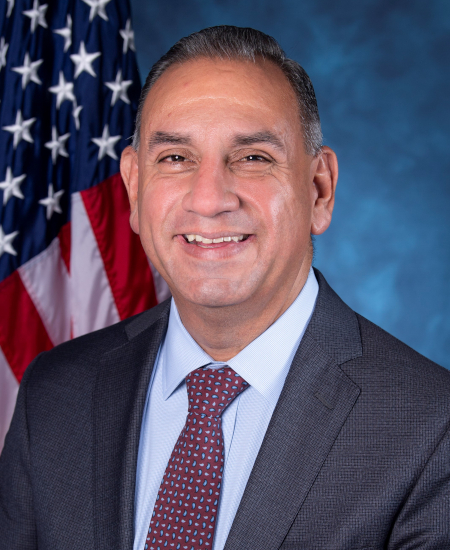
Rep. Gilbert Ray Cisneros, Jr.
Sponsored bills
Maddy summaryThe SERVE Act (HR 3107) aims to improve military recruitment by increasing access for recruiters in high schools and expanding Junior Reserve Officers' Training Corps (JROTC) opportunities. It requires military recruiters to visit schools at least four times per academic year during peak hours in common areas (like lunch or athletic events), and creates "Cross-town" JROTC units allowing students at schools without their own program to join nearby units. The bill also establishes a two-year pilot program to recognize "HERO schools" (high schools with military enlistment rates above the state average) and gives priority consideration to graduates of these schools when applying to military service academies. These changes directly affect high school students in grades 9-12 and school districts without JROTC programs, focusing on practical access and recognition to support military recruitment efforts.
Maddy summaryThe Equality Act (HR 15) amends federal civil rights laws to explicitly prohibit discrimination based on sexual orientation and gender identity in employment, housing, public accommodations, credit, and jury service. It expands existing protections under the Civil Rights Act of 1964 by adding sexual orientation and gender identity as protected characteristics under sex discrimination prohibitions. The bill clarifies that discrimination against LGBTQ people is a form of sex discrimination, consistent with the Supreme Court's Bostock decision, and adds specific definitions for gender identity and sexual orientation. This legislation directly affects businesses, employers, housing providers, financial institutions, and government entities that serve the public. The bill creates a more comprehensive legal framework to address discrimination that LGBTQ people face in multiple aspects of daily life.
Maddy summaryHR 3067, the Arctic Refuge Protection Act, repeals the existing oil and gas program for the Arctic National Wildlife Refuge (ANWR) and designates approximately 1.56 million acres of the refuge's Coastal Plain as wilderness. This directly affects federal management of the ANWR, halting potential oil drilling in the designated area. The bill requires the Secretary of the Interior to administer the newly designated wilderness area under the Wilderness Act, treating it as part of the existing wilderness within ANWR. The change prevents future oil and gas development on this specific portion of the refuge.
Maddy summaryHR 3071, the "Increasing Penalties for Offshore Polluters Act," increases civil and criminal penalties for violations of oil spill regulations under the Federal Water Pollution Control Act. It doubles fines and prison terms for polluters, such as raising the maximum civil penalty from $2,500 to $5,000 per violation and increasing criminal fines from $250,000 to $500,000 per day for severe offenses, with prison terms doubling to up to 30 years. The bill directly affects offshore oil and gas operators who cause spills by making penalties significantly harsher. Key provisions mandate minimum penalty amounts instead of maximums and explicitly double all existing fine and imprisonment limits for violations. These changes apply to both civil enforcement actions and criminal prosecutions under current federal law.
Maddy summaryHR 3045, the West Bank Violence Prevention Act of 2025, imposes U.S. sanctions on foreign individuals and entities responsible for violence, displacement, or property destruction in the West Bank. It targets those directly involved in attacks on civilians, forced displacement, or property seizures, including settler leaders or officials of groups engaged in such activities. Key provisions require freezing assets of sanctioned individuals within U.S. jurisdiction and blocking their entry into the United States via visa restrictions. The law applies to foreign nationals meeting specific criteria outlined in the bill, not U.S. citizens or entities.
Maddy summaryHR 3028, the Duty Drawback Clarification Act, clarifies tariff classifications for whisky imports by updating the Harmonized Tariff Schedule. It replaces a general whisky tariff code with specific subheadings based on whisky type (Irish/Scotch, Bourbon, Rye, or "other") and container size (under or over 4 liters), adding 8 new statistical suffixes. This change directly affects whisky importers and U.S. Customs officials by standardizing how these products are classified for duty-free entry (as indicated by "Free" in the tariff). The new classifications take effect 15 days after the bill's enactment.
Maddy summaryHR 2939, the Drone Espionage Act, updates existing espionage law to explicitly prohibit taking or transmitting video footage of defense information. It amends Title 18, U.S. Code, Section 793 by inserting "video" after "photographic negative" in the definition of prohibited materials. This change directly affects individuals who capture or share video of classified military or defense-related information, whether using drones or other devices. The bill makes no new criminal penalties but ensures video evidence is covered under current espionage statutes.
Maddy summaryThe DRIVE Act of 2025 requires the Department of Veterans Affairs (VA) to set mileage reimbursement rates for veterans at the federal government's current standard rate for employees using personal vehicles on official business, replacing the previous fixed rate of 41.5 cents per mile. It also mandates that the VA process and pay these reimbursements within 90 days of a veteran's valid request. This directly affects veterans who travel for VA medical appointments or services using their personal vehicles. The bill aligns veteran travel reimbursements with federal employee standards and ensures timely payments.
Maddy summaryHRES 326 is a non-binding resolution designating April 10 as "Dolores Huerta Day" to honor the late labor and civil rights leader Dolores Huerta. It recognizes her foundational work co-founding the United Farm Workers, leading grape boycotts that secured union contracts, advocating for farm workers' safety, and championing women's rights and Latino political representation. The resolution has no policy impact or direct effect on any group, as it solely serves to commemorate Huerta's legacy. It was introduced by multiple House members in recognition of her contributions to civil rights and equality.