Insular Area Medicaid Parity Act This bill eliminates Medicaid funding limitations for U.S. territories beginning in FY2021.
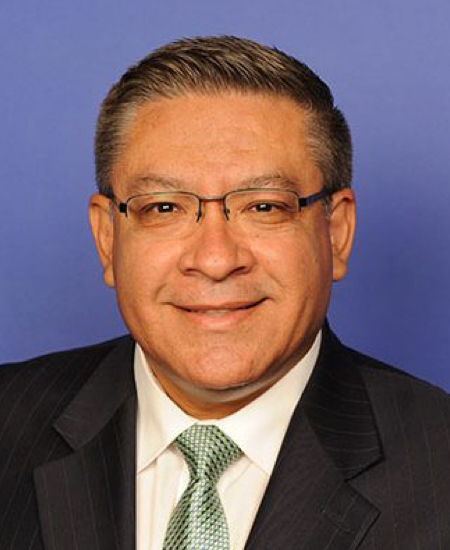
Rep. Salud O. Carbajal
Sponsored bills
Restricting First Use of Nuclear Weapons Act of 2021 This bill prohibits the use of federal funds to conduct a first-use nuclear strike unless Congress expressly authorizes such a strike pursuant to a declaration of war. A first-use nuclear strike is an attack using nuclear weapons against an enemy that did not first launch a nuclear strike against the United States, its territories, or its allies.
Pre-Registration Of Voters Everywhere Act or the PROVE Act This bill requires each state to implement a preregistration process under which individuals age 16 or older may apply to register to vote in federal elections. Further, states must ensure that eligible preregistered individuals are registered to vote in federal elections held on or after the date the individual turns age 18. The Election Assistance Commission must make grants to states to increase the involvement of individuals under age 18 in public election activities.
Safe from the Start Act of 2021 This bill directs the Department of State to direct U.S. foreign assistance to address humanitarian crises in a manner that aims to prevent and respond to gender-based violence at the onset of an emergency. The State Department shall focus on (1) preventing gender-based violence, (2) protecting survivors of humanitarian crises from the onset of the emergency, (3) promoting standards and activities to prevent and respond to gender-based violence, and (4) advancing and empowering survivors and at-risk individuals. Activities shall include improving access to post-sexual-assault medical and mental health services and ensuring such services are available to hard-to-reach populations. The State Department may provide support to local and international organizations to achieve its goals.
Global Health, Empowerment and Rights Act This bill establishes that a foreign nongovernmental organization shall not be disqualified from receiving certain U.S. international development assistance solely because the organization provides medical services using non-U.S. government funds if the medical services are legal in both the United States and the country in which they are being provided. Such foreign organizations shall not be subject to requirements relating to their use of non-U.S. funds for advocacy or lobbying activities, other than those that apply to U.S. nongovernmental organizations. Current U.S. policy prohibits various foreign assistance from going to a foreign nongovernmental organization unless it agrees to not perform or actively promote abortions.
Securing Access to Lower Taxes by ensuring Deductibility Act or the SALT Deductibility Act This bill repeals the temporary restrictions in taxable years 2018 through 2025 on the deductibility of state and local taxes.
Special Districts Provide Essential Services Act This bill makes special districts eligible for the Coronavirus Relief Fund and the Municipal Liquidity Facility program. Specifically, the bill makes special districts eligible for payments from amounts paid to states from any new appropriations to the fund. A special district must submit a request for payment to the state with information demonstrating that the special district has experienced or is likely to experience during the COVID-19 (i.e., coronavirus disease 2019) emergency reduced revenue or operational funding derived from provided services, taxes, fees, or other sources of revenue; reduced indirect funding from the federal government, the state, or a unit of general government below the state level; or as a result of the COVID-19 emergency, increased expenditures necessary to continue operations. The Board of Governors of the Federal Reserve System shall include special districts as eligible issuers in the Municipal Liquidity Facility program, which was created in response to the COVID-19 emergency to buy municipal securities.
Raise the Wage Act of 2021 This bill increases the federal minimum wage for regular employees over a 5-year period, for tipped employees, and for newly hired employees who are less than 20 years old. The bill sets forth a schedule of annual increases in the federal minimum wage for individuals with disabilities. The Department of Labor shall no longer issue special certificates for the payment of subminimum wages to such individuals after the final wage increase under this bill for such individuals takes effect. Labor shall provide, upon request, technical assistance and information to employers to (1) help them transition their practices to comply with wage increases and other requirements under this bill for individuals with disabilities, and (2) ensure continuing employment opportunities for such individuals. The bill eliminates the separate minimum wage requirements for tipped, newly hired, and disabled employees. After a specified period, these employees shall be paid the same minimum wage as regular employees. Labor must publish any increase in the minimum wage in the Federal Register and on its website 60 days before it takes effect.
Health Care Fairness for Military Families Act of 2021 This bill modifies the extension of dependent coverage under TRICARE by allowing a dependent under the age of 26 to be covered without an additional premium. Additionally, the bill authorizes such coverage of dependents without a premium regardless of whether they are eligible to enroll in an employer sponsored plan.
American Food for American Schools Act of 20 21 This bill requires school food authorities (SFAs) to request a waiver from the Department of Agriculture (USDA) to purchase foreign commodities or products for the National School Lunch Program (NSLP). SFAs may purchase foreign commodities or products without a waiver if the commodities or products are not produced or available domestically. Under current law, Buy American provisions require SFAs to purchase, to the maximum extent practicable, domestic commodities or products for the NSLP. There are limited exceptions which permit the purchase of foreign products in circumstances when using domestic products is truly not practicable. If an SFA uses an exception, there is no requirement to request a waiver to purchase a foreign product or commodity, but the SFA must keep documentation justifying the exception. USDA may not provide a waiver for an SFA to purchase foreign commodities or products unless (1) the commodities or products are not produced domestically in sufficient amounts or of satisfactory quality, (2) the domestic commodities or products would be significantly higher in price than foreign commodities or products, and (3) the SFA agrees to make the waiver publicly available on its website and email a notification of the waiver to parents or guardians of students who will be served the foreign commodity or product purchased pursuant to the waiver.