

College Student Hunger Act of 20 21 This bill expands the eligibility of students at institutions of higher education to participate in the Supplemental Nutrition Assistance Program (SNAP). SNAP eligibility for students is expanded to include certain low-income students who (1) are employed a minimum of 10 hours per week (currently 20 hours) during the regular school year, (2) are eligible for a federal Pell Grant, (3) have an expected family contribution equal to zero, or (4) are independent. Additionally, the bill directs the Department of Education to provide notification to certain students regarding their eligibility for SNAP benefits, the Inspector General of the Department of Agriculture (USDA) to conduct an audit of the operations of the Food and Nutrition Service to examine the procedures and outreach practices used by the service to provide to states information about the eligibility of students at institutions of higher education for participation in the program, USDA to update its state outreach plan guidance, and USDA to implement projects to decrease student hunger at institutions of higher education and to reduce barriers to college students fully utilizing SNAP benefits at these institutions.
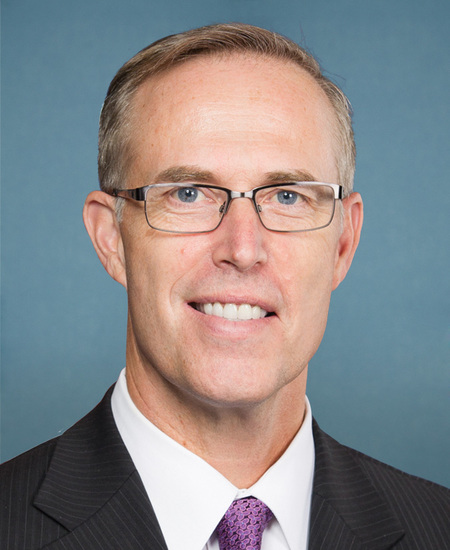
Rep. Jared Huffman
Sponsored bills
This resolution calls for the creation of a Green New Deal with the goals of achieving greenhouse gas and toxic emissions reductions needed to stay under 1.5 degrees Celsius of warming; establishing millions of high-wage union jobs and ensuring economic security for all; investing in infrastructure and industry; securing clean air and water, climate and community resiliency, healthy food, access to nature, and a sustainable environment for all; and promoting justice and equality. The resolution calls for accomplishment of these goals through a 10-year national mobilization effort. The resolution also enumerates the goals and projects of the mobilization effort, including building smart power grids (i.e., power grids that enable customers to reduce their power use during peak demand periods); upgrading all existing buildings and constructing new buildings to achieve maximum energy and water efficiency; removing pollution and greenhouse gas emissions from the transportation and agricultural sectors; cleaning up existing hazardous waste and abandoned sites; ensuring businesspersons are free from unfair competition; and providing higher education, high-quality health care, and affordable, safe, and adequate housing to all.
This resolution rejects the Supreme Court's decisions in the Insular Cases (a series of cases regarding the application of constitutional rights in U.S. territories) and recognizes that constitutional and democratic principles apply throughout the states and territories of the United States.
Families Belong Together Act This bill provides various immigration benefits for eligible alien parents (or legal guardians) and minor children who were separated by the Department of Homeland Security (DHS) between January 20, 2017, and January 20, 2021. Generally, to be an eligible parent or minor child under this bill, the alien must not be inadmissible for certain crime- or security-related grounds, though DHS may waive certain grounds for humanitarian or public interest reasons. Furthermore, an eligible child who was separated as a minor remains eligible for the immigration benefits after reaching majority. DHS must grant humanitarian parole into the United States to an eligible alien who requests such parole, regardless of whether the alien is physically present in the United States. An eligible alien in the United States may apply for lawful permanent resident status. U.S. Citizenship and Immigration Services shall grant a qualifying alien's lawful permanent resident status within 30 days of receiving the alien's application. An alien who receives lawful permanent resident status under this bill shall be eligible for benefits and services that are available to an alien who is admitted as a refugee. Certain annual numerical limitations shall not apply to aliens who receive lawful permanent resident status under this bill. If an alien seeks judicial review of a denial of an application for lawful permanent resident status under this bill, the Department of Justice shall appoint counsel to represent that alien upon request.
Green New Deals for Cities Act of 2021 This bill authorizes the Department of Housing and Urban Development to provide funding to states, local governments, or Native American nations to carry out Green New Deal projects, such as projects to clean up pollution, climate adaptation measures, or conservation projects on family farms. In order to receive such funding, a state, local government, or Native American nation must have a local Green New Deal program proposal and meet other requirements as specified by the bill. A proposal must contain certain commitments, including a commitment to zero greenhouse gas emissions by 2030 through a fair and just transition for all communities and workers.
Khalid Jabara and Heather Heyer National Opposition to Hate, Assault, and Threats to Equality Act of 2021 or the Jabara-Heyer NO HATE Act of 2021 This bill creates grants for state and local governments to combat hate crimes. It also authorizes additional penalties for hate crime offenses. Specifically, it establishes grants for states to create state-run hate crimes reporting hotlines. It also authorizes grants for states and local governments to implement the National Incident-Based Reporting System and to conduct law enforcement activities or crime reduction programs to prevent, address, or respond to hate crimes. Finally, in the case of an individual convicted of a hate crime offense and placed on supervised release, the bill allows a court to order that the individual participate in educational classes or community service as a condition of supervised release.
Dignity for Detained Immigrants Act of 2021 This bill directs the Department of Homeland Security (DHS) to establish standards for facilities holding aliens in its custody, phases out using non-DHS facilities for such purposes, and contains other related provisions. The standards shall comply with the American Bar Association's Civil Immigration Detention Standards. The DHS Office of Inspector General (OIG) shall conduct periodic unannounced inspections of each facility and shall take various actions against noncompliant facilities, including imposing fines, cancelling contracts, and closing facilities. DHS shall report to Congress any death of an alien in its custody within 24 hours and conduct an investigation within 30 days that identifies policy changes that could reduce the likelihood of such a death. DHS is prohibited from entering into contracts for third parties to operate detention facilities or alternatives to detention programs and shall terminate existing contracts within three years of the bill's enactment. The bill establishes that OIG facility inspection reports and contracts for an outside entity to operate a detention facility are records available to the public under the Freedom of Information Act. DHS shall maintain certain information relating to detained aliens, including the alien's location and whether the alien was separated from family. The bill provides for various requirements and procedures related to detaining aliens, including (1) prohibiting DHS from detaining children, (2) imposing a presumption that an alien should be released, and (3) establishing that aliens in custody shall be subject to the least restrictive conditions. The bill also abolishes mandatory detention for asylum seekers.
Equal Access to Abortion Coverage in Health Insurance Act of 2021 or the EACH Act of 2021 This bill requires federal health care programs to provide coverage for abortion services and requires federal facilities to provide access to those services. The bill also permits qualified health plans to use funds attributable to premium tax credits and reduced cost sharing assistance to pay for abortion services.
Outdoors for All Act This bill directs the Department of the Interior to establish an outdoor recreation legacy partnership grant program under which Interior may award grants to states, certain political subdivisions of a state, special purpose districts, Indian tribes, or Alaska Native or Native Hawaiian communities or organizations. Funds must be used for projects to (1) acquire land and water for parks and other outdoor recreation purposes in qualifying areas, and (2) develop new or renovate existing outdoor recreation facilities that provide outdoor recreation opportunities to the public in qualifying areas. A qualifying area is an area that has a population of 30,000 or more in the most recent census, or that is administered by an Indian tribe or an Alaska Native or Native Hawaiian community organization. Interior shall give priority to projects that create or significantly enhance access to park and recreational opportunities in an urban neighborhood or community, engage and empower underserved communities and youth, provide opportunities for employment or job training for youth or underserved communities, establish or expand public-private partnerships, and take advantage of coordination among various levels of government.
Indian Programs Advance Appropriations Act of 2021 This bill authorizes advance appropriations for several covered appropriations accounts of (1) the Bureau of Indian Affairs and the Bureau of Indian Education within the Department of the Interior, and (2) the Indian Health Service within the Department of Health and Human Services. The advance appropriations provide new budget authority that first becomes available for the first fiscal year after the budget year. The covered accounts within the Bureau of Indian Affairs are (1) Operation of Indian Programs, (2) Contract Support Costs, (3) the Indian Guaranteed Loan Program, (4) Construction, and (5) Payments for Tribal Leases. The covered accounts within the Bureau of Indian Education are (1) Operation of Indian Education Programs, and (2) Education Construction. The covered accounts within the Indian Health Service are (1) Indian Health Services, (2) Contract Support Costs, (3) Payments for Tribal Leases, and (4) Indian Health Facilities. The bill also requires the President's budget and the supporting documents submitted to Congress to include detailed estimates related to the advance appropriations.