

Improving Federal Investigations of Organized Retail Crime Act of 2022 This bill requires various federal agencies to develop a strategy to improve coordination with state and local law enforcement entities to address organized retail crime. Specifically, the bill requires the Department of Justice, the Department of Homeland Security, the U.S. Postal Service, and other relevant agencies to improve federal information sharing about organized retail crime networks, assist state and local law enforcement in compiling materials and evidence needed to prosecute organized retail crime, and increase cooperation and information sharing with the retail industry and retail crime task forces. The bill also requires the Government Accountability Office to report on private sector and law enforcement collaboration to deter and investigate organized retail crime.
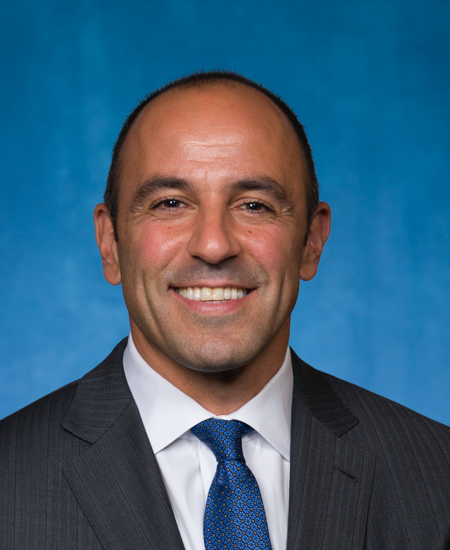
Rep. Jimmy Panetta
Sponsored bills
Dark Web Interdiction Act of 2022 This bill establishes enhanced criminal penalties for distributing controlled substances via the dark web. It also establishes other programs and requirements to address the use of the dark web for illicit drug activities. ( Dark web means the portions of the internet with hidden sites and services that (1) are not generally searchable, and (2) can only be accessed with specialized devices or services that conceal the identities and locations of users.) Specifically, the bill provides an enhanced criminal penalty for delivering, distributing, or dispensing controlled substances via the dark web. The bill also provides statutory authority for the Joint Criminal Opioid and Darknet Enforcement Task Force, which supports the investigation and prosecution of drug offenses committed via the dark web domestically and internationally. In addition, the Department of Justice must report on how and to what extent virtual currencies are used for opioid distribution via the dark web.
Retain COPS Act of 2022 This bill allows funds under the Community Oriented Policing Services grant program to be used for salary increases to retain law enforcement officers.
Stopping Harmful Image Exploitation and Limiting Distribution Act of 2022 or the SHIELD Act of 2022 This bill establishes a new criminal offense related to the distribution of intimate visual depictions. Specifically, it makes it a crime to knowingly distribute (or intentionally threaten to distribute) an intimate visual depiction of an individual (1) with knowledge of or reckless disregard for the individual's lack of consent and reasonable expectation of privacy, and (2) without a reasonable belief that distributing the depiction touches a matter of public concern. A violator is subject to criminal penalties—a fine, a prison term of up to two years for each individual victim depicted, or both.
Housing for All Act of 2022 This bill modifies existing, and creates new, grants and programs concerning affordable housing and homelessness. In particular, the bill authorizes federal funding of the Housing Trust Fund, which supports affordable housing activities. Currently, contributions to the fund come from the earnings of Fannie Mae and Freddie Mac. Additionally, the bill (1) expands eligibility for housing choice vouchers, which provide rental assistance to low-income individuals; and (2) entitles certain individuals to the vouchers. Other matters addressed in the bill include permanently authorizing the U.S. Interagency Council on Homelessness (which terminates on October 1, 2028) and modifying existing programs that support housing for the elderly, individuals with disabilities, and individuals experiencing homelessness or at risk of homelessness. The bill also creates various housing-related grant programs to, for example, support overnight parking for individuals who live in vehicles and no-cost legal assistance with evictions for low-income individuals. The bill also incorporates housing into certain transportation grants and programs.
Latonya Reeves Freedom Act of 2022 This bill prohibits government entities and insurance providers from denying community-based services to individuals with disabilities that require long-term service or support that would enable such individuals to live in the community and lead an independent life. Specifically, these entities may not discriminate against such individuals in the provision of community-based services by such actions as imposing prohibited eligibility criteria, cost caps, or waiting lists or failing to provide a specific community-based service. Additionally, community-based services must be offered to individuals with such disabilities prior to institutionalization. Institutionalized individuals must be notified regularly of community-based alternatives. The bill requires the Department of Justice to issue regulations requiring government entities and insurance providers to offer community-based long-term services to individuals with such disabilities who would otherwise qualify for institutional placement. Government entities must ensure sufficient availability of affordable, accessible, and integrated housing that is not a disability-specific residential setting or a setting where services are tied to tenancy. Regulations shall also (1) require government entities and insurance providers to perform self-evaluation on current services, policies, and practices and concerning compliance with requirements of this bill; and (2) require government entities to submit a transition plan. The bill provides funds for FY2022 for the Department of Health and Human Services to provide technical assistance with respect to transition plans. The bill allows civil actions by individuals subjected to, or about to be subjected to, a violation of its requirements.
Maddy summaryHR 6864, the Ocean Shipping Antitrust Enforcement Act, repeals a specific antitrust exemption for ocean shipping companies under U.S. law. This bill directly affects ocean carriers that previously operated under Section 40307 of Title 46, U.S. Code, which exempted them from standard antitrust enforcement. The key provision removes this exemption, requiring shipping companies to comply with general antitrust laws rather than having a special exception. As a result, federal agencies could pursue antitrust enforcement actions against these companies for practices like price-fixing or market allocation that were previously shielded. The bill does not create new rules but changes the legal framework governing ocean shipping competition.
Porch Pirates Act of 2022 This bill extends federal criminal penalties for obstruction of correspondence and theft of stolen mail matter (which apply to U.S. Postal Service mail) to matter (e.g., packages) sent or delivered by private or commercial interstate carriers.
Climate Resilience Workforce Act This bill sets forth provisions to establish a climate resilience workforce, a national climate resilience action plan, an Office of Climate Resilience within the White House, and related efforts and entities.
Preventing Auto Recycling Theft Act or the PART Act This bill establishes requirements for motor vehicles related to catalytic converters and other motor vehicle parts that contain precious metals. The National Highway Traffic Safety Administration must revise the motor vehicle theft prevention standard for new motor vehicles to include catalytic converters among the parts that require an inscribed or affixed identifying number. Additionally, the Department of Transportation must establish a grant program through which law enforcement agencies and other entities can stamp vehicle identification numbers onto catalytic converters of existing vehicles. The bill establishes retention requirements for the purchase of motor vehicle parts that contain precious metals. It also sets forth criminal penalties for the theft of catalytic converters or any precious metals removed from a vehicle.