National Women's Hall of Fame Commemorative Coin Act of 2021 This bill directs the Department of the Treasury to mint and issue $5 gold coins, $1 silver coins, half-dollar clad coins, and proof silver $1 coins in recognition and celebration of the National Women's Hall of Fame in Seneca Falls, New York. All minted coins shall include a specified surcharge, which shall be paid to the National Women's Hall of Fame Foundation to establish an endowment fund to provide for the long-term financing of the hall's operations.
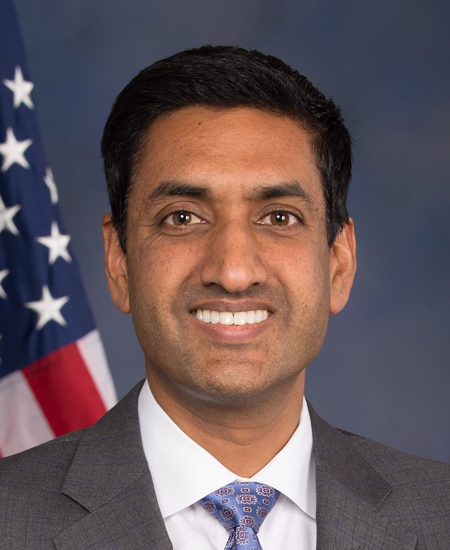
Rep. Ro Khanna
Sponsored bills
LGBTQ Business Equal Credit Enforcement and Investment Act This bill requires financial institutions to report certain credit application data to the Consumer Financial Protection Bureau for the purposes of enforcing fair lending laws. Specifically, financial institutions must report this data regarding lesbian-, gay-, bisexual-, transgender-, or queer-owned businesses. Currently, this data is reported regarding women-owned, minority-owned, and small businesses.
Halt Unchecked Member Benefits with Lobbying Elimination Act or the HUMBLE Act This bill places limits on certain activities of Members and elected officers of Congress. The bill imposes a permanent ban on lobbying contacts by a former Senator (currently, a two-year ban), a former Member of the House of Representatives (currently, a one-year ban), or a former elected officer of the House or Senate (currently, a one-year ban). This bill prohibits federal funds made available for the official travel of a Member or other officer or employee of the legislative branch from being used for airline accommodations that are not coach-class accommodations. Such prohibition is inapplicable for an individual if the use would be permitted for an employee of an agency subject to specified federal regulations for temporary duty travel allowances. Certain benefits and services are eliminated for former Members of the House (e.g., access to the House chamber, the Member's Dining Room, or parking spaces) unless the benefits or services are made available to the public. Finally, the bill prohibits Members of the House from owning the common stock of any individual corporation.
Hong Kong Safe Harbor Act This bill designates certain Hong Kong residents with priority status for refugee consideration and contains other related provisions. An individual and certain family members shall have such priority status if the individual (1) is a Hong Kong resident who suffered persecution or has a well-founded fear of persecution as a result of peaceful political activity; or (2) has been formally charged, detained, or convicted for certain peaceful actions. An individual receiving refugee status under this bill shall not be counted against various numerical limitations. When determining whether an individual shall be admitted as a refugee under this bill, an individual whose citizenship, nationality, or residency was revoked for submitting a nonfrivolous application for a U.S. immigration benefit shall be considered to have suffered persecution on account of political opinion. The general presumption that an alien is seeking immigrant status shall not apply to certain Hong Kong residents seeking asylum into the United States. (Typically, an alien seeking admission as a nonimmigrant must establish that the alien does not intend to immigrate to the United States.) This exception to the presumption shall apply to certain individuals involved in the 2019 and 2020 protests against China's encroachment into Hong Kong's autonomy (Hong Kong is a part of China but has a separate legal and economic system). An individual from Hong Kong may not be denied admission into the United States if the primary reason for the denial is a politically motivated government action against the individual's involvement in protests.
This joint resolution proposes a constitutional amendment authorizing Congress and the states to set reasonable limits on the raising and spending of money by candidates and others to influence elections. The amendment grants Congress and the states the power to implement and enforce this amendment by legislation. They are allowed to distinguish between natural persons and corporations or other artificial entities created by law, including by prohibiting such entities from spending money to influence elections.
This resolution censures and condemns President Donald J. Trump for asking the Georgia Secretary of State on January 2, 2021, to overturn the Georgia results of the November 2020 presidential election. It further calls on President Trump to (1) retract and disavow this behavior, and (2) acknowledge President-elect Joseph R. Biden as the victor of the November 2020 presidential election.
Ellie Helton, Lisa Colagrossi, Kristen Shafer Englert, Teresa Anne Lawrence, and Jennifer Sedney Focused Research Act or Ellie's Law This bill authorizes appropriations for the National Institute of Neurological Disorders and Stroke to conduct or support research on unruptured brain aneurysms in a patient population diversified by age, sex, and race.
Nutrition Counseling Aiding Recovery for Eating Disorders Act of 2021 or the Nutrition CARE Act of 2021 This bill provides for Medicare coverage of medical nutrition therapy services for individuals with eating disorders. Such services must be furnished by a registered dietitian or nutrition professional pursuant to a referral from a physician, psychologist, or other authorized mental health professional.
Federal Death Penalty Prohibition Act This bill prohibits the imposition of a death penalty sentence for a violation of federal law. A person sentenced to death before enactment of this bill must be resentenced.
Preventing Future Pandemics Act of 2021 This bill establishes measures to address global public health risks posed by wildlife markets, which are commercial markets that sell or slaughter wildlife for human consumption as food or medicine in communities where alternative nutritional or protein sources are available. Specifically, the bill prohibits importing, exporting, purchasing, or selling live wild animals in the United States for human consumption as food or medicine. The Department of the Interior must hire, train, and deploy at least 50 new U.S. Fish and Wildlife Service law enforcement attachés around the world, and the U.S. Agency for International Development must increase specified activities to address the threats and causes of zoonotic (animal-to-human transmission) disease outbreaks. Additionally, the United States must work with other United Nations member states to urge a global ban on commercial wildlife markets and enforcement of laws to end wildlife trafficking. Further, the President may impose sanctions against a foreign country or foreign nationals that the Department of State has determined are taking certain actions that enable or facilitate commercial wildlife markets. Among other reports required by the bill, the National Academies of Sciences, Engineering, and Medicine must conduct a study and submit a report that includes an evaluation of (1) the impact that consumption of terrestrial wildlife as food or medicine has on the transmission of novel viral and other pathogens, (2) the role of consuming terrestrial wildlife as food or medicine in the transmission of microbes from animals to humans, and (3) the conditions at live wildlife markets that lead to this transmission.