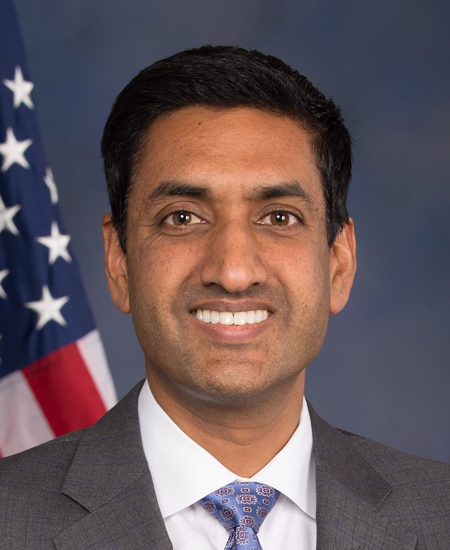
Photo of Ro Khanna
D United States House · District 17 · California On the 2026 ballot

Rep. Ro Khanna

Compare
Total votes
2,837
all sessions
Attendance
99%
29 missed
Near the chamber average
With party
98%
of cast votes
Near the chamber average
Bipartisan score
1%
crosses aisle rarely
Near the chamber average
Sponsored
2,019
bills & resolutions
Higher than 87% of chamber peers
Committees
6
assignments
2,019 bills and resolutions

Sponsored bills

Total
2,019
Primary
138
Co-sponsor
1,881
This page
2,019
matching current filters
Co-sponsor HR 1782
In committee · Indiana House · Co-sponsor
Empowering Law Enforcement for Safer Firearm Transfers Act of 2021

Empowering Law Enforcement for Safer Firearm Transfers Act of 2021 This bill modifies procedural requirements related to the transfer of machine guns, destructive devices, and certain other firearms. Specifically, the bill requires the chief law enforcement officer of the jurisdiction in which the transferee primarily resides to be notified of the pending transfer and given 90 days to object.

In committee Mar 10, 2021 1 co-sponsor
Co-sponsor HR 1731
In committee · Indiana House · Co-sponsor
BEST Act

Biliteracy Education Seal and Teaching Act or the BEST Act This bill directs the Department of Education to award renewable two-year grants to states to establish or improve, and carry out, Seal of Biliteracy programs to recognize student proficiency in speaking, reading, and writing in both English and a second language. Further, these programs must allow speakers of any official Native American language to use equivalent proficiency in speaking, reading, and writing in such language in lieu of proficiency in English.

In committee Mar 10, 2021 1 co-sponsor
Co-sponsor HR 1694
In committee · Indiana House · Co-sponsor
Stop Militarizing Law Enforcement Act

Stop Militarizing Law Enforcement Act This bill restricts the Department of Defense (DOD) from transferring certain surplus military property to federal, state, or local law enforcement agencies. Specifically, DOD may not transfer to such agencies specified property such as controlled firearms, ammunition, grenade launchers, explosives, certain vehicles or trucks, armored or weaponized drones, certain controlled aircraft, silencers, or long-range acoustic devices. DOD may waive this limitation and transfer certain vehicles or trucks if DOD determines that the transfer is necessary for disaster or rescue purposes or for another purpose where life and public safety are at risk. As a condition for a transfer of allowable property, DOD must require the federal or state agency that receives the property to return the property if the agency is investigated by the Department of Justice for civil liberties violations or is otherwise found to have engaged in widespread abuses of civil liberties. DOD must also periodically submit certain transfer-related information and certifications to Congress. Furthermore, as a condition for transfer, the recipient must receive the approval of its local governing body, provide specified notice to the local community, and submit specified information and certifications to DOD. A federal or state agency that receives controlled property under such a transfer may never take ownership of the property. The bill also eliminates the requirement for DOD to give preference to transfers of property that will be used in counter-drug, counterterrorism, disaster-related emergency preparedness, or border security activities.

In committee Mar 9, 2021 1 co-sponsor
Co-sponsor HR 1670
In committee · Indiana House · Co-sponsor
Abortion is Health Care Everywhere Act of 2021

Abortion is Health Care Everywhere Act of 2021 This bill authorizes the use of certain foreign assistance funds to provide comprehensive reproductive health care services in developing countries, including abortion services, training, and equipment.

In committee Mar 9, 2021 1 co-sponsor
Co-sponsor HR 1280
Passed · Indiana House · Co-sponsor
George Floyd Justice in Policing Act of 2021

George Floyd Justice in Policing Act of 2021 This bill addresses a wide range of policies and issues regarding policing practices and law enforcement accountability. It increases accountability for law enforcement misconduct, restricts the use of certain policing practices, enhances transparency and data collection, and establishes best practices and training requirements. The bill enhances existing enforcement mechanisms to remedy violations by law enforcement. Among other things, it does the following: lowers the criminal intent standard—from willful to knowing or reckless—to convict a law enforcement officer for misconduct in a federal prosecution, limits qualified immunity as a defense to liability in a private civil action against a law enforcement officer, and grants administrative subpoena power to the Department of Justice (DOJ) in pattern-or-practice investigations. It establishes a framework to prevent and remedy racial profiling by law enforcement at the federal, state, and local levels. It also limits the unnecessary use of force and restricts the use of no-knock warrants, chokeholds, and carotid holds. The bill creates a national registry—the National Police Misconduct Registry—to compile data on complaints and records of police misconduct. It also establishes new reporting requirements, including on the use of force, officer misconduct, and routine policing practices (e.g., stops and searches). Finally, it directs DOJ to create uniform accreditation standards for law enforcement agencies and requires law enforcement officers to complete training on racial profiling, implicit bias, and the duty to intervene when another officer uses excessive force.

Passed Mar 9, 2021 1 co-sponsor
Co-sponsor HR 943
In committee · Indiana House · Co-sponsor
Social Determinants for Moms Act

Social Determinants for Moms Act This bill directs various federal departments to address social determinants of maternal health. These are nonclinical factors, such as economic or social factors, that impact maternal health outcomes. First, the Department of Health and Human Services (HHS) must convene a task force to coordinate federal efforts on social determinants of maternal health. HHS must also award grants to support access to free child care during prenatal and postpartum appointments; and address social determinants of, and eliminate racial and ethnic disparities in, maternal health. Second, the Department of Housing and Urban Development must award grants to community-based organizations and government entities to assist pregnant and postpartum individuals with affordable housing. Grantees may use funds to, for example, provide individuals with direct financial assistance. Third, the Department of Transportation must report on transportation barriers that prevent pregnant and postpartum individuals from accessing health care and other services. Fourth, the bill extends to 24 months the postpartum eligibility period for the Special Supplemental Nutrition Program for Women, Infants, and Children (WIC). Currently, WIC eligibility lasts for six months postpartum or one year for those breastfeeding. The Department of Agriculture (USDA) must evaluate the impact of this extension. USDA must also establish a grant program to deliver healthy foods and supplies to pregnant and postpartum individuals in food deserts. Last, the Environmental Protection Agency must enter into an agreement with the National Academies of Sciences, Engineering, and Medicine to study the impact of environmental conditions and contaminants on maternal and infant health outcomes.


In committee Mar 9, 2021 1 co-sponsor
Co-sponsor HJRES 29
In committee · Indiana House · Co-sponsor
War Powers Amendments of 2021

War Powers Amendments of 2021 This joint resolution revises the War Powers Resolution, a law that limits the President's power to introduce Armed Forces into hostilities. Changes include shortening the time that Armed Forces may be involved in hostilities without congressional action and providing for judicial enforcement. The President shall remove any Armed Forces introduced into hostilities without congressional approval within 30 days unless Congress (1) declares war, (2) enacts a joint resolution specifically authorizing such use of the Armed Forces, or (3) is unable to meet because of an attack on the United States. This 30-day period may be extended by up to 15 days under specified circumstances. Current law allows such use of the Armed Forces for 60 days from when the President first reports to Congress about the engagement and allows for a 60-day extension. If Congress takes no such actions, funds may not be used to continue Armed Forces involvement in the hostilities, except to withdraw. The bill removes a provision requiring the removal of such engaged Armed Forces if Congress passes a concurrent resolution requiring such removal. A member of Congress may sue in district court for an order directing the President to comply with this bill. A judgment in such an action shall be directly appealable to the Supreme Court. The bill also revises various provisions relating to (1) the President reporting to and consulting with Congress regarding the use of the Armed Forces without congressional authorization, and (2) procedures for the expedited handling of joint resolutions related to such use of force.

In committee Mar 8, 2021 1 co-sponsor
Co-sponsor HRES 196
In committee · Indiana House · Co-sponsor
Expressing the sense of the House of Representatives regarding the importance of taking a feminist approach to all aspects of foreign policy, including foreign assistance and humanitarian response, trade, diplomacy, defense, immigration, funding, and accountability mechanisms.

This resolution supports the goals of a feminist foreign policy (i.e., a foreign policy that requires analysis of and challenges to power structures and inequalities that are based on systems of discrimination), and it supports the adoption of policies that promote gender equity and women's participation in public life.

In committee Mar 8, 2021 1 co-sponsor
Co-sponsor HR 1618
In committee · Indiana House · Co-sponsor
RESPOND Act of 2021

Restructuring Environmentally Sound Pensions in Order to Negate Disaster Act of 2021 or the RESPOND Act of 2021 This bill addresses issues related to the impact of climate change on the economy, including federal retirement plans. The Federal Retirement Thrift Investment Board must establish an advisory panel on the economics of climate change to advise on how the board may invest in clean and renewable energy and make investments in a manner that helps ensure net zero greenhouse gas emissions in the United States by 2050. The board must then assess whether implementing low-carbon investment strategies is profitable and consistent with its duties. If the board cannot implement such strategies, the bill establishes the Climate Choice Stock Index Fund as part of the Federal Employees Retirement System's Thrift Savings Plan. This fund is established as an investment portfolio that performs similarly to other plan index funds, but does not invest in fossil fuels. Finally, the Federal Reserve Board and the Securities and Exchange Commission must annually report on the economic costs of climate change.

In committee Mar 8, 2021 1 co-sponsor
Co-sponsor HR 1644
In committee · Indiana House · Co-sponsor
GOALS Act

Give Our Athletes Level Salaries Act or the GOALS Act This bill prohibits the use of funds for the 2026 World Cup until the U.S. Soccer Federation agrees to provide equitable pay to the members of the U.S. Women's National Team and the U.S. Men's National Team.

In committee Mar 8, 2021 1 co-sponsor
Showing 1,881 to 1,890 of 2,019 bills