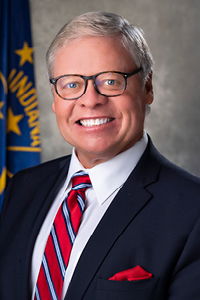
Photo of Ron Alting
R Indiana Senate · District 22 On the 2026 ballot

Sen. Ron Alting

Compare
Total votes
2,574
all sessions
Attendance
92%
163 missed
Near the chamber average
With party
93%
of cast votes
Lower than 85% of chamber peers
Bipartisan score
4%
crosses aisle rarely
Higher than 80% of chamber peers
Sponsored
559
bills & resolutions
Lower than 91% of chamber peers
Committees
2
assignments
559 bills and resolutions

Sponsored bills

Total
559
Primary
219
Co-sponsor
340
This page
559
matching current filters
Primary SB 43
Signed into law · Indiana Senate · Lead sponsor
Study of location of gambling operations.

Requires the Indiana gaming commission (commission) to contract with an independent, qualified gaming industry research firm to conduct a study to identify the top two regions in the state where an owner's license for a riverboat could locate gaming operations. Requires the commission to present the results of the study to the state budget committee not later than November 1, 2025.

Signed into law May 6, 2025 0 co-sponsors
Co-sponsor SB 5
Signed into law · Indiana Senate · Co-sponsor
State fiscal and contracting matters.

Allows a state agency to use artificial intelligence software to prepare information and projections for the state budget. Requires a state agency to provide a quarterly report to the budget committee that details the requests submitted by the state agency for new federal funds or to participate in a new federal program. Provides that, in addition to the quarterly reports, a state agency may not immediately accept an award of new federal funds in certain circumstances or participate in a new federal program before a report has been reviewed by the budget committee. Specifies the contents of the report that must be submitted for budget committee review. Requires a state agency to provide the state comptroller with a contract for inclusion in the Indiana transparency website not later than 30 days after the contract is fully executed. Requires that permanent full-time positions which have been vacant for 90 days or more be reviewed and either reauthorized or eliminated by the budget director. Requires the budget director to provide a quarterly report to the governor's office regarding those positions that were reauthorized or eliminated by the budget director in the preceding three months. Requires a state agency to provide quarterly reports to the budget committee regarding the state agency's active contracts. Provides for the reversion of funds appropriated to a state agency for expenses related to a contract that are unused after the end of the contract term. Requires the department of administration (department) to develop certain contract language to be included in state contracts of $500,000 or more. Requires a state agency to provide a report to the budget committee concerning amendments to a contract that: (1) increase the maximum contract amount by not less than $500,000; or (2) for a contract with an initial maximum contract amount of not less than $500,000, extend the term of the contract by not less than six months. Prohibits a state agency from entering into a nonpublic contract. Requires all contract opportunities of state agencies to be posted in the form of a request for proposals or a request for quotations on the department's website at least 30 days prior to the contract being awarded. Requires the office of the secretary of family and social services and the office of Medicaid policy and planning to do the following: (1) Review monthly reports on the Medicaid program service utilization to identify trends and risks within the state Medicaid program. (2) Post publicly on the office of the secretary of family and social services's website monthly financial reports or expenditures and revenues for each state Medicaid program and commentary providing context for each monthly financial report. (3) Submit a quarterly report to the budget committee.

Signed into law May 6, 2025 1 co-sponsor
Co-sponsor SB 146
Signed into law · Indiana Senate · Co-sponsor
Teacher compensation.

Requires the department of education (department) to submit a report to the general assembly before November 1, 2025, that provides an analysis of the feasibility and cost of increasing school corporation employee health plan options. Creates the Indiana teacher recruitment program. Beginning June 30, 2025: (1) increases the minimum salary for a teacher employed by a school corporation to $45,000 (current law requires $40,000); and (2) requires a school corporation to expend an amount for teacher compensation that is not less than 65% of state tuition support (current law requires 62%). Amends the requirements for a school corporation and the department if the school corporation determines that the school corporation cannot meet minimum teacher salary requirements. Removes a provision that provides that the matrix rating system may not rank or compare teacher preparation programs.

Signed into law May 6, 2025 1 co-sponsor
Primary SB 259
Signed into law · Indiana Senate · Lead sponsor
Law enforcement procedures.

Requires an affidavit for probable cause, or a person testifying at a probable cause hearing, to make certain disclosures relating to a possible conflict of interest. Specifies that a probable cause affidavit must be redacted under certain circumstances. Prohibits a law enforcement officer from directing, encouraging, or knowingly permitting a person who is not a law enforcement officer to question a person in custody under certain circumstances.

Signed into law May 1, 2025 0 co-sponsors
Co-sponsor SB 516
Signed into law · Indiana Senate · Co-sponsor
Economic development.

Establishes the office of entrepreneurship and innovation (office). Specifies the duties of the office. Transfers oversight responsibilities of certified technology parks from the Indiana economic development corporation (IEDC) to the office. Provides for the submission of an annual report of the activities of an innovation development district as to financial information pertaining to tax increment financing districts in an innovation development district to the: (1) fiscal body of the county, city, or town; and (2) department of local government finance. Provides that before the IEDC may purchase land in a county that in total exceeds 100 acres whether acquired in one transaction or a series of transactions, the IEDC must first give notice, in writing, to the board of county commissioners of the county in which the land is located (and to the mayor of a city if the land is located within a city) not later than 30 days before the closing date for the purchase or purchases. Requires the IEDC to provide to the budget committee a copy of the notice being provided to the local unit in which certain land is being purchased. Provides that if the IEDC extends an offer to one or more voting or nonvoting members of the budget committee to tour a potential economic development site that may receive state assistance in undertaking the project, the IEDC shall simultaneously extend the same offer to all voting and nonvoting members of the budget committee. Requires the governor to appoint the president of the IEDC, who shall serve at the pleasure of the governor and report to the secretary of commerce. (Under current law, the secretary of commerce is the president of the IEDC.) Repeals the statute that expires the central Indiana regional development authority.

Signed into law May 1, 2025 1 co-sponsor
Primary SB 463
Signed into law · Indiana Senate · Lead sponsor
Child care matters.

Extends the availability of the employer child care expenditure tax credit through July 1, 2027. Provides that under specified circumstances, an individual who: (1) is at least 15 years of age; and (2) is a student at a school corporation that operates a child care program; may volunteer as a caregiver for the child care program before completing the statutory requirements for individuals to act as a volunteer caregiver at a child care program. Adds two representatives of out-of-school-time programs to the membership of the early learning advisory committee. Provides for purposes of regulation of licensed child care centers that the office of the secretary of family and social services (office) shall: (1) ensure that: (A) Indiana's staff to child ratio for a specified age range is not more stringent than the average of the staff to child ratios permitted for that age range under the laws of Illinois, Kentucky, Michigan, and Ohio; and (B) Indiana's maximum group size for a specified age range is not more stringent than the average of the maximum group sizes permitted for that age range under the laws of Illinois, Kentucky, Michigan, and Ohio; and (2) annually publish on the office's website the: (A) staff to child ratio; and (B) maximum group size; that a licensed child care center is required to maintain for the specified age ranges. Provides exceptions to the bill's group size provisions for: (1) an indoor or outdoor area of a child care center that provides at least 75 square feet of space per child; and (2) a child care center's cafeteria. Provides that if the office has received at least five applications from child care providers wishing to participate in the micro center pilot program (pilot program) but has selected less than five applicants for participation in the pilot program, the office shall select additional applicants for participation in the pilot program such that at least five child care providers are participating in the pilot program.

Signed into law May 1, 2025 0 co-sponsors
Co-sponsor SB 480
Signed into law · Indiana Senate · Co-sponsor
Prior authorization.

Sets forth requirements for a utilization review entity that requires prior authorization of a health care service. Prohibits a utilization review entity from requiring prior authorization for the first 12 physical therapy or chiropractic visits of each new episode of care. Provides that a claim for reimbursement for a covered service or item provided to an insured or enrollee may not be denied on the sole basis that the referring provider is an out of network provider. Repeals superseded provisions regarding prior authorization. Makes corresponding changes.

Signed into law May 1, 2025 1 co-sponsor
Primary HB 1053
Signed into law · Indiana House · Lead sponsor
Gaming and alcohol matters.

Specifies that the horse racing commission (IHRC) may adopt rules that incorporate by reference the most current version of the: (1) model rules; and (2) model rules concerning foreign substances; adopted by the Association of Racing Commissioners International. Provides that, after June 30, 2025, the governor shall appoint the director of the IHRC and the director of the IHRC shall serve at the pleasure of the governor. Removes the requirement that the IHRC appoint an assistant director and provides that the director shall hire an assistant director. Provides that a contracted steward or judge is considered an employee of the IHRC for the purpose of receiving representation by the attorney general in certain suits. Changes references to the horse racing tracks. Provides that judges and stewards may suspend a license for not more than three years on behalf of the IHRC. (Current law allows judges and stewards to suspend a license for not more than one year on behalf of the IHRC.) Provides that the suspension of a license or the imposition of certain civil penalties must occur within 365 days (instead of 180 days) after the date of the violation. Provides that the Indiana gaming commission (commission) shall require an occupational license applicant and occupational licensee to submit fingerprints for review by the state police department (department) and the Federal Bureau of Investigation (FBI): (1) for a criminal history record check; and (2) in the form and manner required by the department and the FBI. Requires the department to provide the results of each requested criminal history record check to the commission. Allows the department to charge a fee for a criminal history record check and requires the commission to pay the fee from money received from fees collected from occupational license applicants or licensees. Provides a list of the individuals required to hold an occupational license. Provides that a horse's veterinary medical records and medical condition must be furnished within five business days without written client authorization to the IHRC as part of an investigation in which a horse under the care, control, or ownership of a licensee has been treated by a veterinarian. Provides that the state lottery commission shall not operate or authorize the operation of a lottery courier service. Requires the state lottery commission to adopt rules regarding the bulk purchase of lottery products. Allows a wine dealer that is not a package liquor store to deliver wine to a customer's residence or office. Provides three-way permits, subject to certain conditions, to the city of Warsaw and the town of Syracuse. Increases the number of gallons of liquor an artisan distiller may produce in a calendar year from 20,000 gallons to 30,000 gallons. Allows the holder of an artisan distiller's permit to manufacture liquor for another holder of an artisan distiller's permit if certain conditions are met. Provides that a municipality may not require a designated permittee or vendor within a designated refreshment area to purchase containers for alcoholic beverages from a certain vendor.

Signed into law May 1, 2025 0 co-sponsors
Primary HB 1275
Signed into law · Indiana House · Lead sponsor
Alcohol and tobacco commission matters.

Makes the following changes: (1) Expands the purpose of the Richard D. Doyle tobacco education and enforcement fund. (2) Amends type II gambling game prize limits to include sports themed gaming. (3) Replaces a reference in the definition of a "Type II gambling game" to an Indiana gaming commission memorandum with a substantive definition. (4) Eliminates the requirement that a farm winery or artisan distiller annually submit excise tax returns to the alcohol and tobacco commission (ATC). (5) Removes a phrase that requires an e-liquid to contain nicotine to be considered a "tobacco product" under provisions concerning tobacco sales certificates. (6) Amends local alcoholic beverage board members' duties to reflect electronic record keeping. (7) Requires an employee or contractor who controls entry into age restricted premises or otherwise checks an individual's proof of age to complete alcohol server training. (8) Prohibits the ATC from issuing an alcoholic beverage permit unless a person has on file with the ATC a verified list containing the name and address of each person or entity: (A) with actual authority to direct or control the operation of the permit; and (B) holding at least a 5% (instead of 2%) interest in the permit and the business conducted, or to be conducted, under it. (9) Prohibits charging an individual a cover fee to access unlimited alcoholic beverages. Allows the sale of event packages. (10) Replaces, in statutes regarding unlawful sales to minors, references to "tobacco", "e-liquid", or "electronic cigarette" with the inclusive term "tobacco product". (11) Allows a person to participate electronically in an online auction or raffle but requires alcoholic beverage prizes to be collected in person. (12) Modifies the insurance coverage requirements that apply to specified permit holders. (13) Allows specified local government entities to permit the retail sale of alcoholic beverages in certain areas if a person that has an agreement to act as concessionaire for the permitted premises applies for and secures the necessary permits. (14) Establishes requirements regarding permittee donations to qualified organizations that are permittees conducting an event. (15) Prohibits, with exceptions, the sale, use, and distribution of flavored nitrous oxide. Repeals statutes that do the following: (1) Allow the ATC to require registration of alcoholic beverage brands and other information used in advertising. (2) Require attachment of an identification marker to a keg at the time of sale. (3) Make it a Class C misdemeanor to transport an alcoholic beverage to a retailer or dealer on a Sunday.


Signed into law May 1, 2025 0 co-sponsors
Primary HB 1276
Signed into law · Indiana House · Lead sponsor
Various alcoholic beverage matters.

Allows a craft manufacturer to participate in a farmers' market, subject to certain conditions. Allows a liquor retailer and a liquor dealer to serve samples of mixed beverages. Increases, from 45 to 75 days, the number of days in a calendar year the alcohol and tobacco commission (commission) may approve for a craft manufacturer to participate in a trade show or exposition. Repeals a provision prohibiting a beer dealer from selling and delivering beer for carry-out, or for delivery to a customer's residence or office, in a quantity that exceeds 864 ounces in a single transaction. Repeals a limitation on the maximum quantity of liquor that a liquor dealer may deliver to a customer's residence or office at any one time. Repeals a provision that allows the holder of a farm winery permit to sell the winery's wine to consumers by the bottle at a farmers' market that is operated on a nonprofit basis. Repeals a limitation on the maximum quantity of wine that a wine dealer may sell in a single transaction. Provides that the commission may issue a three way permit: (1) to a theater within the historic district of a city with a certain population; and (2) that is not subject to the quota. Requires a permittee to obtain written permission from the appropriate local or state agency to locate a restaurant or hotel patio or terrace in the public right-of-way. Allows the commission to issue a food hall master permit to a food hall that meets certain requirements.

Signed into law May 1, 2025 0 co-sponsors
Showing 41 to 50 of 559 bills
Previous 1 … 4 5 6 … 56 Next