

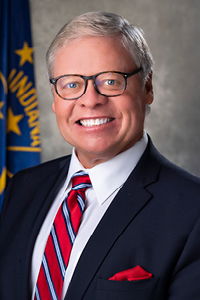
Photo of Ron Alting
R Indiana Senate · District 22 On the 2026 ballot

Sen. Ron Alting

Compare
Total votes
2,574
all sessions
Attendance
92%
163 missed
Near the chamber average
With party
93%
of cast votes
Lower than 84% of chamber peers
Bipartisan score
4%
crosses aisle rarely
Higher than 80% of chamber peers
Sponsored
559
bills & resolutions
Lower than 90% of chamber peers
Committees
2
assignments
559 bills and resolutions

Sponsored bills

Total
559
Primary
219
Co-sponsor
340
This page
559
matching current filters
Co-sponsor SR 37
Passed · Indiana Senate · Co-sponsor
Congratulating the IU Hoosiers football team.

A SENATE RESOLUTION congratulating the Indiana University Hoosiers football team on their 2025-2026 College Football Playoff National Championship title and historic 16-0 undefeated season.

Passed Feb 10, 2026 1 co-sponsor
Co-sponsor SR 38
Passed · Indiana Senate · Co-sponsor
Honoring Senator Kyle Walker upon his retirement from the Indiana Senate.

Maddy summaryThis is a ceremonial resolution (SR 38) honoring Senator Kyle Walker for his service in the Indiana Senate upon his retirement. It does not create new laws or affect any policies; it is a formal expression of appreciation from the Senate. The resolution was unanimously adopted by voice vote on February 9, 2026, with broad bipartisan support from 44 senators as co-authors.

Passed Feb 9, 2026 1 co-sponsor
Co-sponsor SR 17
Passed · Indiana Senate · Co-sponsor
Memorializing Richard Young.

Maddy summaryThis Senate Resolution (SR 17) honors the late State Senator Richard D. Young, Jr., who served Indiana's District 47 for decades, including as Senate Minority Leader. The resolution memorializes his lifetime of service to his community and the State of Indiana, acknowledging his roles as a legislator, rural caucus co-founder, and longtime Crawford County official. It directs the Senate Secretary to send copies of the resolution to his widow, Ashira Young. As a memorial resolution, it has no policy impact or procedural mechanisms beyond formal recognition.

Passed Feb 9, 2026 1 co-sponsor
Co-sponsor SR 6
Passed · Indiana Senate · Co-sponsor
Honoring Dr. Erica Graham.

Maddy summaryThis is a commemorative Senate Resolution (SR 6) honoring Dr. Erica Graham for her work advancing mental health awareness and suicide prevention efforts in Indiana. It does not create new laws or affect any specific policies or individuals; instead, it serves as a symbolic gesture of recognition from the Indiana Senate. The resolution was authored by Senator Hunley and adopted unanimously by the Senate on February 3, 2026, with broad bipartisan support.

Passed Feb 5, 2026 1 co-sponsor
Co-sponsor SR 23
Passed · Indiana Senate · Co-sponsor
Memorializing Nancy Nugent.

Maddy summaryThis bill (SR 23) is a ceremonial Senate resolution honoring Nancy Nugent. It does not create new laws or affect policies; instead, it formally memorializes her contributions. The resolution was adopted unanimously by the Senate on February 3, 2026, with Senator Maxwell as the author and 42 senators as co-authors.

Passed Feb 5, 2026 1 co-sponsor
Co-sponsor SB 85
Passed · Indiana Senate · Co-sponsor
Health care debt and costs.

Authorizes the attorney general to enforce provisions concerning health care debt wage garnishment and principal residence lien restrictions and establish a complaint process. Requires hospitals to do the following: (1) Offer a person who meets certain income guidelines and has received health services the opportunity to pay the charges through a payment plan that satisfies certain requirements. (2) Develop a written notice about a charity care program operated by the hospital, provide the notice to patients, and post the notice. (3) Include certain information concerning financial assistance on a billing statement. (4) Requires a hospital that reports an annual gross patient revenue of at least $20,000,000 to provide written notice and information to a person who has requested an eligibility determination concerning a payment plan or charity care. Provides that the unpaid earnings of a consumer who meets specified income eligibility requirements may not be attached by garnishment if an individual makes 200% of the federal income poverty level or less, and limits the amount to be garnished over a certain amount of the individual's disposable earnings in satisfaction of: (1) health care debt owed or alleged to be owed by the consumer; or (2) any amount of the judgment that represents health care debt determined to be owed by the consumer. Provides that: (1) health care debt owed or alleged to be owed by a consumer; or (2) in an action against a consumer in which a judgment has been entered, the amount of the judgment that represents health care debt determined to be owed by the consumer; does not constitute a lien against the consumer's principal residence for a consumer. Requires the disclosure of whether a debt is a health care debt in the execution of a judgment. Provides that in any action filed in Indiana for the recovery of health care debt owed or alleged to be owed by a consumer, the principal residence of the consumer is not liable to judgment or attachment or to be sold on execution against the consumer.

Passed Feb 2, 2026 1 co-sponsor
Co-sponsor SB 197
Passed · Indiana Senate · Co-sponsor
Garnishment.

Amends the limitation on garnishment provided in the Uniform Consumer Credit Code. Requires a garnishment order or attachment order that requires an employer to make deductions from a debtor's disposable earnings to provide certain information to the employer. Provides that tangible personal property, including choses in action, deposit accounts, and cash (but excluding debts owing and income owing), of $1,500 is exempt from bankruptcy (current law is $300). Removes provisions in code requiring the department of financial institutions to adopt rules that establish or adjust exemption amounts for purposes of bankruptcy proceedings.

Passed Jan 29, 2026 1 co-sponsor
Primary SB 269
In committee · Indiana Senate · Lead sponsor
Youth peer support program.

Permits a school corporation to establish a youth peer support program (program). Requires a program to: (1) be developed in consultation with one or more local mental health organizations serving the school's geographic area; (2) utilize evidence based training models approved by the department of education; (3) include written referral protocols to school based and community based mental health services; (4) provide ongoing supervision by a school counselor, school social worker, licensed mental health professional, or qualified community partner; and (5) include safeguards to protect student confidentiality and well-being. Provides that a program may not: (1) provide clinical diagnosis or treatment; (2) be established to replace school counselors or mental health professionals; or (3) require participation by a student. Requires a school corporation to provide certain students voluntary, online mental health screenings. Establishes parameters for certain partnerships between school corporations and local mental health organizations participating in the school corporation's program. Creates the youth peer support advisory committee.

In committee Jan 15, 2026 0 co-sponsors
Showing 31 to 40 of 559 bills
Previous 1 3 4 5 56 Next