

Global War on Terrorism Memorial Location Act This bill authorizes the establishment of a National Global War on Terrorism Memorial in the area of the National Mall.
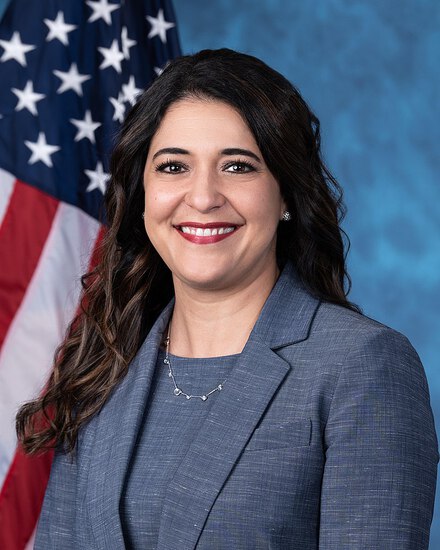
Rep. Stephanie I. Bice
Sponsored bills
Help Independent Tracks Succeed Act or the HITS Act This bill permits taxpayers to treat as currently deductible expenses the cost of qualified sound recording productions not exceeding $150,000 in a taxable year. The bill defines qualified sound recording production as certain sound recordings produced and recorded in the United States.
Promoting New Manufacturing Act This bill directs the Environmental Protection Agency (EPA) to annually publish information related to preconstruction emission permits issued or denied by the EPA. The EPA must publish such information applicable to FY2016-FY2020 not later than 60 days after the date of enactment. Additionally, the EPA must publish guidance for implementing any final rule that establishes or revises a national ambient air quality standard.
QUEST Act of 2021 This bill directs the Department of Energy to establish and carry out a program (to be known as the Quantum User Expansion for Science and Technology program or the QUEST program) to encourage and facilitate access to U.S. quantum computing hardware and quantum computing clouds for research purposes in order to (1) enhance the quantum research enterprise of the United States, (2) educate the future quantum computing workforce, and (3) accelerate the advancement of U.S. quantum computing capabilities.
Quantum Network Infrastructure Act of 2021 This bill directs the Department of Energy (DOE) to carry out a research, development, and demonstration program to accelerate innovation in quantum network infrastructure in order to (1) facilitate the advancement of distributed quantum computing systems through the internet and intranet, (2) improve the precision of measurements of scientific phenomena and physical imaging technologies, and (3) develop secure national quantum communications technologies and strategies. DOE shall submit to Congress a four-year research plan that identifies and prioritizes basic research needs relating to quantum network infrastructure.
Developing Responsible Individuals for a Vibrant Economy Act or the DRIVE-SAFE Act This bill directs the Department of Transportation to promulgate regulations to implement an apprenticeship program for licensed commercial motor vehicle drivers under the age of 21. Under the program, an apprentice must complete two probationary periods that total 400 hours of on-duty time, of which at least 240 hours must be driving time in a commercial motor vehicle. Additionally, the apprentice must be accompanied in the cab of the commercial motor vehicle by an experienced driver. Further, the bill requires all commercial motor vehicles used in the program for training to be equipped with safety technology such as active braking collision mitigation systems and video event capturing systems. An employer shall not knowingly allow, require, permit, or authorize a driver under the age of 21 to operate a commercial motor vehicle unless the driver is participating in, or has completed, an apprenticeship program that meets the requirements set forth in this bill.
Fair Access to Banking Act This bill restricts certain banks, credit unions, and payment card networks from refusing to do business with a person who is in compliance with the law. Restrictions include prohibiting the use of certain lending programs, initiating the process of terminating an institution's depository insurance, and instituting specified civil penalties.
TRICARE Reserve Select Improvement Act This bill expands TRICARE Reserve Select eligibility to include members of the Selected Reserve who are enrolled or eligible to enroll in the Federal Employees Health Benefits Program.
Death Tax Repeal Act This bill repeals the estate and generation-skipping transfer taxes. It also makes conforming amendments related to the gift tax.
This bill requires the Federal Communications Commission (FCC) to analyze and report on the demands associated with edge provider data transmitted over rural broadband networks during a specified six-year period. An edge provider is an entity that provides content, applications, or services over the internet (e.g., search engine providers, streaming video or music services, social media platforms, and retailers). Some edge providers generate revenue by selling products or subscriptions to their content, while others offer their content for free and generate revenue by selling advertising to users based on user-provided information. In its analysis, the FCC must retrospectively and prospectively estimate the quantity of edge provider data transmitted over rural broadband networks. It must also calculate costs to rural broadband providers that are not otherwise recovered for transmitting such data. These costs include (1) initial deployment of rural broadband networks, (2) operation and maintenance of those networks, and (3) the delivery of services to users over those networks.