

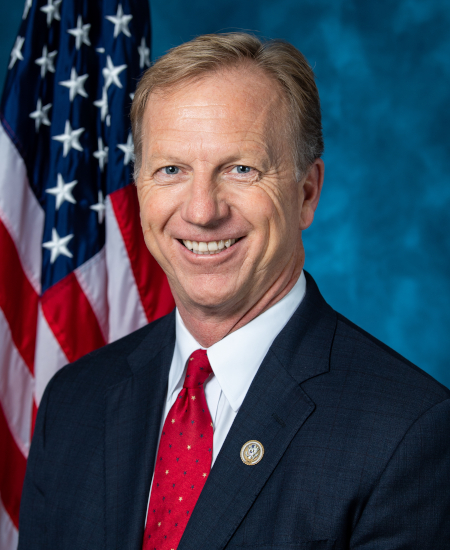
Photo of Kevin Hern
R United States House · District 1 · Oklahoma

Rep. Kevin Hern

Compare
Total votes
2,818
all sessions
Attendance
98%
48 missed
Near the chamber average
With party
92%
of cast votes
Near the chamber average
Bipartisan score
4%
crosses aisle rarely
Near the chamber average
Sponsored
527
bills & resolutions
Lower than 92% of chamber peers
Committees
3
assignments
527 bills and resolutions

Sponsored bills

Total
527
Primary
55
Co-sponsor
472
This page
527
matching current filters
Primary HR 8921
In committee · Delaware House · Lead sponsor
Tribal Child Welfare Support Act

Maddy summaryHR 8921, the Tribal Child Welfare Support Act, directly affects Indian tribes and tribal consortia by changing how federal child welfare funds are distributed. The bill requires the Secretary of Health and Human Services to pay funds directly to tribal organizations (instead of through states) for child welfare services under Section 428 of the Social Security Act. It also reserves 3% of funds from Section 425 specifically for these tribal payments each fiscal year. This change only applies if total funding meets or exceeds 103% of the 2024 level, ensuring state allotments aren't reduced when the tribal funds are allocated.

In committee Dec 17, 2024 0 co-sponsors
Co-sponsor HR 8832
In committee · Delaware House · Co-sponsor
Maintaining Innovation and Safe Technologies Act

Maddy summaryHR 8832 requires the Health and Human Services Secretary to issue Medicare payment guidance by January 1, 2026, for specific AI-powered remote monitoring devices. It directly affects Medicare beneficiaries using devices like continuous glucose monitors that employ AI for automatic adjustments and transmit health data to providers. The bill mandates guidance on payment under Medicare Part B for these devices, focusing on their AI components and data transmission features. This policy change aims to clarify how Medicare will cover these technologies, impacting both patients and healthcare providers. The summary is based solely on the bill's text, with no additional interpretation.

In committee Dec 17, 2024 1 co-sponsor
Primary HR 8576
In committee · Delaware House · Lead sponsor
Securing Access to Care for Seniors in Critical Condition Act of 2024

Maddy summaryThis bill changes Medicare payment rules for long-term care hospitals treating critically ill seniors. It adds a new "high acuity criterion" requiring that a patient's discharge must be assigned to a Medicare payment category with a severity score of at least 0.8 (measured by the MS-LTC-DRG system) and occur on or after October 1, 2025, to qualify for certain payment adjustments. This directly affects long-term care hospitals that serve seniors in critical condition, ensuring Medicare payments better reflect the complexity of care for these patients. The change modifies how site-neutral payments apply, aiming to support facilities providing high-acuity care to vulnerable seniors.

In committee Dec 17, 2024 0 co-sponsors
Co-sponsor HR 8398
In committee · Delaware House · Co-sponsor
Miscellaneous Tariff Bill Reform Act

Maddy summary# Summary of Tariff Suspensions and Reductions Document This document is a section of U.S. tariff legislation that adds new duty suspensions and reductions to the Harmonized Tariff Schedule of the United States. It contains 120 new tariff items (numbered 9902.19.01 through 9902.20.24) that provide temporary duty-free or reduced-duty status for various goods. Key features of the document: 1. **Content**: The list includes chemical compounds, food ingredients, and specialty materials (such as shelled pine nuts, licorice extract, refined carrageenan, various chemicals like neodymium metal, tungsten concentrate, and numerous organic compounds). 2. **Tariff Treatment**: Most entries are listed as "Free" (meaning duty-free), with a few having small duty rates (e.g., 0.7%, 1.8%, 2.3%, 2.9%, 4.3%). 3. **Effective Period**: All listed suspensions and reductions are effective "On or before 12/31/2025." 4. **Purpose**: These tariff suspensions are intended to support specific industries, reduce costs for manufacturers, or provide temporary relief for certain imported goods. 5. **Technical Details**: Each entry includes the chemical name, CAS number, Harmonized Tariff Schedule code, duty rate, and a brief description of the product. This document represents a legislative amendment to the Harmonized Tariff Schedule, specifically adding new subchapter II of chapter 99 to provide temporary duty relief for these specific items.

In committee Dec 17, 2024 1 co-sponsor
Primary HR 8227
In committee · Delaware House · Lead sponsor
To amend title XVIII of the Social Security Act to remove in-person requirements under Medicare for mental health services furnished through telehealth and telecommunications technology.

Maddy summaryHR 8227 removes Medicare's requirement for an initial in-person visit before covering mental health services delivered via telehealth. It directly affects Medicare beneficiaries seeking mental health care, allowing them to receive these services remotely without first needing an in-person appointment. The bill amends Medicare rules to eliminate geographic restrictions for telehealth mental health visits, effective July 1, 2019, or after the end of the public health emergency period. This change applies to services provided through rural health clinics and federally qualified health centers as well, streamlining access to mental health care via technology.

In committee Dec 17, 2024 0 co-sponsors
Primary HR 7693
In committee · Delaware House · Lead sponsor
To amend the Internal Revenue Code of 1986 to treat distributions from health savings accounts for funeral expenses of the account beneficiary as qualified distributions.

Maddy summaryThis bill amends the tax code to allow health savings account (HSA) funds to be used tax-free for funeral expenses of the account holder or beneficiary. It directly affects HSA account holders who may need to cover costs like burial, cremation, caskets, or funeral services for themselves or a deceased beneficiary. Key provisions define "funeral expenses" broadly to include related costs (e.g., embalming, transportation, grave plots) but limit tax-free withdrawals to $5,000 per person. The bill also permits expenses incurred within 90 days before death to be treated as if paid before death, aligning with existing HSA rules for death-related distributions.

In committee Dec 17, 2024 0 co-sponsors
Primary HR 7476
In committee · Delaware House · Lead sponsor
Countering Communist China Act

Maddy summary# Summary of Proposed Legislation This document outlines a comprehensive U.S. legislative proposal with several key components: 1. **Research Restrictions**: - Requires certification from Federal research grant recipients that they are not Chinese citizens or participants in Chinese talent programs - Prohibits employment of Chinese nationals in federally funded research - Requires institutions receiving Federal assistance to agree not to knowingly employ individuals participating in Chinese talent programs 2. **Foreign Gifts and Contracts Disclosure**: - Mandates disclosure of foreign gifts/contracts over $50,000 to universities - Requires public reporting of restricted/conditional gifts/contracts - Creates a searchable public database of foreign gifts to universities - Requires institutions to maintain policies regarding foreign gifts to faculty and staff 3. **Investment Restrictions**: - Restricts tax-exempt organizations from holding investments in "disqualified Chinese companies" (defined as corporations incorporated in China or with significant Chinese government ownership) - Requires annual reporting on such investments - Allows limited waivers with public disclosure 4. **Taiwan Policy**: - Prohibits U.S. government from recognizing PRC claims to sovereignty over Taiwan without Taiwan's consent - Requires U.S. government to treat Taiwan's democratically elected government as the legitimate representative of the people of Taiwan - Requires a strategy to protect U.S. businesses from Chinese coercion efforts 5. **Additional Provisions**: - Requires participants in Chinese talent programs to register as agents of the Chinese government - Amends economic espionage laws to include education and research - Mandates disclosure of certain funds received by visa holders The legislation represents a significant effort to limit Chinese influence in U.S. academic institutions, research, and business sectors while establishing a more robust policy framework regarding Taiwan.

In committee Dec 17, 2024 0 co-sponsors
Primary HR 6817
In committee · Delaware House · Lead sponsor
To impose a fee on certain remittance transfers to fund border security.

Maddy summaryHR 6817 imposes a 10% fee on money sent overseas through remittance services (e.g., Western Union, MoneyGram) to fund border security. The fee applies to all international transfers, with U.S. citizens receiving a refundable tax credit equal to the fee paid. Collected fees will fund the new Border Enforcement Trust Fund, which can only be used to hire border agents, build barriers along the U.S.-Mexico border, and operate detention facilities for undocumented immigrants. The bill also includes penalties for evading the fee and restricts foreign aid for countries aiding fee evasion.

In committee Dec 17, 2024 0 co-sponsors
Co-sponsor HR 6114
In committee · Delaware House · Co-sponsor
Maximum Pressure Act

Maddy summaryThe Maximum Pressure Act (HR 6114) is a legislative proposal that would maintain and expand U.S. sanctions against Iran. The bill would codify existing sanctions, require Iran to meet 12 specific conditions before sanctions could be lifted (including ending support for terrorism, releasing hostages, and ending nuclear enrichment), and expand sanctions on Iran's Revolutionary Guard Corps and missile programs. It also establishes new reporting requirements for the U.S. government to monitor Iran's activities and the impact of sanctions. The legislation would require congressional review before any sanctions could be lifted or modified, preventing the executive branch from unilaterally easing restrictions.

In committee Dec 17, 2024 1 co-sponsor
Co-sponsor HR 5737
In committee · Delaware House · Co-sponsor
Elevating HSA Limits Act of 2023

Maddy summaryHR 5737, the Elevating HSA Limits Act of 2023, increases the maximum annual contribution limits for Health Savings Accounts (HSAs) to match the deductible and out-of-pocket limits of qualifying high-deductible health insurance plans. This change directly affects individuals with HDHPs who use HSAs, as their annual contribution caps will now automatically adjust each year based on the current plan's deductible and out-of-pocket maximums instead of fixed 2023 dollar amounts. The bill amends the Internal Revenue Code to replace the current fixed limits ($2,250 for self-only coverage and $4,500 for family coverage) with a dynamic formula tied to plan costs. These changes apply to tax years beginning after December 31, 2023.

In committee Dec 17, 2024 1 co-sponsor
Showing 131 to 140 of 527 bills
Previous 1 13 14 15 53 Next