

Processing Revival and Intrastate Meat Exemption Act or the PRIME Act This bill exempts from federal inspection requirements animals and meats that are slaughtered and prepared at custom animal slaughter facilities for distribution within the state. Under current law, a custom slaughter exemption applies if the meat is slaughtered exclusively for personal, household, guest, or employee uses. Specifically, the bill expands the federal inspection exemption to include the slaughter of animals or the preparation of carcasses, meat, and meat food products that are slaughtered and prepared at a custom slaughter facility in accordance with the laws of the state where the facility is located; and prepared exclusively for distribution to household consumers in the state or restaurants, hotels, boarding houses, grocery stores, or other establishments in the state that either prepare meals served directly to consumers or offer meat and food products for sale directly to consumers in the state. The bill does not preempt any state law concerning (1) the slaughter of animals or the preparation of carcasses, meat, and meat food products at a custom slaughter facility; or (2) the sale of meat or meat food products.
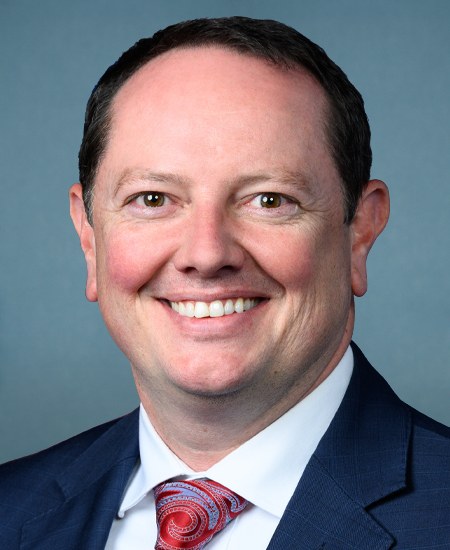
Rep. Eric Burlison
Sponsored bills
Maddy summaryHJRES 61 is a resolution seeking to block a Department of Labor rule published in March 2023. The rule would have removed legal requirements related to religious exemptions under the Equal Opportunity Clause in federal employment regulations. If passed, this resolution would prevent the rule from taking effect, maintaining the existing requirements for religious exemptions. It uses a specific congressional disapproval process under Title 5 of the U.S. Code to stop the rule without requiring presidential action.
Stand Your Ground Act of 2023 This bill establishes affirmative defenses for individuals who use (or threaten or attempt to use) force in the commission of certain federal criminal violations. First, an individual is justified in using (or threatening or attempting to use) non-deadly force if the individual reasonably believes it is necessary to defend against an imminent use of unlawful force. An individual who uses or threatens to use non-deadly force in accordance with this affirmative defense does not have a duty to retreat before using or threatening to use such force. Second, an individual is justified in using (or threatening or attempting to use) deadly force if the individual reasonably believes it is necessary to prevent imminent death or great bodily harm or to prevent the imminent commission of a forcible felony. An individual who uses, threatens, or attempts to use deadly force in accordance with this affirmative defense does not have a duty to retreat and has the right to stand his or her ground so long as the individual is not engaged in a criminal activity and is in a place where he or she has a right to be.
Maddy summaryHR 3115, the Public Service Reform Act, changes employment rules for most federal career employees (non-political appointees) by establishing at-will employment, meaning they can be fired for any reason - including no reason - without needing cause. It abolishes the Merit Systems Protection Board (MSPB), replaces its role with agency-level procedures for removals (including a 14-day response window for employees), and limits appeals to the agency head or federal courts for specific claims like whistleblower retaliation. The bill also redirects certain appeals to the Equal Employment Opportunity Commission (EEOC) for discrimination cases and modifies whistleblower protections to allow direct court appeals for retaliation claims. These changes directly affect over 1 million career federal workers across executive agencies.
Maddy summaryHR 3039, the DRIVE Act, prohibits the Federal Motor Carrier Safety Administration (FMCSA) from requiring speed limiting devices on trucks weighing over 26,000 pounds operating in interstate commerce. This directly affects commercial trucking companies and drivers transporting goods across state lines. The bill's key provision explicitly bans the FMCSA from issuing any rule mandating such devices, which are typically set to limit vehicle speed. The law applies specifically to interstate trucking operations and does not affect state-level regulations.
Maddy summaryThe Employee Rights Act (HR 2700) amends key labor laws to strengthen employee rights in collective bargaining and privacy. It requires employers to use secret ballot elections for selecting bargaining representatives and to provide labor organizations with voter lists containing employee names and one form of contact information (chosen by the employee) within two business days of an election. The bill prohibits employers from using employee personal information for non-organizing purposes and mandates written authorization for using union dues on non-bargaining activities, with authorizations expiring after one year. Additionally, it clarifies joint employment standards to prevent misclassification and adds tribal sovereignty protections to labor law definitions.
Maddy summaryHR 2928, the Responsible Borrower Protection Act of 2023, blocks the Federal Housing Finance Agency (FHFA) and mortgage enterprises (Fannie Mae and Freddie Mac) from implementing specific changes to mortgage credit fees announced in January 2023. The bill directly affects mortgage borrowers and lenders by reversing a pricing framework update that would have altered fees for single-family mortgages. It prohibits the FHFA from enforcing the January 2023 pricing changes detailed in FHFA's announcement and related lender letters. The bill clarifies that enterprises may still use risk-based pricing for mortgage fees, but the specific fee adjustments from the 2023 framework are canceled. This is a direct policy change to mortgage fee structures, not a broader reform.
Restoring Fuel Market Freedom Act of 2023 This bill repeals various alternative fuels tax credits, including the tax credits for (1) alcohol used as fuel; (2) biodiesel and renewable diesel used as fuel; (3) sustainable aviation fuel; (4) clean fuel production; and (5) alcohol fuel, biodiesel, and alternative fuel mixtures. It also repeals the inclusion in gross income of alcohol and biodiesel fuels and payments for certain fuels not used for taxable purposes.
Maddy summaryHR 2826, the Save Local Business Act, clarifies when multiple businesses can be held jointly responsible for labor laws. It amends the National Labor Relations Act and Fair Labor Standards Act to state that a business is only a joint employer if it directly controls key employment terms like hiring, pay, schedules, or discipline for another business's workers. This directly affects franchisors, contractors, and similar business models that might previously have been deemed joint employers under broader interpretations. The bill aims to limit joint employer liability to cases where one business has clear, day-to-day control over essential worker conditions.
Maddy summaryHR 734, the Protection of Women and Girls in Sports Act of 2023, amends Title IX to prohibit federally funded schools and athletic programs from allowing individuals assigned male at birth to participate in women's or girls' sports teams. The bill defines "sex" for this purpose as "reproductive biology and genetics at birth," making it a violation of federal law to permit such participation in designated women's or girls' programs. It allows males to train with women's teams only if no female is deprived of a roster spot, competition opportunity, scholarship, or other benefit tied to the team. This law directly affects public and private schools receiving federal financial assistance that operate athletic programs.