

Fight Notario Fraud Act of 2021 This bill prohibits certain types of fraud or misrepresentations related to immigration matters, provides for criminal penalties for such actions, and contains related provisions. Specifically, a person shall be subject to fines, imprisonment, or both, if that person knowingly executes a scheme related to immigration laws to (1) defraud another, or (2) receive anything of value from another based on false pretenses or representations. Such a person shall be subject to additional criminal penalties if that person (1) threatens to report another to federal or state authorities, (2) takes actions or makes attempts to adversely impact another's immigration status, or (3) demands or retains anything of value for services fraudulently performed or not performed. Similarly, a person shall be subject to fines, imprisonment, or both, if the person knowingly and falsely claims to be an attorney or an accredited representative in any matter arising under the immigration laws. (An accredited representative is an individual authorized by the Executive Office of Immigration Review to represent clients in certain immigration matters.) The bill provides for longer terms of imprisonment for a person who causes a cumulative loss of more than $10,000 through actions prohibited under this bill. The Department of Justice shall establish at least 15 Special U.S. Attorney positions to enforce these provisions and take other actions related to enforcement and protecting consumers from fraudulent immigration schemes.
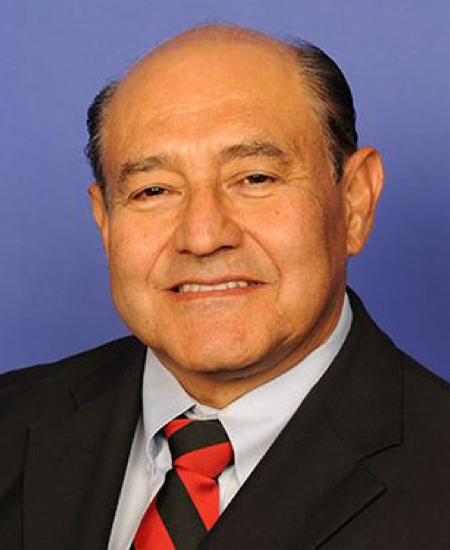
Rep. J. Luis Correa
Sponsored bills
DHS Blue Campaign Enhancement Act This bill requires the Department of Homeland Security (DHS) to expand its Blue Campaign, which coordinates DHS actions to identify and prevent human trafficking. The bill requires DHS to (1) provide web-based training for law enforcement and corrections personnel, and (2) establish an advisory board for the campaign.
Mandating that being an Elected Member Be an Essential Requirement for Speakership Resolution or the MEMBERS Resolution This resolution bars an individual from being eligible to be nominated to serve as Speaker of the House of Representatives unless the individual is a Member, Delegate, or Resident Commissioner (or, in the case of a nomination made prior to the beginning of the Congress in which the individual would serve as Speaker, is a Member-elect, Delegate-elect, or Resident Commissioner-elect).
This resolution supports the goals of Bebe Moore Campbell BIPOC Mental Health Awareness Month, including bringing attention to the mental health disparities faced by communities of color.
Green New Deal for Public Schools Act of 2021 This bill provides environmental and educational resources to public elementary and secondary schools and Bureau of Indian Education (BIE) schools. Specifically, the bill requires the Department of Energy's (DOE's) Office of Energy Efficiency and Renewable Energy to provide climate capital facilities grants to eligible entities (e.g., public schools and BIE schools). Grant recipients must use these funds to construct new, or convert existing facilities into, healthy zero-carbon schools. Healthy zero-carbon school refers to a school with highly energy-efficient facilities that produce or procure sufficient carbon-free and pollution-free renewable energy to meet the school's needs. Next, the bill directs the Department of Education (ED) to award resource block grants to qualified local educational agencies (LEAs) to hire and retain educators and support staff in high-need schools. ED must award grants to eligible consortia of LEAs for educational equity planning and implementation. In addition, ED must establish the Climate Change Resiliency Program to increase the resiliency of public and BIE schools during climate change-related events, natural disasters, and public health crises. Further, ED must establish a related grant program for state educational agencies. Grant recipients must use these funds for certain activities (e.g., green infrastructure projects). The bill establishes the Office of Sustainable Schools within ED to (1) administer the resource block grant and educational equity grant programs, and (2) coordinate with DOE and the White House Office of Domestic Climate Policy on climate capital facilities grants and the Climate Change Resiliency Program.
Veterans Entrepreneurship Act of 2021 This bill requires the Small Business Administration to carry out a pilot program assessing the feasibility and advisability of making grants to eligible veterans to start or acquire a small business concern, a franchise business enterprise, or any other appropriate category of business enterprise. Eligible veterans are those veterans or members of the Armed Forces who (1) are currently retiring or separating from the Armed Forces or have been honorably discharged from active duty, (2) have completed a specified minimum period of active duty, and (3) are entitled to certain educational assistance programs. Grant recipients must complete an entrepreneurship readiness program and prepare a business plan, and they may use grant funds for purposes such as purchasing goods or services, funding a project that is directed toward economic development objectives, and acquiring a business enterprise.
Pipeline Security Act This bill revises the duties of the Transportation Security Administration (TSA) to include securing pipelines and pipeline facilities against cybersecurity threats, acts of terrorism, and other acts that jeopardize the physical security or cybersecurity of the pipelines or facilities. Specifically, the bill (1) establishes a pipeline security section within the TSA, (2) directs the TSA to develop a personnel strategy for enhancing operations within such section, and (3) requires the TSA to publish updated pipeline security guidelines. The TSA must also convene not less than two industry days to engage with relevant pipeline transportation and pipeline facilities stakeholders on matters related to the security of pipeline transportation and pipeline facilities.
This resolution expresses support for the designation of Journeyman Lineworkers Recognition Day. (A journeyman lineworker is a person who builds and maintains electrical power systems.)
Preserving Rules Ordered for The Entities Covered Through 340B Act of 2021 or the PROTECT 340B Act of 2021 This bill prohibits pharmacy benefit managers (PBMs) and health insurance plans from discriminating against health providers participating in the 340B drug pricing program, including pharmacies contracted with such providers to dispense 340B drugs. The 340B program allows certain providers to receive covered outpatient drugs at reduced prices from manufacturers. Specifically, PBMs and insurance plans may not reimburse 340B participants at a lower rate than other entities not participating in the program; impose differing terms (such as fees, charge-backs, or audits) on 340B participants; interfere with an individual's choice to receive drugs from a 340B participant; require 340B participants to identify which drugs fall within the program; or refuse to contract with a 340B participant on the basis that they utilize the program. Violations of this bill are subject to a civil penalty of not more than $5,000 per violation per day. These prohibitions also apply to prescription drug (Part D) sponsors under Medicare. The bill also provides for a process to prevent duplicate 340B drug discounts to states under Medicaid.
Safe Schools Improvement Act of 2021 This bill requires states to direct their local educational agencies (LEAs) to establish policies that prevent and prohibit bullying and harassment of elementary and secondary school students. In particular, these policies must prohibit bullying and harassment based on race, color, national origin, sex, sexual orientation, gender identity, disability, or religion. Further, LEAs must provide (1) students, parents, and educational professionals with annual notice of the conduct prohibited in their disciplinary policies; (2) students and parents with grievance procedures that target such conduct; and (3) the public with annual data on the incidence and frequency of that conduct at the school and LEA level. The Department of Education must conduct and report on an independent biennial evaluation of programs and policies to combat bullying and harassment in elementary and secondary schools. The National Center for Education Statistics must collect state data to determine the incidence and frequency of the conduct prohibited by LEA disciplinary policies.