

Maddy summaryThe BLANCHE Act of 2026 prohibits the United States government from entering into settlement agreements with the President that result in the President or a third party receiving any payment, including cash, goods, or legal fees. This rule applies to claims filed by the President or individuals who assumed office while a claim was pending, ensuring no such agreements are valid unless a federal court explicitly approves them. To gain court approval, the agreement must be proven to be between adverse parties, not collusive or fraudulent, and in the interest of justice, requiring a formal hearing with evidence presented by both sides. The law also mandates that the President file the proposed terms with the court if no separate civil action has already been initiated. These provisions aim to prevent potential conflicts of interest and ensure transparency in any legal settlements involving the highest office in the land.
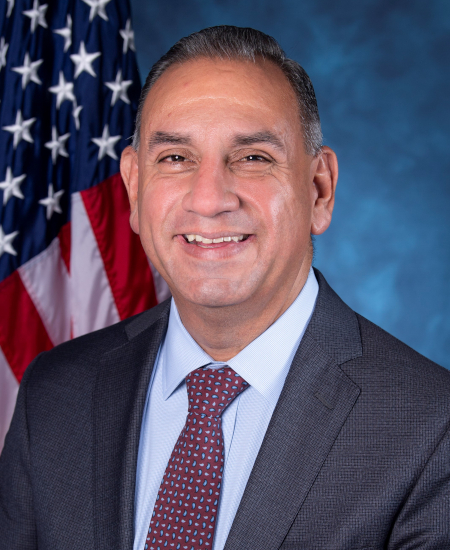
Rep. Gilbert Ray Cisneros, Jr.
Sponsored bills
Maddy summaryThe Small Business Workforce Pipeline Act of 2026 directs the Small Business Administration to help small businesses create and improve training programs for their employees. This bill requires the agency to share information from the Department of Labor and other federal sources on setting up work-based learning, registered apprenticeships, pre-apprenticeships, and job training initiatives. By amending the Small Business Act, the legislation aims to strengthen the workforce development resources available to small business owners.
Maddy summaryThis bill, known as the Arlington National Cemetery Viewshed Protection Act, restricts the construction of large triumphal arches in the Washington, D.C. area to preserve visual sightlines. It specifically bans the building of any such arches within Lady Bird Johnson Park and prohibits the use of federal funds for these structures there. Additionally, the law prevents the erection of triumphal arches taller than 50 feet on any land managed by the National Park Service unless Congress explicitly approves them. These measures aim to limit new monumental structures that could obstruct views of the Arlington National Cemetery from the capital region.
Maddy summaryThis resolution condemns specific racist rhetoric directed at Indian and Chinese Americans and calls on all elected officials, including the President, to stop using language that promotes racial or ethnic division. It specifically addresses recent statements made by the President that characterized immigrants from India and China in derogatory terms and linked them to negative stereotypes. The bill affirms that immigrants from all backgrounds are vital to the United States and declares that attacks based on national origin are un-American. While it does not change laws or policies, it serves as a formal statement of disapproval from the House of Representatives regarding the targeted hate speech.
Maddy summaryThis bill prevents the United States Postal Service from finalizing or enforcing a proposed rule that would allow the mailing of concealable firearms. Directly affecting the Postal Service, the legislation blocks the implementation of regulations scheduled for April 2, 2026, which would have changed how handguns are shipped through the mail. By prohibiting the enforcement of these specific rules, the bill ensures that the current mailing standards for firearms remain in place without the new restrictions or allowances proposed in the document.
Maddy summaryThe SCREEN for Type 1 Diabetes Act of 2026 directs the Centers for Disease Control and Prevention to launch a national public awareness campaign focused on type 1 diabetes detection, screening, and management. This initiative will provide written materials and public service announcements across various media platforms, including social media and television, while consulting with health organizations, schools, and community groups to ensure the content is culturally and linguistically appropriate. The bill authorizes $5 million annually from 2027 to 2031 to fund grants for nonprofit entities and state or local health departments to distribute these resources and increase screening access in communities with high incidence rates. Additionally, the law requires the Secretary of Health and Human Services to submit a report to Congress within one year detailing the campaign's activities and its impact on diabetes detection and management.
Maddy summaryThis bill, titled the No Presidential Self-Serving Lawsuits Act of 2026, prevents the current or former President of the United States from filing civil lawsuits against the federal government. It specifically invalidates an existing settlement agreement between a former President and the Internal Revenue Service and bars the use of federal funds to create compensation for such lawsuits. Additionally, the legislation authorizes the Treasury Secretary to recover any money already spent in violation of these new restrictions. The primary goal is to stop a President from using taxpayer money to settle legal disputes with the government they lead.
Maddy summaryThe DONOR Milk Act establishes new federal regulations to improve the safety and oversight of pasteurized donor human milk, which is milk collected from mothers and given to infants other than their own. This legislation requires facilities that produce or store this milk to undergo annual inspections, including unannounced visits, to ensure they meet food safety standards. To support these facilities in complying with the new rules, the bill authorizes an $8 million grant program to help with equipment upgrades and necessary certifications. These changes directly affect nonprofit organizations and food establishments that manufacture, process, pack, or hold donor human milk.
Maddy summaryThis bill, the Provider Reimbursement Stability Act of 2026, aims to create more predictable payment adjustments for physicians and other healthcare providers under the Medicare program. It directly affects medical practices and providers who receive reimbursement for services through the physician fee schedule. The legislation increases a threshold for certain budget neutrality calculations from $20 million to $54.3 million in 2027, with automatic increases every five years thereafter. It also requires the government to correct payment estimates when actual service usage differs significantly from projections, mandates regular updates to cost calculations for practice expenses, and limits how much Medicare payment rates can change from year to year to a maximum of 2.5 percent.
Maddy summaryThis bill authorizes the U.S. Mint to produce commemorative $5 gold and $1 silver coins marking the 25th anniversary of the September 11, 2001, terrorist attacks. The coins must feature designs honoring victims and first responders (including the inscription "Never Forget") and will be sold only during 2027-2028. All surcharges ($35 per gold coin, $10 per silver coin) collected from sales will fund the National September 11 Memorial and Museum at the World Trade Center, with no net cost to the federal government. The coins are legal tender but primarily intended for collectors, not circulation.