

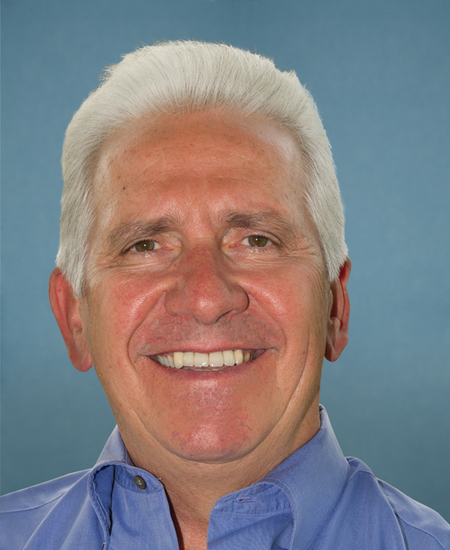
Photo of Jim Costa
D United States House · District 21 · California On the 2026 ballot

Rep. Jim Costa

Compare
Total votes
2,818
all sessions
Attendance
95%
129 missed
Near the chamber average
With party
93%
of cast votes
Lower than 94% of chamber peers
Bipartisan score
3%
crosses aisle rarely
Higher than 93% of chamber peers
Sponsored
1,712
bills & resolutions
Higher than 82% of chamber peers
Committees
5
assignments
1,712 bills and resolutions

Sponsored bills

Total
1,712
Primary
78
Co-sponsor
1,634
This page
1,712
matching current filters
Primary HR 5875
In committee · Delaware House · Lead sponsor
COWS Act of 2025

Maddy summaryThe COWS Act of 2025 creates a new program to help livestock and dairy farmers adopt manure management practices that reduce greenhouse gas emissions, such as composting, pasture-based systems, and technologies avoiding wet storage. It provides financial incentives (up to 100% of costs for planning, equipment, and implementation) with at least 50% paid upfront, prioritizing small/mid-sized operations, beginning farmers, and socially disadvantaged producers. The bill requires the Secretary to develop evaluation criteria focused on maximizing carbon sequestration, emissions reductions, and environmental benefits like improved water quality, while offering technical assistance for implementation.

In committee Dec 2, 2025 0 co-sponsors
Co-sponsor HR 5597
In committee · Delaware House · Co-sponsor
BECCS Advancement Commission Act of 2025

Maddy summaryThe BECCS Advancement Commission Act of 2025 establishes a new federal commission within the Department of Agriculture to develop policy recommendations for bioenergy with carbon capture and storage (BECCS) systems. The commission, composed of agency officials, industry representatives (including timber and BECCS sectors), and state/federal land management stakeholders, must report to Congress within one year on key metrics like forest health, wildfire mitigation, job growth, energy costs, and economic development in forestry. It will assess how BECCS deployment affects local communities, energy reliability, and domestic supply chains, while identifying federal policy changes to support the industry. This bill directly affects federal agencies, the forestry sector, commercial timber industry, and rural counties receiving federal funds under the Secure Rural Schools Act.

In committee Dec 2, 2025 1 co-sponsor
Co-sponsor HR 1262
Passed · Delaware House · Co-sponsor
Mikaela Naylon Give Kids a Chance Act

Give Kids a Chance Act of 2025 This bill expands the Food and Drug Administration’s (FDA’s) authority with respect to research on rare pediatric diseases, including by permitting the FDA to take enforcement action against drug sponsors that fail to satisfy pediatric study requirements and by reauthorizing programs that support pediatric research.  Specifically, the bill modifies requirements relating to molecularly targeted pediatric cancer investigations to permit research on new drugs in combination with active ingredients that have already been approved, provided certain conditions are met; permits the FDA to take enforcement action against drug sponsors that fail to comply with pediatric study requirements, if such sponsors demonstrated a lack of due diligence in satisfying the requirement; renews the FDA’s authority to award priority review vouchers to sponsors of new products intended to treat rare pediatric diseases through September 30, 2029; and reauthorizes through FY2027 certain funding for the National Institutes of Health to support priority pediatric research.  The bill also provides statutory authority for the FDA’s interpretation of the orphan drug exclusivity period. The bill specifies, consistent with FDA regulations, that the seven-year market exclusivity period for drugs for rare diseases or conditions (i.e., orphan drugs) prohibits the approval of the same drug for the same approved use or indication with respect to the disease or condition. (In Catalyst Pharmaceuticals, Inc. v. Becerra , a court rejected the FDA’s interpretation and held that orphan drug exclusivity extends to all uses or indications for the disease or condition.)

Passed Dec 2, 2025 1 co-sponsor
Primary HR 5796
In committee · Delaware House · Lead sponsor
BUILD Act

Maddy summaryThe BUILD Act creates a federal grant program to support economic development in low-income communities through partnerships with qualifying colleges and universities. It provides planning grants (up to $100,000 annually for 2 years) to help institutions develop community revitalization plans, followed by implementation grants ($25-50 million over 5 years) for approved projects. Eligible projects include renovating community-accessible facilities (like housing, cultural centers, or health clinics), launching business incubators, creating local apprenticeships, and building public broadband networks. To qualify, institutions must be located in areas where median income is at least 25% below state or national averages, excluding high-research universities and military academies.

In committee Dec 1, 2025 0 co-sponsors
Primary HR 5677
In committee · Delaware House · Lead sponsor
RIDE FAST Act

Maddy summaryThe RIDE FAST Act extends the deadline for using federal grants supporting intercity passenger rail projects from 2026 to 2032. This change directly affects states and rail operators eligible for these grants, giving them six additional years to plan and implement rail improvements. The bill amends Section 22106(a) of the Infrastructure Investment and Jobs Act to adjust the authorization period without creating new funding. It focuses solely on extending existing grant availability for rail projects.

In committee Dec 1, 2025 0 co-sponsors
Co-sponsor HR 5652
In committee · Delaware House · Co-sponsor
Wildfire Recovery Act

Maddy summaryHR 5652, the Wildfire Recovery Act, increases federal reimbursement for wildfire response by setting a minimum 75% federal cost share under Section 420 of the Stafford Act, directly benefiting states, local governments, and Tribal governments that deploy firefighting resources. It requires FEMA to develop rules within three years to determine when the federal share could exceed 75% based on a state's financial impact from wildfires. The bill also updates FEMA policy to allow reimbursement for predeployment of fire assets (like crews or equipment) before a fire occurs. These changes aim to provide more predictable and timely federal support for wildfire recovery efforts.

In committee Dec 1, 2025 1 co-sponsor
Co-sponsor HRES 915
In committee · Delaware House · Co-sponsor
Expressing the sense of the House of Representatives that the Ukrainian famine of 1932-1933, known as the Holodomor, is recognized as a genocide and should serve as a reminder of repressive Soviet policies against the people of Ukraine.

Maddy summaryHRES 915 formally recognizes the 1932-1933 Ukrainian famine, known as the Holodomor, as a genocide perpetrated by the Soviet Union. The resolution directly affects Ukrainian victims, survivors, and communities by affirming historical truth and condemning Soviet policies that intentionally starved millions. Key provisions include declaring the Holodomor a genocide, commemorating its victims, and condemning ongoing Russian aggression against Ukraine, including Vladimir Putin’s denial of Ukrainian sovereignty. This symbolic resolution aims to educate the public and align U.S. policy with historical facts about Soviet repression.

In committee Nov 28, 2025 1 co-sponsor
Co-sponsor HR 6249
In committee · Delaware House · Co-sponsor
Addressing Addiction After Disasters Act

Maddy summaryHR 6249, the "Addressing Addiction After Disasters Act," updates federal disaster relief guidelines to explicitly include substance use and alcohol use disorders in crisis counseling services. It amends the Robert T. Stafford Disaster Relief Act to allow FEMA-funded programs to address these issues alongside mental health needs for disaster survivors. The bill requires FEMA to revise application forms and guidance within 180 days to reflect these changes and mandates a GAO report on program duration and compliance with using funds only for disaster-related substance/alcohol issues. This directly affects disaster survivors facing substance use or alcohol challenges by expanding access to covered support services.

In committee Nov 22, 2025 1 co-sponsor
Co-sponsor HR 6229
In committee · Delaware House · Co-sponsor
Water Infrastructure Finance and Innovation Act Amendments of 2025

Maddy summaryThis bill amends the Water Infrastructure Finance and Innovation Act to make water infrastructure financing more accessible to small communities and rural water projects. It lowers the maximum eligible project cost from $5 million to $1 million, provides technical assistance for small communities (population ≤ 25,000) to develop project proposals, and clarifies definitions to include projects for federally recognized Indian Tribes. The bill introduces collaborative project delivery methods like design-build and construction management at-risk, and authorizes $68 million annually for the EPA and $15 million annually for the Army Corps of Engineers through fiscal year 2029. These changes directly affect small communities and rural water projects seeking federal assistance for water infrastructure improvements.

In committee Nov 22, 2025 1 co-sponsor
Co-sponsor HR 6286
In committee · Delaware House · Co-sponsor
Indo-Pacific Partner and Ally Tariff Repeal Act

Maddy summaryHR 6286, the Indo-Pacific Partner and Ally Tariff Repeal Act, repeals tariffs imposed on 39 specific Indo-Pacific countries and territories through two executive orders. The bill directly affects these nations, including Australia, Japan, India, South Korea, and others, by eliminating tariffs that were applied under Executive Orders 14257 and 14326. Its key provision requires the immediate termination of these tariffs upon the bill's enactment. The legislation targets only the listed countries and does not alter tariffs on other nations.

In committee Nov 21, 2025 1 co-sponsor
Showing 131 to 140 of 1,712 bills
Previous 1 13 14 15 172 Next