

The bill removes human trafficking for involuntary servitude and human trafficking for sexual servitude (human trafficking offenses) from the list of crimes of violence that are subject to enhanced sentencing if they involve the use, or possession and threatened use of, a deadly weapon or the infliction of serious bodily injury or death. Instead, the bill requires a court to sentence a person convicted of a human trafficking offense or a related attempt or conspiracy to the department of corrections for a term of at least the midpoint, but not more than twice the maximum, of the presumptive range authorized for the applicable offense. It clarifies that a class 3 felony human trafficking offense is also subject to sentencing modifications that are permitted under current law for crimes that present an extraordinary risk of harm to society.The bill subjects a person convicted of the following to enhanced sentencing:Pimping, if the victim is an at-risk person; andHuman trafficking for involuntary servitude, or human trafficking for sexual servitude, if the victim is an at-risk adult.The bill adds the source of money posted to satisfy a monetary condition of release, including the likelihood that the money is derived from criminal activity, to the list of criteria a court may consider in making a determination of the type of bond and conditions of release.The bill changes terminology related to child prostitution to commercial sexual activity in the crimes of soliciting for child prostitution, pandering of a child, keeping a place of child prostitution, pimping a child, inducement of child prostitution, and patronizing a prostituted child, including changing the name of the offenses for soliciting for child prostitution, keeping a place of child prostitution, inducement of child prostitution, and patronizing a prostituted child.In the crime of soliciting for commercial sexual activity with a child, the bill adds soliciting a child for commercial sexual activity as a means of committing the offense and requires that when arranging or offering to arrange a meeting, the offender must know that the meeting will facilitate commercial sexual activity with a child.(Note: This summary applies to this bill as introduced.)
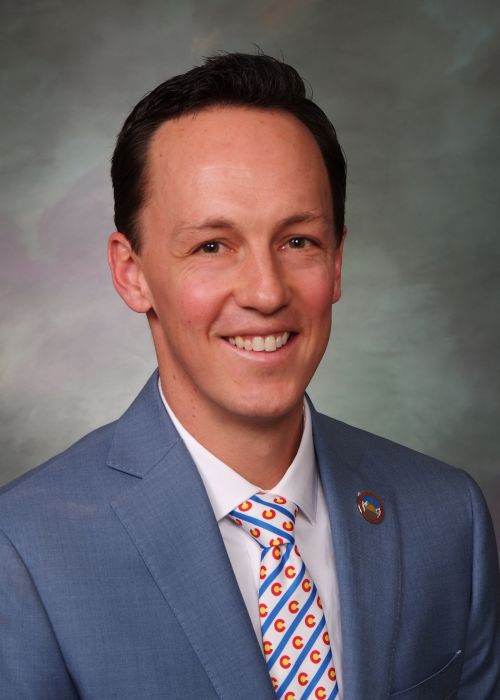
Sen. Dylan Roberts
Sponsored bills
Maddy summaryThis bill is a Senate Joint Resolution that formally recognizes the Colorado Mining Association for its 150th anniversary in 2026. It highlights the organization's historical significance and its role in supporting Colorado's mining industry, which contributes billions to the state's economy and supports tens of thousands of jobs. The resolution acknowledges the association's partnerships with state and federal agencies in promoting safety, environmental stewardship, and responsible mineral development. This measure does not change any laws or policies but serves as an official acknowledgment of the association's contributions to Colorado's history and economy.
Current law requires an individual to be at least 18 years old in order to obtain a marriage license; except that a minor who is 16 or 17 years old may obtain a marriage license with judicial approval. The bill repeals this exception, therefore requiring that an individual be at least 18 years old to obtain a marriage license.(Note: This summary applies to the reengrossed version of this bill as introduced in the second house.)
The bill creates the Colorado nuclear workforce development and education council (council) in the Colorado school of mines to help meet growing workforce demand in the nuclear energy sector. The bill establishes a related grant program (grant program) to provide grants to institutions of higher education for the development or expansion of nuclear engineering degree or certificate programs or course offerings. The council shall convene advisory sessions with stakeholders from the nuclear, educational, and workforce development sectors; implement the grant program; and contract with one or more third-party entities for staffing and operational assistance. The council may seek, accept, and expend gifts, grants, and donations for council-related purposes. The state treasurer shall credit the gifts, grants, and donations to the Colorado nuclear workforce development and education cash fund (cash fund), which is created in the bill. The general assembly shall not appropriate general fund money to implement or maintain council operations or grant awards. The council shall convene and begin awarding grants only after the balance of the cash fund reaches or exceeds $500,000 (threshold) . The bill imposes requirements to report to the Colorado commission on higher education and the general assembly about the council's funding sources, grant program implementation, and other uses of the grant program money. If the cash fund balance does not reach the threshold on or before September 1, 2027, the council is repealed and the money in the cash fund is refunded to the grantors or donors. Otherwise, the bill repeals the council, effective September 1, 2033, unless the council is extended following a sunset review.(Note: Italicized words indicate new material added to the original summary; dashes through words indicate deletions from the original summary.)(Note: This summary applies to the reengrossed version of this bill as introduced in the second house.)
Beginning July 1, 2027, the bill prohibits the immediate release of a patient's sensitive test results to the patient's electronic health record or through a patient portal. Instead, the bill requires that sensitive test results, once they are finalized, not be released as part of the patient's electronic health record or through a patient portal for 3 business days. The bill establishes 2 exceptions one exception to this requirement: Sensitive test results may be immediately released as part of the patient's electronic health record or through a patient portal immediately and without delay if the patient's health-care provider authorizes immediate release of the results or if the patient requests to receive the sensitive test results of a particular test without delay the sensitive test results to be released before the end of the three 3-business-day period . The bill defines 'sensitive test results' as:A pathology or radiology report that is ordered for the purpose of diagnosing or monitoring a patient for cancer; orTest results that may reveal a genetic marker that relates to a cancer condition. The bill specifies that a custodian of person that administers and controls a patient's electronic health record that contains sensitive test results is responsible for implementing the requirements of the bill. The bill states that compliance with the requirements of the bill is not information blocking under the federal '21st Century Cures Act'. A person that fails to comply with the requirements of the bill is not subject to civil, criminal, or administrative liability or professional disciplinary action.(Note: Italicized words indicate new material added to the original summary; dashes through words indicate deletions from the original summary.)(Note: This summary applies to the reengrossed version of this bill as introduced in the second house.)
Maddy summaryThis Senate Resolution designates May 2026 as ALS Awareness Month to highlight the impact of amyotrophic lateral sclerosis, a progressive and fatal neurodegenerative disease. The measure calls on Coloradans to support research, advocate for funding, and show solidarity with patients and their families who face challenges such as muscle weakness and limited life expectancy. While the resolution does not change laws or allocate funds, it formally recognizes the importance of multidisciplinary care and clinical trials in managing the disease. Copies of the resolution are sent to medical leaders, advocacy groups, and a caregiver to emphasize community support for those affected by ALS.
The act defines critical infrastructure material as any component or part used in covered infrastructure that is made of or contains a commodity metal, the theft of which poses an imminent threat to life or the physical safety of a person, including through serious harm to the basic supply of covered infrastructure to the population or to the exercise of a core function of covered infrastructure. The act adds critical infrastructure materials to regulations in existing law on the sale and possession of commodity metals. The act prohibits an owner, keeper, or proprietor (owner) of a junk shop, junk store, salvage yard, or junk cart or other vehicle, and every collector of or dealer in junk, salvage, or other secondhand property who buys a critical infrastructure material (buyer) from paying cash for the critical infrastructure material unless the seller is paid by means of any process in which a picture of the seller is taken or the transaction is worth less than $300. The act prohibits a buyer from possessing critical infrastructure material without an affidavit from the seller or donator of the commodity metal. Unlawful possession of critical infrastructure materials is a class 2 misdemeanor if the amount is less than $1,000, a class 2 misdemeanor if the amount is $1,000 to $2,000, and a class 6 felony if the amount is $2,000 or more. A buyer who unknowingly takes possession of critical infrastructure material as part of a load of otherwise noncritical infrastructure materials with an affidavit stating they can transfer the noncritical infrastructure material has a duty to notify the appropriate law enforcement agency or municipal code enforcement agency. Failure to report stolen critical infrastructure materials is a class 2 misdemeanor if the amount is less than $1,000, a class 2 misdemeanor if the amount is $1,000 to $2,000, and a class 6 felony if the amount is $2,000 or more. An owner of a junk shop, junk store, salvage yard, or junk cart must make their book or register available to a law enforcement agency or municipal code enforcement agency upon request. The act modifies existing criminal penalties related to the theft of commodity metals so that it is a class 6 felony for any amount that is $2,000 or more.(Note: This summary applies to this bill as enacted.)
The act defines, and creates requirements for, portable-scale solar generation devices. In addition, the act prohibits a provider of retail electric service or wholesale energy from, among other things, requiring a customer to obtain the provider's approval before installing or using a portable-scale solar generation device. The act also prohibits a person from directly or indirectly unreasonably prohibiting the installation, use, or operation of a portable-scale solar generation device. A covenant or restriction that explicitly or indirectly unreasonably prohibits or restricts the installation, use, or operation of a portable-scale solar generation device is unenforceable and void as a matter of public policy, though a real property owner may require reasonable restrictions. The act clarifies that a portable-scale solar generation device is considered an energy efficiency measure on and after January 1, 2027, and a unit owners' association of a common interest community is therefore not permitted to prohibit the installation or use of a portable-scale solar generation device. However, a real property owner that resides in a common interest community and installs a portable-scale solar generation device may be required to reasonably secure the device to their unit and may be responsible for all liability and costs associated with the device's installation, maintenance, or removal. The act specifies that a provider of retail electric service or wholesale energy is not liable for any damage caused by a portable-scale solar generation device and requires that the installation of a portable-scale solar generation device be in accordance with fire code requirements and applicable building codes that pertain to health and safety. Under current law, a utility that is subject to regulation by the public utilities commission (commission) must allow for customer ownership and use of a meter collar adapter through the utility's interconnection standards. The act requires the commission, on or before December 31, 2026, to revise existing commission interconnection rules to explicitly require commission-regulated utilities to:Maintain a public list of at least one approved meter collar adapter;Have a process for approving a meter collar adapter that is not included in the public list;Approve proposed meter collar adapters that meet certain technical requirements;If the installation of an approved meter collar adapter requires relocation of the meter enclosure or replacement of the meter housing, provide an estimate of costs associated with this work upon request of the customer;Establish and publish a process for a customer to request and install a meter collar adapter; andFacilitate the installation of a meter collar adapter by a registered electrical contractor and require that all electrical work be performed by a qualified party such as a master electrician. In addition, the act states that the revised commission interconnection rules must allow commission-regulated utilities to require that installation work for a meter collar adapter be performed by the commission-regulated utility, a licensed electrical contractor, or a party approved by the commission-regulated utility if the installation of an approved meter collar adapter requires removal of the meter. The act requires cooperative electric associations and customer-generators to comply with the rules adopted by the commission regarding meter collar adapters and with other commission rules regarding production meters. Similarly, the act requires municipally owned utilities to:Maintain a public list of at least one approved meter collar adapter;Have a process for approving a meter collar adapter that is not included in the public list;Approve proposed meter collar adapters that meet certain technical requirements;If the installation of an approved meter collar adapter requires relocation of the meter enclosure or replacement of the meter housing, provide an estimate of costs associated with this work upon request of the customer; andInclude a process for a customer to request and install a meter collar adapter. (Note: This summary applies to this bill as enacted.)
Section 4 of the bill creates the 'Building Excellent Teacher and Employee Residences Act' (BETER). BETER creates a new school district financing opportunity for the development of housing for teachers and other school district and public school staff (workforce housing). The bill creates an application process by which a school district (applicant) may apply to the workforce housing assistance board (board) for financial assistance in connection with developing a workforce housing project. The division of public school capital construction assistance within the department of education (division of public school capital construction assistance) and the division of housing within the department of local affairs (division of housing) shall assist applicants in identifying workforce housing needs and in submitting applications to the board. No later than June 1, the board, with the support of the division of housing and division of public school capital construction assistance, shall review these applications according to guidelines that the board establishes and creates an initial prioritized list of workforce housing projects to award financial assistance. The board shall submit this initial prioritized list to the state board of education and the state housing board for comment. No later than July 15, the board shall determine a final prioritized list of projects for which the board will provide financial assistance. The board may only award financial assistance to an applicant for a workforce housing project if:The board determines that the project complies with affordability, tenancy, and environmental and building requirements established by the board; andUnless the board grants an exemption, the applicant provides matching money in an amount at least equal to the portion of the total development cost of the workforce housing project that can be financed with and supported by net operating income generated from the project.The board may only provide an amount of financial assistance to an applicant for a workforce housing project that is equal to or less than the portion of the amount of the workforce housing project's total development cost that exceeds the amount that the applicant can finance and support with the workforce housing project's net operating income. The board may provide financial assistance to an applicant for a workforce housing project by awarding matching grants that are paid out of the workforce housing assistance fund (fund) or by instructing the state treasurer to enter into a financed purchase of an asset or certificate of participation agreement. In this context, the financed purchase of an asset or certificate of participation agreement means a lease-purchase agreement between the state treasurer and a trustee pursuant to which:The state makes rental payments that include principal and interest components; andThe trustee, pursuant to an indenture of trust, creates certificates of participation evidencing undivided interests in the payments made by the state under the lease-purchase agreement. Any payment obligation of the state as part of a financed purchase of an asset or certificate of participation agreement is subject to annual appropriation and does not create an indebtedness or multiple fiscal year financial obligation of the state within the meaning of any provision of the state constitution or state statute. If the state treasurer enters into a financed purchase of an asset or certificate of participation agreement, the board shall enter into a sub-financed purchase of an asset or certificate of participation agreement for the workforce housing project with the applicant that will use the workforce housing. The sub-financed purchase of an asset or certificate of participation agreement must:Require the applicant to perform for the state all duties of the state to maintain and operate the workforce housing project and to make periodic rental payments to the state or otherwise make a payment to the state in the amount of the matching money required for the award of financial assistance; andProvide for the transfer of ownership of the workforce housing from the state to the applicant upon the fulfillment of both the state's obligations under the financed purchase of an asset or certificate of participation agreement and the applicant's obligations under the sub-financed purchase of an asset or certificate of participation agreement. The board is required to present an annual written report to the education and finance committees of the house of representatives and the senate regarding the provision of financial assistance to applicants. The board is also required to post a similar report on the department of education's website. Sections 5, 6, 7, and 8 establish the funding mechanism for the fund. The state constitution restricts the use of the principal of the public school fund and only allows for the use of public school fund interest and income. Sections 6 and 7 clarify that public school fund interest and income includes realized and unrealized gains and directs the transfer of the lesser of an amount of interest and income equal to 2.5% of the total value of the public school fund after making currently required interest and income distributions from the public school fund or $40 million to the state public school fund. Section 5 creates the public school fund income stabilization account within the public school fund and directs the treasurer to credit the difference between the amount transferred from the public school fund to the state public school fund as described in section 6 and $40 million to the account. The uses of the account are limited to supplementing payment from or the principal of the public school fund. Section 8 directs the state treasurer to annually transfer an amount equal to the amount transferred from the public school fund to the state public school fund pursuant to section 6 from the state education fund to the fund. Section 1 expands school district powers concerning the development and financing of workforce housing. Specifically, section 1 allows for school districts to:Acquire, construct, improve, own, operate, lease, and lease-purchase workforce housing;Issue bonds to finance workforce housing;Enter into contracts with public entities and private parties to finance workforce housing; andCreate enterprises for the acquisition, construction, improvement, ownership, operation, leasing, and lease-purchasing of workforce housing.Section 1 also describes the characteristics of bonds issued by school district-created enterprises for the purpose of financing workforce housing. Section 2 adds certain school district and school district enterprise lease agreements, lease-purchase agreements, and revenue bonds entered into or issued in connection with financing workforce housing to the state intercept program. Sections 3, 9, and 10 grant the division of public school capital construction assistance, the state treasurer, and the division of housing the powers necessary to implement the bill.(Note: This summary applies to this bill as introduced.)
The division of housing in the department of local affairs (division) administers an affordable home ownership program (program) that makes grants to nonprofit organizations, local governments, community development financial institutions, and community land trusts (eligible organizations) and tribal governments to support affordable home ownership, including the development of residential housing units that are described in an eligible organization's funding request (project). Current law specifies that only a household with an income less than or equal to 120% of the area median income is eligible for assistance through the program, but it is unclear whether this requirement applies to housing units constructed by an eligible organization through one of its projects. The act clarifies that only a household with an income less than or equal to either 120% of the area median income of households of that size in the jurisdiction of a local government in which the households are located, or 120% of the statewide area median income of households of that size, is eligible for housing constructed by an eligible organization through one of its projects. In addition, the act requires the program to offer housing that costs not more than 38% of a household's monthly income unless the ownership program is providing a homeowner with assistance for home rehabilitation. The act also requires the program to offer grants and loans to groups or associations of mobile home owners and their assignees to support affordable homeownership for households with income less than or equal to 120% of the area median income of households of that size in the territory or jurisdiction of the local government in which the households are located, and specifies that the monthly housing payment must not cost more than 35% of the monthly household income. The act allows the division to modify the maximum percentage of income that a household may allocate pursuant to the program as applied to a residential unit constructed by an eligible organization as part of an affordable housing project pursuant to a waiver process initiated by an eligible organization if a substantial need for housing the project's target population exists, the unit has been adequately marketed to eligible buyers for purchase for at least 6 months after final completion of the unit, and the unit has not been purchased by an eligible buyer within that 6-month period. For grants from the program to support tribal government programs, the tribe is responsible for establishing limitations on household income and maximum percentage of income that a household may allocate for monthly housing costs and a tribal affordability mechanism in lieu of any state-prescribed use covenant. The tribe shall submit evidence to the division that it has satisfied these requirements but is not required to disclose confidential tribal data, including the specific limitations or mechanisms it sets. The division also administers a land banking program (land banking program) that makes grants to local and tribal governments and loans to nonprofits to acquire and preserve land for the development of affordable housing. For grants made to local governments or loans to nonprofits, the development of affordable housing includes rental housing projects with an imputed income limit by household size not to exceed 60% of area median income. Regulated units in the project must have a gross rent limit that does not exceed 30% of the imputed income limitation applicable to the units. Current law requires that a project provide for-sale housing that may be purchased by a household with an annual income of 100% of area median income. The act changes the income limit to 120% of area median income. For land banking program grants to support tribal government programs, the tribe is required to establish income limits by household size and gross rent limits and is not required to use the limits otherwise required for eligible organizations. The tribal government is required to submit evidence that it has established income and gross rent limits but is not required to disclose confidential tribal data, including what the specific limitations are. The division may issue a waiver with housing cost limits that are different from those requested by an eligible organization if different housing cost limits would better serve needs identified in the community, the project remains financially feasible, and there are eligible buyers that meet the division's requirements. Alternatively, the division may modify the total amount of funding to account for an increase in the sales price of the unit. In lieu of this process, the division may approve an eligible organization's process for determining when to exceed the maximum monthly household income for a unit funded by the program, which shall not require a 6-month marketing period. The division may allow an eligible organization to rent residential units constructed as part of the project. On or before December 31, 2026, the division is required to issue guidance for when units within a project may be rented and develop a process by which rented units may return to the for-sale market. A homeowner may rent a unit funded by the ownership program as long as the unit remains their primary residence.(Note: This summary applies to this bill as enacted.)