

The act codifies a definition of "nonmedical exemption" to mean an immunization exemption based upon a religious belief whose teachings are opposed to immunizations or a personal belief that is opposed to immunizations. The act requires the department of public health and environment (department) to develop standardized forms and a submission process for persons who want to claim a nonmedical exemption for an immunization for a religious or personal belief. A person who wants to claim a nonmedical exemption for an immunization can do so by submitting to the school either: A certificate of completion of the online education module; or A certificate of nonmedical exemption. The act requires the department to annually evaluate the state's immunization practices, including an examination of best practices and guidelines recommended by the advisory committee on immunization practices. The state board of health may update the state's immunization practices pursuant to the annual evaluation. The act creates a vaccinated children standard, whereby the immunization rate goal for every school is 95% of the student population to be vaccinated. The act requires the department to amend an immunization document it currently publishes annually to include information about the vaccinated children standard. Every school shall publish its immunization rate and exemption rate for the measles, mumps, and rubella vaccine on the document and annually distribute it to the parents, legal guardians, and students of the school. The act requires, as applicable, a practitioner who is a licensed physician, physician assistant, advanced practice nurse, or person authorized to administer immunizations within their scope of practice to students to submit immunization, medical, or nonmedical exemption data to the immunization tracking system. The practitioner is not subject to a regulatory sanction for noncompliance. The act appropriates $41,906 from the general fund to the department of public health and environment for the following uses: $31,884 for use by the environmental epidemiology division for program costs and an additional 0.1 FTE; and $10,022 for the purchase of information technology services, which is reappropriated to the office of the governor for use by the office of information technology.(Note: This summary applies to this bill as enacted.)
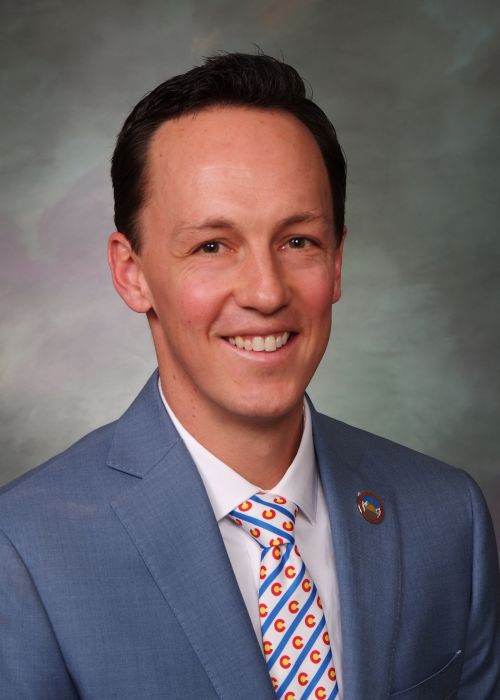
Sen. Dylan Roberts
Sponsored bills
The act implements recommendations of the department of regulatory agencies' sunset review and report on the coal mine board of examiners in the department of natural resources by: Continuing the board for 9 years, until 2029; Defining "commissioner" as the commissioner of mines in the statute that lists the board members; Replacing an obsolete reference to a "flame safety lamp" with a reference to a "digital gas detector"; and Repealing references to "assistant mine foreman" because that is no longer a position held in coal mines.(Note: This summary applies to this bill as enacted.)
Beginning January 1, 2022, the bill requires a health insurance carrier (carrier) that offers an individual health benefit plan in this state to offer a Colorado option plan in the Colorado counties where the carrier offers the individual health benefit plan. The commissioner of insurance (commissioner) is required to develop and implement a Colorado option plan that must: Be offered to Colorado residents who purchase health insurance in the individual market; Implement a standardized plan that: Allows consumers to easily compare health benefit plans; and Provides first-dollar, predeductible coverage for certain services; Include the essential health benefits package; Provide different, specific levels of coverage; Include a hospital reimbursement rate formula; Require hospital participation; Require a minimum medical loss ratio of 85%; and Require carriers and pharmacy benefit management firms to pass rebate savings through to consumers and document the savings and pass-through in a form and manner determined by the commissioner. The Colorado option advisory board (board) is created to advise and make recommendations to the commissioner on all aspects of the Colorado option plan. The bill authorizes the commissioner to promulgate rules to develop, implement, and operate the Colorado option plan, including: Expanding the Colorado option plan to the small group market; Establishing a hospital reimbursement rate formula; and Requiring carriers to offer the Colorado option plan in specific counties. If a hospital refuses to participate in the Colorado option plan, the department of public health and environment may issue a warning, impose fines, or suspend, revoke, or impose conditions on the hospital's license. The commissioner, in consultation with the board, is required to evaluate the Colorado option plan beginning July 1, 2024, and each year thereafter. (Note: This summary applies to this bill as introduced.)
Under existing law, the office of transportation safety within the office of the executive director of the department of transportation (department) receives funding from the law enforcement assistance fund (LEAF fund) to provide funding to local governments that have established a qualified drunk driving prevention and law enforcement program. The department receives funding from the first time drunk driving offender account in the highway users tax fund for high-visibility drunk driving enforcement. The bill requires the general assembly to annually appropriate $2 million to the department for allocation to local government programs that implement high-visibility drunk driving enforcement. The bill repeals department funding for high-visibility drunk driving enforcement from the first time drunk driving offender account and repeals office of transportation safety funding from the LEAF fund. (Note: This summary applies to this bill as introduced.)
The act allows, upon approval of the county treasurer, a board of county commissioners or a city council of a city and county to temporarily reduce, waive, or suspend delinquent interest payments for property tax payments. The act also requires a board of county commissioners or city council to notify local taxing jurisdictions of the intent to reduce, waive, or suspend delinquent property tax interest payments. If a local taxing jurisdiction would be unable to meet its bond payment obligations after the proposed reduction, waiver, or suspension, the local taxing jurisdiction shall notify the board of county commissioners or city council. Finally, the act requires a treasurer to advance property tax payments to local taxing jurisdictions to assist the local taxing jurisdictions in the payment of bonded indebtedness payments and monthly operation costs, if the local taxing jurisdiction submits a letter to the board of county commissioners of the county or the city council of the city and county that contains the local taxing jurisdiction. (Note: This summary applies to this bill as enacted.)
A working group was convened over the 2019 interim pursuant to House Bill 19-1264 to develop proposed statutes to address certain issues affecting the creation, valuation, tax treatment, and stewardship of conservation easements in the state. The bill implements the recommendations of the working group as follows: Section 1 of the bill modifies the method of calculating the amount of the state income tax credit that may be claimed for the donation of a conservation easement. The section also clarifies the manner in which certain business entities claim the credit. Section 2 requires the state to provide compensation for certain taxpayers who were denied state income tax credits for conservation easements donated between 2000 and 2013 if the federal internal revenue service allowed a federal income tax deduction for the same donation. The amount of the compensation is based upon the amount of the credit that could have been claimed at the time of the original donation based upon the value of the donation accepted by the internal revenue service. The amount of compensation is reduced by any amount that was allowed to be claimed against Colorado income tax or otherwise reinstated to the claimant of the compensation. Where a tax credit was transferred to another taxpayer as transferee, the bill provides a process for all parties to the transaction to submit a mutual application for compensation or, if there is objection, a process to resolve disputes about the distribution of compensation. The total amount of compensation to be paid to all claimants is limited to the amount of unused conservation easement tax credits that could have been claimed between 2013 and 2019 under an existing statutory cap amount, but were not claimed. If the unclaimed amounts are not sufficient to satisfy all claims, then any unsatisfied claims would be paid in future years. The cap for each future year would be reduced by the amount of claims paid; except that the total amount of claims paid in a year could not exceed 50% of the amount of the cap for that year. Section 3 requires the director of the division of conservation to designated an ombudsman to assist in resolving certain disputes related to conservation easements. Section 3 also addresses the abandonment of conservation easements, which occurs when the holder of an easement no longer fulfills its stewardship obligations with respect to the easement. The division of conservation is required to investigate potential abandoned easements, make findings regarding each easement, and report its findings to the conservation easement oversight commission (commission). The commission then conducts a public hearing on the easement and, if it determines that an easement is abandoned, appoints a receiver to monitor the easement. Receivership for an abandoned easement is limited to 5 years, during which time the commission reviews the easement and attempts to identify options to reform the easement, have it assigned to another holder, or extinguish the easement. A stewardship account is established to provide for the cost of carrying out the stewardship obligations resulting from abandoned easements. A specified amount of money is appropriated to the stewardship account for the 2020-21 fiscal year, with a corresponding reduction in the amount of conservation easement tax credits that can be claimed for one year.(Note: This summary applies to this bill as introduced.)
Section 1 of the bill enacts the "Colorado Prescription Drug Price TransparencyAct of 2020", which requires: Health insurers, starting in 2021, to submit to the commissioner of insurance (commissioner) information regarding prescription drugs covered under their health insurance plans that the health insurers paid for in the preceding calendar year, including information about rebates received from prescription drug manufacturers, a certification regarding how rebates were accounted for in insurance premiums, and a list of all pharmacy benefit management firms (PBMs) with whom they contract; Prescription drug manufacturers to notify the commissioner, state purchasers, health insurers, PBMs, pharmacies, and hospitals when the manufacturer, on or after January 1, 2021, increases the price of certain prescription drugs by more than specified amounts or introduces a new specialty drug in the commercial market; Prescription drug manufacturers, within 15 days after the end of each calendar quarter that starts on or after January 1, 2021, to provide specified information to the commissioner regarding the drugs about which the manufacturer notified purchasers; Health insurers or, if applicable, PBMs to annually report specified information to the commissioner regarding rebates and administrative fees received from manufacturers for prescription drugs they paid for in the prior calendar year and the average wholesale price paid for prescription drugs by individuals, small employers, and large employers enrolled in health plans issued by the health insurer or that contain prescription drug benefits managed or administered by the PBM; and Certain nonprofit organizations to compile and submit to the commissioner an annual report indicating the amount of each payment, donation, subsidy, or thing of value received by the nonprofit organization or its officers, employees, or board members from a prescription drug manufacturer, PBM, health insurer, or trade association and the percentage of the nonprofit organization's total gross income that is attributable to those payments, donations, subsidies, or things of value. The commissioner is required to post the information received from health insurers, prescription drug manufacturers, PBMs, and nonprofit organizations on the division of insurance's website, excluding any information that the commissioner determines is proprietary. Additionally, the commissioner, or a disinterested third-party contractor, is to analyze the data reported by health insurers, prescription drug manufacturers, PBMs, and nonprofit organizations and other relevant information to determine the effect of prescription drug costs on health insurance premiums. The commissioner is to publish a report each year, submit the report to the governor and specified legislative committees, and present the report during annual "State Measurement for Accountable, Responsive, and Transparent (SMART) Government Act" hearings. The commissioner is authorized to adopt rules as necessary to implement the requirements of the bill. Health insurers that fail to report the required data are subject to a fine of up to $10,000 per day per report. Nonprofit organizations are subject to a fine of up to $10,000 for failure to comply with reporting requirements. Section 2 specifies that failing to ensure that a PBM that a health insurer uses to manage or administer its prescription drug benefits is complying with reporting requirements constitutes an unfair method of competition and an unfair or deceptive act or practice in the business of insurance. Section 3 specifies that a PBM is an entity that manages or administers prescription drug benefits for a health insurer, either pursuant to a contract or as an entity associated with the health insurer. Under sections 4 and 5 , a prescription drug manufacturer that fails to notify purchasers or fails to report required data to the commissioner is subject to discipline by the state board of pharmacy, including a penalty of up to $10,000 per day for each day the manufacturer fails to comply with the notice or reporting requirements. The commissioner is to report manufacturer violations to the state board of pharmacy. Section 6 requires a health insurer to reduce premiums for the health plans it issues or renews on or after January 1, 2022, to adjust for the rebates the health insurer received from prescription drug manufacturers in the previous plan year.(Note: This summary applies to this bill as introduced.)
Capital Development Committee. Current statute requires the Colorado commission on higher education (commission) to request annually from the governing board of each state institution of higher education (institution) a 2-year projection (projection) of capital construction projects to be undertaken by an institution that is estimated to require total project expenditures exceeding $2 million if the capital construction project is for new acquisitions of real property or new construction and funded solely from cash funds held by the institution or the project is funded through the higher education revenue bond intercept program, or exceeding $10 million if the project is not for new acquisitions of real property or new construction and is funded solely from cash funds held by the institution. The bill adjusts the law to current practice and instead requires the projection to be reviewed at the commission's next available meeting and repeals the requirement that an institution amend the projection prior to commencing a project if the project is not in the institution's most recent projection. The bill repeals the requirement that the commission annually prepare a unified, 2-year report for capital construction or capital renewal projects acquired or constructed and operated and maintained solely from cash funds held by the institution that are not for new acquisitions of real property or new construction and are estimated to require total project expenditures exceeding $10 million. The bill repeals the requirement that the commission annually prepare a unified, 2-year report for capital construction projects for new acquisitions of real property or for new construction, estimated to require total project expenditures exceeding $2 million. Current law requires the capital development committee (CDC) to review the projections at a hearing but does not specify what to do when the legislature is not in session. The bill clarifies deadlines for when such hearings must be held. The bill also requires each state institution of higher education, for informational purposes only, to annually present its current projections at the capital development committee's December hearings. Current law requires the CDC to have a hearing regarding projections whenever a projection is amended. The bill repeals this requirement. Current law specifies that the CDC is required to review and approve guidelines prepared by the office of the state architect regarding the classification of facilities as academic facilities or auxiliary facilities. The bill repeals this requirement. (Note: This summary applies to this bill as introduced.)
The bill limits the use of a mobile electronic device while driving to adult drivers who use the mobile electronic device through a hands-free accessory. The bill establishes penalties of $50 and 2 points for a first violation, $100 and 2 points for a second violation, $200 and 4 points for a third or subsequent violation, and $300 and 4 points if the violation involves text messaging. (Note: This summary applies to the reengrossed version of this bill as introduced in the second house.)
The bill defines possession for purposes of sexual exploitation of a child. The bill updates certain actions described as sexual exploitation of a child to reflect access and viewing due to evolving technology. The bill makes sexual exploitation of a child an extraordinary risk crime, enhancing the presumptive sentencing range, if the sexually exploitative material depicts a child who is: Under 12 years of age; Subjected to the actual application of physical force or violence; or Subject to sexual intercourse, sexual intrusion, or sadomasochism. The bill creates the sexual exploitation of a child surcharge for any person who is convicted or receives a deferred sentence for sexual exploitation of a child. Ninety-five percent of the surcharge goes to the sexual exploitation of children surcharge fund. The money in the fund will fund the enhance the effective investigation and prosecution of computer-facilitated sexual exploitation of children grant program. The grant awards go to law enforcement agencies to assist with developing and acquiring necessary technological or expert resources to investigate and prosecute computer-facilitated crimes of sexual exploitation of a child is continuously appropriated to the Colorado bureau of investigation to enhance the effective investigation and prosecution of computer-facilitated sexual exploitation of children. (Note: Italicized words indicate new material added to the original summary; dashes through words indicate deletions from the original summary.) (Note: This summary applies to the reengrossed version of this bill as introduced in the second house.)