

In general, current law provides that a felony conviction or other offense involving moral turpitude does not, in and of itself, prevent a person from applying for or obtaining public employment. The bill extends this to persons applying to positions within the wildland fire management section in the department of public safety. The bill requires the division of fire prevention and control (division) to develop materials to increase awareness of wildland fire career opportunities for persons who acquired experience in wildland fire services through the inmate disaster relief program (program). The bill states that the division is encouraged to hire persons who acquired experience in the program for positions performing wildland fire services. The bill requires the division to develop and implement a peer mentor program for persons hired who acquired experience in wildland fire services through the program so those persons may develop and sustain professional skills. The bill requires the wildfire matters review committee to review and permits the committee to propose legislation or other policy changes relating to maximizing the utilization of wildland fire services through the inmate disaster relief program and creating wildland fire career opportunities for persons who acquire experience in wildland fire services through the inmate disaster relief program. (Note: Italicized words indicate new material added to the original summary; dashes through words indicate deletions from the original summary.) (Note: This summary applies to the reengrossed version of this bill as introduced in the second house.)
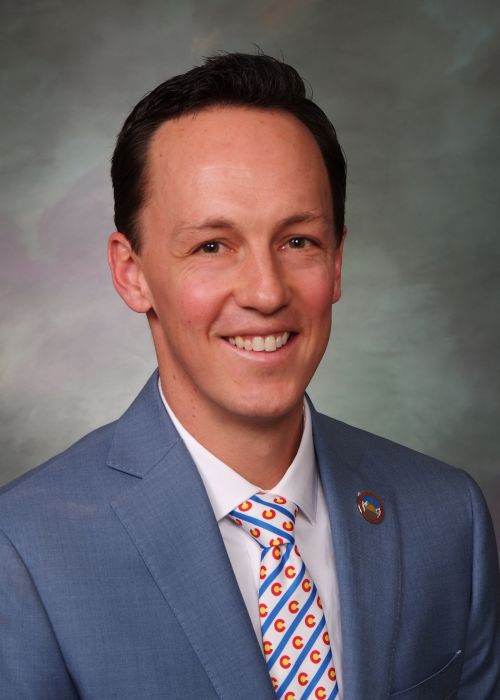
Sen. Dylan Roberts
Sponsored bills
The act authorizes a business (retailer) with one of the following types of alcohol beverage licenses to sell and deliver alcohol beverages to customers, including by the drink, for off-premises consumption and to allow customers to take alcohol beverages off the licensed premises: A manufacturer or wholesaler license, if the retailer operates a sales room; A beer and wine license; A hotel and restaurant license; A tavern license; A brew pub license; A club license; A vintner's restaurant license; A distillery pub license; A lodging and entertainment license; or A fermented malt beverage on- and off-premises retailer's license or on-premises retailer's license. To engage in the sale and delivery of alcohol beverages for off-premises consumption, a retailer must: Sell or deliver the alcohol beverages in a sealed container that complies with state licensing authority rules; Sell or deliver alcohol beverages only to a customer who is 21 years of age or older; If the governor has not declared a disaster emergency, or the retailer is not a wholesaler or manufacturer that operates a sales room, a brew pub, a vintner's restaurant, or a distillery pub, sell or deliver no more than 750 milliliters of vinous liquors and spirituous liquors and no more than 72 fluid ounces of malt liquors, fermented malt beverages, and hard cider; If the governor has not declared a disaster emergency, or the retailer is not a wholesaler or manufacturer that operates a sales room, derive no more than 50% of its gross annual revenues for sales of food and alcohol beverages from the sale of alcohol beverages through takeout orders and deliveries; If the governor has not declared a disaster emergency, obtain a state and, if applicable, local permit to sell takeout or deliver alcohol beverages; and Permit delivery only by an employee of the licensee who is 21 years of age or older and who has satisfactorily completed seller and server training under the responsible vendor program. The act directs the state licensing authority to adopt rules: Specifying the types of containers to be used for delivery of alcohol beverages; Creating a state permit for retailers to engage in takeout and delivery of alcohol beverages; Setting fees for takeout and delivery state permits; and Concerning any other matters necessary to implement the bill act. If a business demonstrates the ability to comply with the requirements of the act, the state licensing authority is required to issue a takeout and delivery permit to the retailer. The act authorizes local licensing authorities to create a local takeout and delivery permit and establish fees to process and approve applications. If a local licensing authority creates a local takeout and delivery permit, a retailer wishing to engage in takeout and delivery of alcohol beverages, other than a manufacturer or wholesaler that operates a sales room, must obtain the local takeout and delivery permit in addition to the state permit and must apply simultaneously to the state and local licensing authorities. The act does not apply to any other person licensed or permitted under the "Colorado Liquor Code" or the "Colorado Beer Code" or to a caterer that is licensed to sell alcohol beverages. The act repeals on July 1, 2021. (Note: This summary applies to this bill as enacted.)
The act specifies that the money credited to the capital construction fund pursuant to House Bill 20-1377, concerning a requirement that a portion of the proceeds of the Senate Bill 17-267 lease-purchase agreement that will be executed in state fiscal year 2019-20 be credited to the capital construction fund and appropriated only for controlled maintenance projects, including controlled maintenance projects that are capital renewal projects, must be appropriated in the following priority: $34,098,768 for current year and out year level 1 controlled maintenance projects; $3,779,372 for the capital renewal project at University of Northern Colorado for the Boiler #3 Replacement; $2,819,630 for the capital renewal project at Adams State University for the Plachy Hall HVAC Upgrade and Replacement; and Any remaining money is appropriated to the emergency controlled maintenance account. The act also specifies that in the event there is insufficient money credited to the capital construction fund to fully fund the first 3 appropriations, no partial projects may proceed with partial appropriations. Any partial appropriation must instead be appropriated to the emergency controlled maintenance account. The act takes effect upon passage only if House Bill 20-1377 becomes law and takes effect either upon the effective date of this act or House Bill 20-1377, whichever is later. (Note: This summary applies to this bill as enacted.)
The act allows a homeowner in a community organized under the "Colorado Common Interest Ownership Act" to operate a licensed family child care home, as defined in state laws governing child care facilities, notwithstanding anything to the contrary in the community's governing documents. The community's regulations concerning architectural control, parking, landscaping, noise, and other matters continue to apply, but the community must make reasonable accommodations for any requirements pertaining to fences under the state's family child care home licensing laws. The owner or operator of the child care home may also be required to carry additional liability insurance. The act does not apply to a community qualified as housing for older persons under federal law. (Note: This summary applies to this bill as enacted.)
The act: Extends the rural jump-start program for an additional 5 years; Adds a legislative declaration stating that the purpose of the 5-year extension is to create or retain jobs in order to help address the still significant contraction of local economies in certain areas of the state; Changes the existing competition clause to specify that a new business applying for rural jump-start program benefits cannot compete with an existing business in the rural jump-start zone in which the business will be located or in any distressed county that is contiguous to the rural jump-start zone; Adds economic development organizations as authorized entities to apply to: Form a rural jump-start zone; or To allow a new business to participate in the rural jump-start program; and Amends the reporting requirements to ensure that any future evaluation of the rural jump-start program can rely on clear, relevant, and ascertainable metrics and data provided by the economic development commission.(Note: This summary applies to this bill as enacted.)
The act requires a farm owner or operator to confine chicken, turkey, duck, goose, or guinea fowl hens (hens) in accordance with the standards established in the act. On and after January 1, 2023, the act also prohibits a business owner or operator from selling shell eggs or egg products that are produced by egg-laying hens that were confined in a manner that conflicts with these standards. In connection with this prohibition, the act: Requires, by January 1, 2023, hens to be confined in an enclosure with at least one square foot of usable floor space per hen; Requires, by January 1, 2025, hens to be confined in a cage-free housing system with at least: One square foot of usable floor space per hen if the hens have unfettered access to vertical space; or 1.5 square feet of usable floor space per hen if the hens do not have unfettered access to vertical space; Deems a sale to have occurred at the location where the buyer takes physical possession of the shell egg or egg product; Allows a business to rely upon written certification that the shell egg or egg product did not come from hens that were confined in a manner that conflicts with the act; Authorizes the commissioner of agriculture to impose a civil penalty of up to $1,000 per violation; Requires the commissioner to promulgate rules to implement and enforce the act; and Authorizes the commissioner to use a government or private inspection process. The act requires shell eggs and egg products to be annually certified as complying with the standards. Certification requires an inspection. The following are exempt from the act's requirements: Medical research; Veterinary procedures; Transportation; A state or county fair exhibition, 4-H program, or similar exhibition; Slaughter; Temporary confinement in connection with animal husbandry; A farm with 3,000 or fewer egg-laying hens; or A nonfarm business owner or operator with each location selling fewer than 25 cases of, or 30 dozen, shell eggs per week if all locations owned or operated by the business sell fewer than 100 cases of shell eggs per week.(Note: This summary applies to this bill as enacted.)
The act grants bureau of animal protection agents the authority to conduct investigations related to certain complaints of animal cruelty. (Note: This summary applies to this bill as enacted.)
The act appropriates $1.5 million from the species conservation trust fund for programs that are designed to conserve native species that state or federal law lists as threatened or endangered, that are candidate species, or that are likely to become candidate species as determined by the United States fish and wildlife service, allocated as follows: Native terrestrial wildlife conservation, $454,505; Native aquatic wildlife conservation, $295,495; Platte river recovery implementation program, $670,000; and Selenium management, research, monitoring, evaluation, and control, $80,000.(Note: This summary applies to this bill as enacted.)
The act appropriates the following amounts from the Colorado water conservation board (CWCB) construction fund to the CWCB or the division of water resources in the department of natural resources for the following projects: Continuation of the satellite monitoring system operation and maintenance, $380,000 (section 1 of the act); Continuation of the Colorado floodplain map modernization program, $500,000 (section 2); Continuation of the weather modification permitting program, $350,000 (section 3); Continuation of the Colorado Mesonet project, $150,000 (section 4); Acquisition of LIDAR data, $200,000 (section 5); Continuation of the Arkansas river decision support system, $500,000 (section 6); Continuation of the Colorado decision support system operation and maintenance, $500,000 (section 7); Continuation of the water forecasting partnership project, $350,000 (section 8); Creation of the Colorado water loss control initiative, $1,000,000 (section 9); Continuation of the watershed restoration program, $4,000,000 (section 10); and Continuation of the alternative agricultural transfer methods grant program, $750,000 (section 11). The state treasurer will make the following transfers from the CWCB construction fund: Up to $2,000,000 on July 1, 2020, to the litigation fund (section 12); and $1,000,000 on July 1, 2020, to the fish and wildlife resources fund (section 13). Section 14 appropriates $7,500,000 to the CWCB to continue implementation of the state water plan from the CWCB construction fund to be used as follows: Up to $3,000,000 to facilitate the development of additional storage, artificial recharge into aquifers, and dredging existing reservoirs; Up to $1,000,000 for grant funding to implement long-term strategies for conservation, land use, and drought planning; Up to $500,000 for grants for water education, outreach, and innovation efforts; Up to $1,500,000 for agricultural projects; and Up to $1,500,000 for environmental and recreational projects. The CWCB is authorized to make loans from the severance tax perpetual base fund or the CWCB construction fund: In an amount up to $23,230,000 to the Pueblo conservancy district to bring levees up to federal emergency management agency standards (section 15); In an amount up to $17,250,800 to the Tunnel Water Company to rehabilitate the Laramie-Poudre tunnel (section 16); and In an amount up to $90,000,000 to the southeastern Colorado water conservancy district to provide nonfederal cost-sharing funding for the Frying Pan-Arkansas project. $10,000,000 is also transferred from the severance tax perpetual base fund to the CWCB construction fund and then appropriated from the CWCB construction fund for the 2020-21 state fiscal year to the CWCB to grant money to the southeastern Colorado water conservancy district for the Frying Pan-Arkansas project (section 17). Current law prohibits the CWCB from recommending treated water distribution systems to the general assembly, and section 18 removes the prohibition. Section 19 extends the CWCB's water efficiency grant program to June 30, 2030. Section 20 reduces the $1,700,000 appropriation made to the CWCB in the 2019-20 state fiscal year for stakeholder outreach and technical analysis regarding the development of a water resources demand management program to $833,258, which amount is available to the CWCB through the 2020-21 state fiscal year. Current law authorizes an annual, continuous appropriation of $150,000 from the CWCB construction fund to the Colorado water conservation board for the ongoing operations of a water education foundation, which is currently known as Water Education Colorado. Section 21 repeals the continuous appropriation. (Note: This summary applies to this bill as enacted.)
Pursuant to an opinion of the Colorado supreme court, if a party to a criminal case wrongfully procures the unavailability of a witness, that witness's hearsay evidence may be inadmissible. The act provides that such evidence may be admissible as an exception to the hearsay rule if: The proponent of the evidence has given reasonable notice of the party's intent to introduce the evidence; and The court determines by a preponderance of the evidence that the party intended to and did procure the unavailability of the witness.(Note: This summary applies to this bill as enacted.)