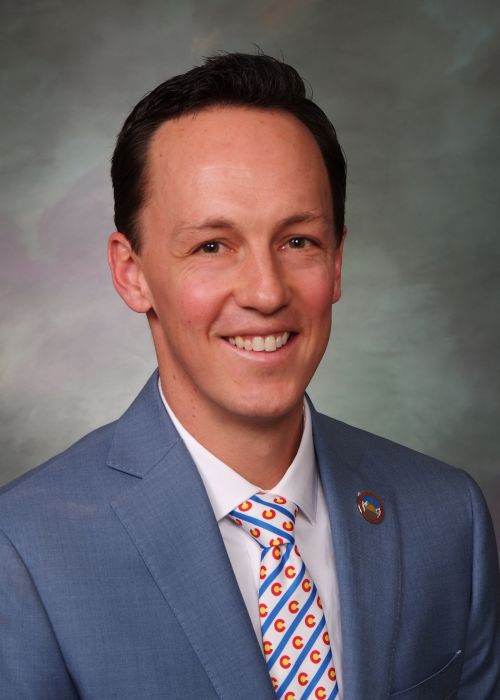
Photo of Dylan Roberts
D Colorado Senate · District 8 On the 2026 ballot

Sen. Dylan Roberts

Compare
Total votes
4,741
all sessions
Attendance
94%
282 missed
Near the chamber average
With party
94%
of cast votes
Lower than 95% of chamber peers
Bipartisan score
3%
crosses aisle rarely
Higher than 86% of chamber peers
Sponsored
635
bills & resolutions
Near the chamber average
Committees
7
assignments
635 bills and resolutions

Sponsored bills

Total
635
Primary
369
Co-sponsor
266
This page
635
matching current filters
Primary HB 20-1159
Signed into law · Colorado House · Lead sponsor
State Engineer Confirm Existing Use Instream Flow

Current law specifies that the Colorado water conservation board's appropriation of water for instream flow purposes is subject to existing uses and exchanges of water. The act directs the state engineer, in administering current law, to confirm a claim of an existing use or exchange if the use or exchange has not previously been confirmed by court order or decree. The person making the claim may also seek confirmation by the water judge. (Note: This summary applies to this bill as enacted.)

Signed into law Apr 1, 2020 0 co-sponsors
Primary HB 20-1157
Signed into law · Colorado House · Lead sponsor
Loaned Water For Instream Flows To Improve Environment

Under current law, the Colorado water conservation board (board), subject to procedural requirements established to prevent injury to water rights and decreed conditional water rights, may use loaned water for instream flows if the loaned water is used for preserving the natural environment of a stream reach that is subject to a decreed instream flow water right held by the board. The act expands the number of years within a 10-year period that a renewable loan may be exercised from 3 years to 5 years, but for no more than 3 consecutive years, and allows a loan to be renewed for up to 2 additional 10-year periods. The act limits the duration that an expedited loan may be exercised for up to one year, and prohibits an applicant from seeking additional expedited loans regarding a water right following an approved expedited loan of that water right. The act also expands the board's ability to use loaned water for instream flows to improve the natural environment to a reasonable degree pursuant to a decreed instream flow water right held by the board. In considering whether to accept a proposed loan, the board must evaluate the proposed loan based on biological and scientific evidence presented, including a biological analysis performed by the division of parks and wildlife. The state engineer will review a proposed loan and must consider any comments filed by parties notified of the application in determining whether the loaned water will not cause injury to other vested or conditionally decreed water rights, decreed exchanges of water, or undecreed existing exchanges of water that were administratively approved before the date that the loan application was filed. The filing fee is increased from $100 to $300. The board is required to promulgate rules regarding the necessary steps for reviewing and accepting a loan for instream flow use to improve the natural environment to a reasonable degree. The state engineer's decision to approve or deny a proposed loan may be appealed to a water judge, who is required to hear and determine the matter on an expedited basis using the procedures and standards established for matters rereferred to the water judge by a water referee. (Note: This summary applies to this bill as enacted.)

Signed into law Mar 20, 2020 0 co-sponsors
Primary HB 20-1067
Signed into law · Colorado House · Lead sponsor
Managment Of Property Held By Certain Junior College Districts

Current law includes ambiguities regarding the existence and powers of the Moffat County Affiliated Junior College District (MCAJCD) and the Rangely Junior College District (RJCD). The statutes do not allow the ownership or transfer of certain real estate held by the MCAJCD and the RJCD. Prior statutes that granted the MCAJCD and the RJCD broad authority, including the authority to own and convey real estate, were inadvertently repealed in 2009. The act allows the MCAJCD to hold and sell its current real estate holdings, provided: The sale is for fair market value as determined by an independent appraiser; and The proceeds are used for the benefit of the Colorado Northwestern Community College (CNCC). The act authorizes the transfer of the Rangely and Craig campuses of CNCC to the state board for community colleges and occupational education consistent with the original plan and statutory authority of the RJCD and the MCAJCD prior to the inadvertent repeal of statutes. (Note: This summary applies to this bill as enacted.)

Signed into law Mar 20, 2020 0 co-sponsors
Primary SB 20-039
Signed into law · Colorado Senate · Lead sponsor
Update Accessibility Signage State-owned Facility

Instead of the international symbol of accessibility icon of a character in a wheelchair, any required accessibility signage in a facility must depict an accessible icon with a more dynamic character who leans forward in the wheelchair and who shows a sense of movement. This requirement applies to the construction, acquisition, or substantial renovation of any facility that contains 5,000 or more gross square feet, undertaken on and after the date the state architect obtains approval from the United States department of justice that, on a statewide basis, the accessible icon provides equal or greater access to persons with disabilities and is thus an equivalent facilitation under the federal "Americans with Disabilities Act of 1990". The state architect is required, with assistance from the Colorado advisory council for persons with disabilities, to seek this approval no later than January 1, 2021. (Note: This summary applies to this bill as enacted.)

Signed into law Mar 20, 2020 0 co-sponsors
Primary SB 20-048
Signed into law · Colorado Senate · Lead sponsor
Study Strengthening Water Anti-speculation Law

Current law specifies that an appropriation of water cannot be based on speculation. Speculation may be evidenced by either of the following: The applicant for an appropriation of water does not have either a legally vested interest or a reasonable expectation of procuring such an interest in the lands or facilities to be served by the appropriation, unless the appropriator is a governmental agency or an agent in fact for the persons proposed to be benefitted by the appropriation; or The applicant does not have a specific plan and intent to divert, store, or otherwise capture, possess, and control a specific quantity of water for specific beneficial uses. The act requires the executive director of the department of natural resources to convene a work group to explore ways to strengthen current anti-speculation law and to report to the water resources review committee by August 15, 2021, regarding any recommended changes. (Note: This summary applies to this bill as enacted.)

Signed into law Mar 11, 2020 0 co-sponsors
Primary HB 20-1054
In committee · Colorado House · Lead sponsor
Withdraw Plea Agreement If Condition Rejected

Under current law, if a judge decides not to accept specific conditions of a plea agreement, only the defendant is permitted to withdraw from the agreement. The bill allows either the defendant or the prosecution to withdraw from such a plea agreement. (Note: This summary applies to this bill as introduced.)

In committee Feb 4, 2020 0 co-sponsors
Primary HB 19-1264
Signed into law · Colorado House · Lead sponsor
Conservation Easement Tax Credit Modifications

Income tax - credit for donation of conservation easement - extend repeal of conservation easement oversight commission and easement holder certification program - alternative valuation method - conservation easement working group - disclosure form - access to COMaP. A conservation easement is an agreement in which a property owner agrees to limit the use of his or her land in perpetuity in order to protect one or more specified conservation purposes. The instruments creating the conservation easement are recorded in the public records affecting the ownership of the property. The conservation easement is held by a third party (holder), which monitors the use of the land and ensures that the terms of the agreement are upheld. A state income tax credit is currently allowed for a portion of the value of a donated conservation easement. The statutes establishing the conservation easement oversight commission and the program to certify conservation easement holders in the division of conservation are currently set to repeal on July 1, 2019. The act extends the repeal dates for each to July 1, 2026. In addition, the act: Eliminates a requirement that the board of real estate appraisers establish education and experience requirements for conservation easement appraisers; Relocates and modifies certain provisions governing the creation and valuation of conservation easements; Allows the division of conservation to use an alternative method acceptable to the division and the conservation easement oversight commission to value a conservation easement; Modifies provisions governing a conservation easement working group convened to address specified issues relating to claiming a state income tax credit for the donation of a conservation easement; Requires the owner of property who is granting a conservation easement to execute a disclosure form developed by the division of conservation and the conservation easement oversight commission regarding the easement; Modifies provisions governing when a conservation easement may be extinguished; Prohibits a conservation easement for which a state income tax credit has been allowed from being released, terminated, extinguished, or abandoned by merger, which occurs when the same entity holds both the easement and the land subject to the easement; Increases the total amount that may be claimed as an income tax credit for an individual donation of a conservation easement, but limits the amount that may be claimed per year; and Makes a $250,000 appropriation to Colorado state university to facilitate the provision of public access to the Colorado ownership, management, and protection (COMaP) service which maintains a database and corresponding map of conservation easements and other protected lands in Colorado. Additionally, the act makes conforming amendments to certain statutory sections contained in HB 19-1172, which recodifies title 12, Colorado Revised Statutes, to ensure that the provisions of the act will be effective as a result of HB 19-1172 becoming law. Specifies that certain sections take effect only if House Bill 19-1172 becomes law. (Note: This summary applies to this bill as enacted.) Read More

Signed into law Jun 3, 2019 0 co-sponsors
Primary SB 19-107
Signed into law · Colorado Senate · Lead sponsor
Broadband Infrastructure Installation

Electric utility easements - installation of broadband facilities in easements - broadband suppliers' provision of broadband using facilities - notice requirements - conditions. The act authorizes an electric utility that has an electric easement on real property or a commercial broadband supplier designated by the electric utility to act on the electric utility's behalf, after having provided advanced notice to the owner of the real property and to any interest holder in the real property that has requested notice , to install, maintain, or own a broadband facility within the electric easement or to lease any excess capacity of such facility to a commercial broadband supplier. The broadband facility may be installed, maintained, or owned aboveground within the electric easement if the facility is attached to the electric utility's electric service infrastructure. An electric utility or a designated commercial broadband supplier may maintain or own an underground broadband facility within the electric easement only if the facility existed before notice was delivered to the property owner and to interest holders requesting notice pursuant to the act. An electric utility may assign its rights under the act to install, maintain, own, or lease excess capacity of broadband facilities. The terms and conditions of a written electric easement, including any notice requirements related to entering the real property on which the electric easement is located, apply; except that any terms and conditions that prohibit the electric utility from exercising the rights authorized under the act do not apply. The act establishes a 2-year limitations period within which an interest holder may bring a claim against an electric utility or commercial broadband supplier with regard to the electric utility's or commercial broadband supplier's exercise of rights under the act; except that the statutory limitations period does not apply to claims based on physical damage to property, injury to natural persons, or breach of the terms and conditions of a written electric easement. Damages for claims subject to the statutory limitations period are limited to damages that existed at the time that the electric utility or commercial broadband supplier first exercised its rights under the act at issue and measured by the fair market value of the reduction in value of the interest holder's interest in the real property. An electric utility or commercial broadband supplier exercising rights under the act: Cannot discriminate among commercial broadband suppliers, including with respect to leasing fees charged and pole access provided, in offering or granting rights to install or attach broadband facilities; Is required to charge just and reasonable pole attachment fees; and May only withhold authorization to a commercial broadband supplier to install, maintain, own, operate, or use broadband facilities on the electric utility's electric service infrastructure if there is insufficient capacity for the broadband facilities or for reasons of safety or reliability concerns or engineering considerations that weigh against granting an authorization. An electric utility shall not directly provide retail commercial broadband service but a broadband affiliate of the electric utility may do so if: A separate accounting system is maintained for the broadband affiliate; An independent certified public accountant performs a financial audit of the broadband affiliate within 2 years after it commences retail commercial broadband service and at least once every 2 years thereafter; and The electric utility does not cross-subsidize the broadband affiliate or the broadband affiliate's provision of commercial broadband service. A commercial broadband supplier that is unaffiliated with an electric utility may request that the electric utility and a broadband affiliate of the electric utility, if they are exercising rights under the act, certify that the electric utility and the broadband affiliate are in compliance with the act. The certification is admissible in court in any action that arises between the unaffiliated commercial broadband supplier and the electric utility or broadband affiliate. (Note: This summary applies to this bill as enacted.) Read More

Signed into law Jun 3, 2019 0 co-sponsors
Primary SB 19-221
Signed into law · Colorado Senate · Lead sponsor
CO Water Conservation Board Construction Fund Project

Colorado water conservation board construction fund - project and loan authorizations - appropriations - transfers. The act appropriates the following amounts from the Colorado water conservation board (CWCB) construction fund (fund) to the CWCB or the division of water resources in the department of natural resources for the following projects: Continuation of the satellite monitoring system operation and maintenance, $380,000 (section 1 of the act); Continuation of the Colorado floodplain map modernization program, $500,000 (section 2); Continuation of the weather modification permitting program, $175,000 (section 3); Continuation of the Colorado Mesonet project, $150,000 (section 4); Continuation of instream flow engineering support services, $250,000 (section 5); Acquisition of LIDAR data, $200,000 (section 6); and Technical assistance grants for beneficiaries of the federal "Colorado River Storage Project Act", $200,000 (section 7). The state treasurer will make the following transfers from the fund: Up to $2,000,000 on July 1, 2019, to the litigation fund (section 8); and $2,500,000 on June 30, 2019, to the water supply reserve fund (section 9). Section 10 appropriates $17,500,000 from the fund to the CWCB for continuing implementation of the state water plan as follows: Up to $4,000,000 to support watershed health goals; Up to $3,000,000 to facilitate the development of additional storage, artificial recharge into aquifers, and dredging existing reservoirs; Up to $1,000,000 for agricultural projects; Up to $1,000,000 for grant funding to implement long-term strategies for conservation, land use, and drought planning; Up to $500,000 for grants for water education, outreach, and innovation efforts; Up to $1,500,000 for environmental and recreational projects; Up to $1,000,000 to provide continued funding for the alternative agricultural grant program; and Up to $5,500,000 to fund updates to basin implementation plans, improve basin data collection and metrics for tracking state water plan implementation, and for use of the data for future updates of the state water plan. Section 11 authorizes the CWCB to make loans up to $15,150,000 from the fund for the Walker recharge project, a water supply retiming effort that uses the alluvial aquifer of the South Platte river to increase irrigation opportunities for agricultural production. Current law: Makes money appropriated for use in Republican river matters available until June 30, 2019; section 12 extends availability until the money is fully expended; Authorizes and directs the state treasurer to transfer $200,000 from the fund to the feasibility study small grant fund; section 13 makes this an annual obligation on July 1 of each year and increases the transfer cap to $500,000 in order to restore the unencumbered balance in the fund up to $500,000; and Creates the flood and drought response fund; section 14 authorizes and directs the state treasurer to annually transfer money on July 1 of each year from the fund to the flood and drought response fund to restore the unencumbered balance in the flood and drought response fund to $500,000. Section 15 changes a continuing annual transfer established in statute of $10 million from the severance tax perpetual base fund to the fund for implementation of the state water plan to a single transfer of $10 million on July 1, 2019. (Note: This summary applies to this bill as enacted.) Read More


Signed into law Jun 3, 2019 0 co-sponsors
Showing 581 to 590 of 635 bills
Previous 1 58 59 60 64 Next