

The act creates the office of cardiac arrest management (office) in the department of public health and environment, the purpose of which is to promote the use of public access defibrillators and the use of registries so the public know where defibrillators can be found and used. The office is required to: Coordinate the collection of sudden cardiac arrest data, including outcome data from hospitals; Implement an outreach campaign to raise public awareness regarding sudden cardiac arrest; Maintain a list of training and education programs offered in this state to teach life-saving skills; Employ a statewide cardiac arrest data coordinator and other personnel as necessary; and Coordinate the submission of data to an automated external defibrillator registry. $200,000 is appropriated from the general fund to the department of public health and environment for use in the 2022-23 state fiscal year by the health facilities and emergency medical services division to implement the act. (Note: This summary applies to this bill as enacted.)
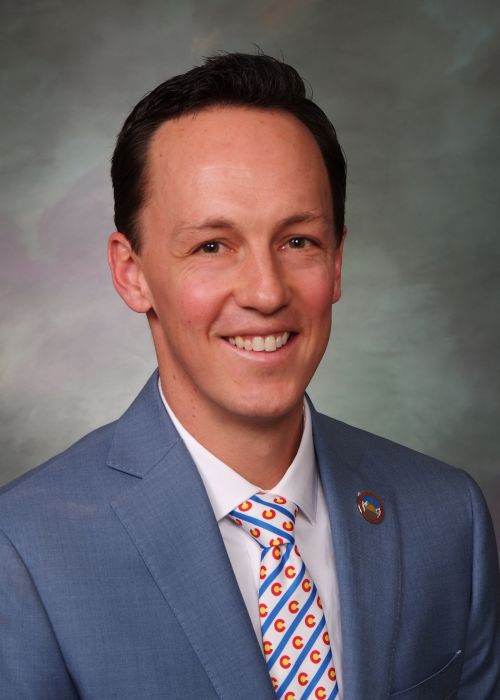
Sen. Dylan Roberts
Sponsored bills
Under current law, ambulance services are regulated at the local level. On and after July 1, 2024, the act requires an ambulance service to obtain a state license from the department of public health and environment (department). In licensing ambulance services, the department is authorized to conduct inspections, investigate and hold hearings regarding alleged violations, and, for any violations found, take action against an ambulance service's license or application for an initial or renewed license, impose civil penalties in an amount of up to $500 per violation or up to $500 per day for a continuing violation, or both. On or before January 1, 2024, the state board of health (board) is required to adopt rules regarding minimum standards for ambulance services, including equipment, staffing, medical oversight, and general and vehicle liability insurance standards and, if the board deems it necessary, rules imposing application and licensing fees. On and after July 1, 2024, a county or city and county is authorized to grant an ambulance service authorization to operate within the county's or city and county's jurisdiction and to enter into service agreements, memoranda of understanding, and other contracts with ambulance services operating in the county's or city and county's jurisdiction. The act also creates a statewide task force to make statutory, rule, and policy recommendations for how to preserve, promote, and expand consumer access to emergency medical services in the state, including recommendations: Regarding the regulation of ambulance service; To address inequities and disparities in access to emergency medical services; To address workforce recruiting and retention issues; To promote the financial sustainability of emergency medical services; and Regarding the long-term sustainability of emergency medical services. For state fiscal year 2022-23, the act appropriates from the general fund: $254,622 to the department for use by the health facilities and emergency management services division for administration and operations; and $1,882 to the legislative department for use by the legislative council.(Note: This summary applies to this bill as enacted.)
The act repeals the requirements that property must be owned for strictly charitable purposes and not for private gain or corporate profit and that the property must be irrevocably dedicated to a charitable purpose in order for the property to qualify for the property tax exemption for property used as an integral part of a child care center. These changes allow property that is used by a tenant or subtenant to operate a child care center to be eligible for the exemption, and the act specifies that in such case, only the operator's use is to be considered for purposes of determining whether the property is eligible for the exemption. An operator of an eligible facility, or the operator's authorized agent, is required to sign the exemption application form and to provide the property tax administrator with any requested information related to the exemption. (Note: This summary applies to this bill as enacted.)
The act expands the purposes of the peace officers behavioral health support and community partnerships grant program to include hiring, contracting, or developing a remote network to provide behavioral health counseling, therapy, or other related support services to peace officers involved in job-related traumatic situations. The act appropriates $3 million from the general fund to the peace officers behavioral health support and community partnership fund. (Note: This summary applies to this bill as enacted.)
Current law requires a peace officer to be a bona fide Colorado resident. The act removes that requirement. (Note: This summary applies to this bill as enacted.)
The act creates the groundwater compact compliance and sustainability fund (fund) to help finance groundwater use reduction and sustainability efforts in the Rio Grande river basin and the Republican river basin, such as efforts to buy and retire irrigation wells and irrigated acreage in the river basins. The Colorado water conservation board (board) administers the fund and can make expenditures from the fund based on recommendations from the board of directors of the Rio Grande water conservation district or the Republican river water conservation district. A conservation district's recommendations must first be approved by the state engineer. For the 2022-23 state fiscal year, $60 million is appropriated from the economic recovery and relief cash fund to the fund and, on August 15, 2024, up to $20 million of any unobligated money in the fund is transferred to the water plan implementation account, which account the board administers to finance efforts to help accomplish critical actions identified in the state water plan. The board and any recipient of money from the fund or the account must comply with the compliance, reporting, record-keeping, and program evaluation requirements that the office of state planning and budgeting and the state controller establish for use of money allocated to the state pursuant to the "American Rescue Plan Act of 2021". (Note: This summary applies to this bill as enacted.)
The act creates the public defender and prosecutor behavioral health support program (program) in the department of local affairs (department). The department allocates fifty percent of program money and any gifts, grants, and donations received to the office of the state public defender and the remaining fifty percent to the Colorado district attorneys' council (CDAC). CDAC administers a grant program to award grants to individual district attorney's offices. A grant recipient and the office of the state public defender may use program money for counseling services, including reimbursements for the costs of counseling services; training and education programs that teach the symptoms of job-related trauma and how to prevent and treat trauma; and peer support programs. The office of the state public defender and CDAC are annually required to report to the House and Senate judiciary committees about the grant program. The act prohibits a district attorney or public defender peer support team member from being examined as a witness in court about any communication between the peer support team member and a person receiving peer support services without the consent of the person who received the peer support services. The act appropriates $500,000 from the general fund for the public defender and prosecutor behavioral health support program. (Note: This summary applies to this bill as enacted.)
The act defines a "controlled environment agricultural facility" (CEA facility) as a nonresidential structure and related equipment and appurtenances that combines engineering, horticultural science, and computer management techniques to optimize hydroponics, plant quality, and food production efficiency from the land's water for human or livestock consumption. The sole purpose of growing crops in a CEA facility is to obtain a monetary profit from the wholesale of plant-based food for human or livestock consumption. Commencing January 1, 2023, for property tax purposes: The definition of "agricultural and livestock products" includes crops grown within a CEA facility in a raw or unprocessed state for human or livestock consumption excluding marijuana or any other nonfood crop agricultural products; The definition of "agricultural equipment" that is used on the farm or ranch or in a CEA facility includes any personal property within a facility, whether attached to a building or not, that is capable of being removed from the facility, and is used in direct connection with the operation of a CEA facility, which facility is used solely for planting, growing, or harvesting crops in a raw or unprocessed state; and On and after January 1, 2023, but prior to January 2, 2028, agricultural equipment that is used in any CEA facility is exempt from the levy and collection of property tax. Under section 3 of the act, a CEA facility is valued for assessment purposes as all other agricultural property using the cost, market, and income approaches to value. If the sole use of the CEA facility is not the growing of crops for human or livestock consumption, then the property is classified and valued for assessment purposes based on actual use. Under section 3, as part of the personal declaration that the owner of a CEA facility signs and returns to the county assessor, the act requires the owner to include an affidavit executed by the owner in which the owner affirms that the CEA facility meets the requirements for such a facility as specified in the act. If the crop grown in the CEA facility is hemp, the owner must also include a copy of a license to verify to the assessor that the crop is not marijuana . Section 3 is repealed, effective July 1, 2029.(Note: This summary applies to this bill as enacted.)
Senate Bill 21-260, concerning the sustainability of the transportation system in Colorado: Created phased-in road usage fees on gasoline and diesel that increase from 2 cents per gallon for state fiscal year (FY) 2022-23, when they are first imposed, to 8 cents per gallon for FYs 2028-29 through 2031-32, and thereafter continue to increase to account for inflation; and Temporarily reduced the amount of the road safety surcharge, which is imposed annually when a motor vehicle is registered by $11.10 for registration periods beginning in 2022 and $5.55 for registration periods beginning in 2023. The act delays the initial imposition of the road usage fees from July 1, 2022, to April 1, 2023, and increases the amount of the reduction in the road safety surcharge for registration periods beginning in 2023 from $5.55 to $11.10. The act also requires transfers to be made on July 1, 2022, to hold the department of transportation, counties, and municipalities harmless from the reductions in road usage fee and road safety surcharge revenue as follows: $47.1 million from the general fund to the state highway fund; and $31.4 million from the general fund to the highway users tax fund. For implementation of the act, $5,850 is appropriated from the general fund to the department of revenue for use by the division of motor vehicles. (Note: This summary applies to this bill as enacted.)
The bill requires the Colorado water conservation board (board) to establish one or more remote wildfire camera technology pilot programs. The board must acquire or contract for a system of remote pan-tilt-zoom cameras and associated tools to provide a live feed of information that can detect, locate, and confirm ignition in the wildland-urban interface. The board must report to the wildfire matters review committee on the system's effectiveness and potential for more widespread use in the state.(Note: This summary applies to this bill as introduced.)