

The act creates the drug repository task force (task force) in the department of public health and environment (department) to examine drug repository programs for unused prescription drugs and over-the-counter medications in the country to determine the best model to implement for Colorado. The task force consists of at least 13 and no more than 15 members, including up to 8 members appointed by the executive director of the department, 6 members appointed by the executive director of the department of regulatory agencies, and one member appointed by the department of health care policy and financing representing that department. The task force members include, in part, representatives of impacted state departments, hospitals, pharmacists and pharmacy associations, physicians, and members representing patients. The task force members must be appointed by August 1, 2022. The executive director of the department or the executive director's designee shall convene the task force no later than September 15, 2022. In part, the task force shall consider drug depository programs in other states and which model is the safest and most efficient and effective model for Colorado; medications to be included in the program; the requirements for donating and receiving medications; legal issues; and fees and rule-making for the program. The department shall provide staff support to the task force. The task force shall report its findings and recommendations to the governor and the health committees of the general assembly by December 15, 2022. The task force is repealed on July 1, 2023. (Note: This summary applies to this bill as enacted.)
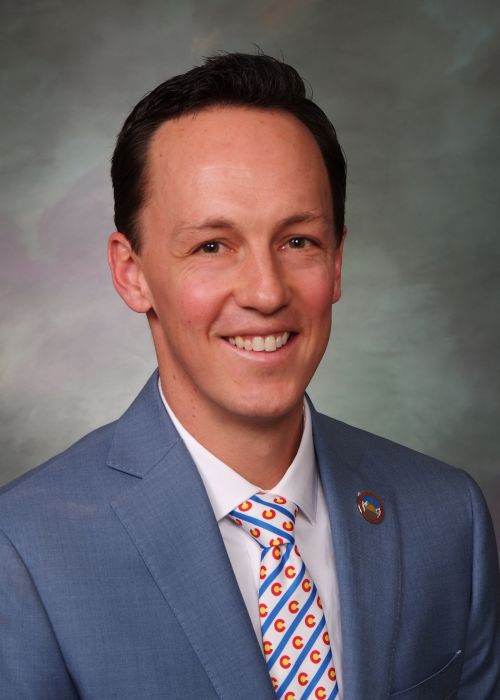
Sen. Dylan Roberts
Sponsored bills
The act allows a board of county commissioners (board), in consultation with its fire protection district or fire authority, to apply to the state engineer for the designation of a pond as a fire suppression pond. The director of the division of fire prevention and control (director) in the department of public safety is required to promulgate rules to establish criteria for boards, in consultation with fire protection districts or fire authorities, to use to identify and evaluate potential fire suppression ponds. Before applying for the designation of a pond as a fire suppression pond, a board, in consultation with its fire protection district or fire authority, must identify ponds in areas where the outbreak of a fire could result in a major wildfire disaster and perform a needs assessment of each such pond. If a pond that is under consideration for designation as a fire suppression pond is located in whole or in part upon private property, a board must acquire the voluntary written approval of each owner of private property that abuts the pond before the board applies to the state engineer for the designation of the pond as a fire suppression pond. For each pond that is identified and under consideration as a potential fire suppression pond, a board must provide notice of such fact to the state engineer. The act prohibits the state engineer, with exceptions, from ordering any pond to be drained or backfilled: While the pond is under consideration for designation as a fire suppression pond; If the state engineer has designated the pond as a fire suppression pond; or On and after the effective date of the act, and until the date upon which the director promulgates rules. The state engineer may not designate more than 30 total surface acres of pond in any county as a fire suppression pond or designate any pond as a fire suppression pond unless the pond satisfies certain requirements and the board that requested the designation provided notice of the request to interested parties included in the substitute water supply plan notification list established for the water division in which the pond is located. The state engineer may impose reasonable requirements on a board as a condition of designating a pond as a fire suppression pond, including requirements for measuring and recording devices. A board and its fire protection district or fire authority must inspect a designated fire suppression pond at least annually. The designation of a pond as a fire suppression pond expires 15 years after the date of the designation. Before the expiration, the board and the fire protection district or fire authority may perform a needs assessment of the pond. If the needs assessment demonstrates that the pond is in compliance with criteria established in the director's rules, the board and fire protection district or fire authority shall notify the state engineer of such fact, and the state engineer shall redesignate the pond as a fire suppression pond. If the needs assessment demonstrates that the pond is not in compliance with the criteria, the board and fire protection district or fire authority must either: Notify the state engineer that the designation of the pond as a fire suppression pond should be rescinded or allowed to expire; or Provide to the state engineer a plan and a timeline for bringing the pond back into compliance with such criteria. Within 70 days after the state engineer designates a pond as a fire suppression pond, a holder of a decreed water right may file with the water clerk of the water division in which the fire suppression pond is located a petition for review of the state engineer's decision. Upon receiving a petition, a water judge must conduct a review of the state engineer's decision. A water judge may nullify the state engineer's designation of a pond as a fire suppression pond if, after considering the entire record, including any evidence of material injury, the judge finds that: In applying for the designation, the board did not describe a pond that complies with criteria established by rules promulgated by the director; or The state engineer's decision did not accord with certain other requirements in the act concerning fire suppression ponds. The act states that a fire suppression pond and the water associated with it: Are not considered a water right; Do not have a priority for the purpose of determining water rights; and May not be adjudicated as a water right. The act states that a proposed fire suppression pond is presumed to not cause material injury to vested water rights. A holder of a decreed water right may rebut the presumption by providing evidence to the state engineer sufficient to show that material injury has occurred or will occur to the decreed water right. The act appropriates, for the 2022-23 state fiscal year, $19,428 from the general fund to the department of natural resources for use by the executive director's office, to be used as follows: $11,828 to be reappropriated to the department of law for the provision of legal services; and $7,600 to be reappropriated to the office of information technology for the provision of information technology services.(Note: This summary applies to this bill as enacted.)
The act requires the Colorado water conservation board (board) to develop a statewide program to provide financial incentives for the voluntary replacement of irrigated turf with water-wise landscaping (turf replacement program). The act defines water-wise landscaping as a water- and plant-management practice that emphasizes using plants with lower water needs. Local governments, certain districts, Native American tribes, and nonprofit organizations with their own turf replacement programs may apply to the board for money to help finance their turf replacement programs. The board will contract with one or more third parties to administer one or more turf replacement programs in areas where local turf replacement programs do not exist. The state treasurer is required to transfer $2 million from the general fund to the turf replacement fund, which fund is created to finance the turf replacement program. The money is appropriated to the department of natural resources for use by the board to implement the turf replacement program, with $11,400 of the money reappropriated to the office of the governor for use by the office of information technology to provide information technology services to the department of natural resources. (Note: This summary applies to this bill as enacted.)
The act establishes a study to investigate devices that are capable of assessing cognitive and physical impairment of motorists to detect the presence of drugs other than alcohol during roadside sobriety investigations. The act requires the Colorado department of transportation (department) to issue a request for proposal for a study and report to be conducted and completed not later than June 1, 2023. The department shall submit and present a final report with the findings of the study at the joint transportation committee's "State Measurement for Accountable, Responsive, and Transparent (SMART) Government Act" hearing and to the Colorado task force on drunk and impaired driving. The act sets requirements and standards for the study. The study repeals July 1, 2024. The act appropriates $751,649 from the marijuana tax cash fund to the department for the study. (Note: This summary applies to this bill as enacted.)
The act specifies that if property encumbered by a conservation easement in gross is condemned through an eminent domain proceeding, and, as a result of the condemnation, the condemning authority is acquiring such property free and clear of the conservation easement interest or subordinating the deed of conservation easement to such acquired property interest, just compensation must be determined based on the value of the property as if unencumbered by the conservation easement in gross. The compensation must be allocated between the fee owner and the holder of the conservation easement based upon the value of their respective interests in the property. (Note: This summary applies to this bill as enacted.)
The act renews for July 2022, August 2022, and September 2022, after a 10-month hiatus, a temporary deduction from state net taxable sales for qualifying retailers in the alcoholic beverages drinking places industry, the catering industry, the food service contractors industry, the mobile food services industry, the restaurant and other eating places industry and for retailers operating a hotel-operated restaurant, bar, or catering service in the state. The temporary deduction from state taxable sales for qualifying retailers is equal to the lesser of state net taxable sales or $70,000 for each month for which a deduction is allowed. (Note: This summary applies to this bill as enacted.)
The act implements most of the recommendations of the department of regulatory agencies, as contained in the department's sunset review of the board of real estate appraisers (board), as follows: Continues the board for 9 years, until September 1, 2031; Requires the board to adopt rules to authorize an exemption from compliance with the uniform standards of professional appraisal practice that would allow an appraiser to perform an evaluation instead of a full appraisal for a federally regulated financial institution and authorizes an appraiser to conduct an evaluation in accordance with the board's rules; Amends statute to comport with federal law, including updating the number of appraisers with which a licensed appraisal management company does business, updating the qualifications for licensure to require the minimum appraisal experience required by the Appraiser Qualifications Board of the Appraisal Foundation or its successor organization, clarifying that the federal regulating authorities that regulate a financial institution are exempted from state registration or licensure, and aligning the hours of continuing education required for reactivation of an inactive license with the number of hours required by the Appraiser Qualifications Board; Repeals the requirement that the board send letters of admonition by certified mail; and Clarifies that fines are assessed on a per-violation basis and reduces the maximum penalty from $2,000 to $1,000, which maximum penalty applies to any violation.(Note: This summary applies to this bill as enacted.)
The act implements the recommendations of the department of regulatory agencies, as contained in the department's sunset review of preneed funeral contracts, as follows: Continues the regulation of preneed funeral contracts for 7 years, to September 1, 2029; Removes from statute the surety bond or net worth requirements for an applicant for a license to sell preneed funeral contracts and requires the commissioner of insurance (commissioner) to establish the requirements in rule; Allows the commissioner to investigate the books, records, and accounts of a contract seller without the requirement that the commissioner first receive a complaint or indication of noncompliance; Removes the fees for license renewal from statute and requires the commissioner to establish the fees in rule based on the cost of regulating the industry and the outstanding preneed contract obligations of the contract sellers; Declares money held in trust for a preneed contract is unclaimed and must be reported to the state treasurer for deposit into the unclaimed property trust fund at the earlier of: 3 years after the date on which the contract seller has knowledge of the death of the preneed contract beneficiary; the date the preneed contract beneficiary, if living, would have attained 115 years of age; or 65 years from the date that the preneed contract was executed; and Requires each funeral establishment, at the time of registration renewal, to attest to whether the funeral establishment sells preneed contracts and requires the director of the division of professions and occupations to enter into a memorandum of understanding with the commissioner to share information on funeral establishments that sell preneed contracts.(Note: This summary applies to this bill as enacted.)
The act establishes the Colorado rural health-care workforce initiative (initiative) to expand the number of health-care professionals practicing in Colorado's rural or frontier counties. As part of the initiative, an institution of higher education (institution) is authorized to establish and operate a health-care professionals rural track within any health-care professional education program offered by the institution. A rural track must set aside seats in its health-care professional education program for students who express an interest in studying and working in a rural or frontier county, offer didactic curriculum related to practicing the health-care discipline in rural or frontier counties, place students in rural or frontier counties for hands-on instruction and training, and award scholarships to students in the rural track. In order to receive a scholarship, a student must commit to working as a health-care professional in a rural or frontier county for 2 years after completing education and training. The rural office at the university of Colorado's school of medicine (rural program office) provides technical assistance to the institutions operating a rural track regarding recruiting and admitting students committed to working in rural areas and identifying rural or frontier counties in which students may be placed for clinical training. The rural program office also facilitates, arranges, or advises an institution about arranging housing for students placed in a rural or frontier county. The rural program office must provide, without charge, to institutions operating a rural track, didactic curriculum related to practicing in rural or frontier counties. The act requires the rural program office to annually evaluate the effectiveness of the initiative and report to the general assembly's education committees about the initiative. The act requires the department of higher education (department) to enter into limited purpose fee-for-service contracts to provide funding for the rural program office to carry out its duties related to the initiative. The department is also required to enter into limited purpose fee-for-service contracts with institution governing boards to operate a rural track in programs specified in the act. The department is required to allocate money to Colorado mountain college to establish a rural track in its nursing program. The act appropriates $1,200,000 to the department from the general fund for fee-for-service contracts and allocations for the initiative. (Note: This summary applies to this bill as enacted.)
The act creates 2 state grant programs: The local investments in transformational affordable housing grant program (affordable housing grant program), administered by the division of housing (DOH) in the department of local affairs (department); and The infrastructure and strong communities grant program (strong communities grant program), administered by the division of local government (DLG) in the department. The affordable housing grant program provides grants to local governments and nonprofit organizations to enable such entities to make investments in their communities or regions of the state in transformational affordable housing and housing related matters. The strong communities grant program provides grants to eligible local governments to enable local governments to invest in infill infrastructure projects that support affordable housing. The strong communities grant program requires a multi-agency group, comprised of DLG, the state energy office, and the department of transportation, with the assistance of stakeholders, to develop a list of sustainable land use best practices that will accomplish the goals of the grant program and improve a local government's viability in being considered for a grant award. The act requires both DOH and DLG to develop policies, procedures, and guidelines governing the administration of the respective grant programs. The act specifies how grant funding is to be prioritized and eligible uses of grant money awarded under the grant programs. The act creates 2 funds in the state treasury: The local investments in transformational affordable housing fund and the infrastructure and strong communities grant program fund. The act specifies requirements pertaining to the administration of these funds. The affordable housing grant program is initially funded by a transfer to the local investments in transformational affordable housing fund of $138 million of money from the affordable housing and home ownership cash fund that originated from the federal coronavirus state fiscal recovery fund. The strong communities grant program is initially funded by a transfer to the infrastructure and strong communities grant program fund of $40 million of money from the affordable housing and home ownership cash fund that originated from the federal coronavirus state fiscal recovery fund. Both grant programs are subject to reporting requirements specified in the act, and both grant programs are repealed, effective December 31, 2026. For the 2022-23 state fiscal year, $431,985 is appropriated from various sources to the governor's office to implement the act. (Note: This summary applies to this bill as enacted.)