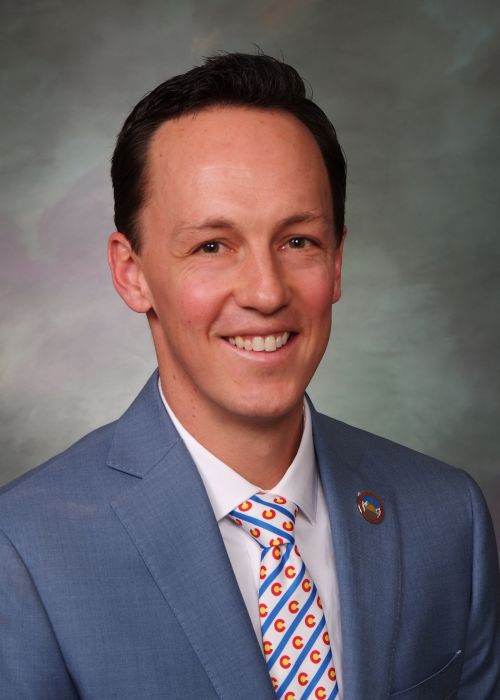
Photo of Dylan Roberts
D Colorado Senate · District 8 On the 2026 ballot

Sen. Dylan Roberts

Compare
Total votes
4,741
all sessions
Attendance
94%
282 missed
Near the chamber average
With party
94%
of cast votes
Lower than 95% of chamber peers
Bipartisan score
3%
crosses aisle rarely
Higher than 86% of chamber peers
Sponsored
635
bills & resolutions
Near the chamber average
Committees
7
assignments
635 bills and resolutions

Sponsored bills

Total
635
Primary
369
Co-sponsor
266
This page
635
matching current filters
Primary SB 22-080
Failed · Colorado Senate · Lead sponsor
Wildland Fire Investigations

The bill establishes that conducting investigations of reporting on the investigation of wildland fires in the state to the wildfire matters review committee is a duty of the director of the division of fire prevention and control within the department of public safety and makes an appropriation creates the fire origin and cause investigation fund to fund such investigations. (Note: Italicized words indicate new material added to the original summary; dashes through words indicate deletions from the original summary.) (Note: This summary applies to the reengrossed version of this bill as introduced in the second house.)


Failed May 12, 2022 0 co-sponsors
Primary SB 22-175
Failed · Colorado Senate · Lead sponsor
Mobile Electronic Devices And Motor Vehicle Driving

Current law prohibits a person who is under 18 years of age from using a mobile electronic device when driving. The bill applies the prohibition to a person who is 18 years of age or older unless the person is using a hands-free accessory. The following uses are exempted: By a person reporting an emergency to state or local authorities; By an employee or contractor of a utility services provider when responding to a utility emergency; By a person operating a commercial truck when using a mobile data terminal that transmits and receives data; By a first responder; or By a person in a motor vehicle that is lawfully parked. The penalties for a violation are: For a first offense, $150 $75 and 2 license suspension points; For a second offense within 24 months, $250 $150 and 3 license suspension points; and For a third or subsequent offense within 24 months, $500 $250 and 4 license suspension points. It is an affirmative defense to a The violation will be dismissed if the defendant has not previously committed a violation, produces proof of purchase of a hands-free accessory, and affirms, under penalty of perjury, that the defendant has not previously claimed this affirmative defense option to dismiss . Current law requires a peace officer who makes a traffic stop to record the demographic information of the violator, whether a citation has been issued, and the violation cited. The bill clarifies that the peace officer must record whether the bill has been violated. A peace officer is prohibited from stopping a driver or issuing a citation for a violation of the bill unless the officer visually observes the operator using, holding, or physically supporting with any part of the person's body the mobile electronic device. The executive director of the department of transportation, in consultation with the chief of the Colorado state patrol, will create a campaign raising public awareness of the requirements of the bill and of the dangers of using mobile electronic devices when driving. To implement the bill, $23,941 is appropriated to the department of revenue from the Colorado DRIVES vehicle services account in the highway users tax fund. (Note: Italicized words indicate new material added to the original summary; dashes through words indicate deletions from the original summary.) (Note: This summary applies to the reengrossed version of this bill as introduced in the second house.)
Failed May 12, 2022 0 co-sponsors
Primary HB 22-1417
Passed · Colorado House · Lead sponsor
Alcohol Beverages Task Force And Retailer Licenses

The bill creates a task force in the department of revenue to study the regulation of alcohol beverages. The task force is required to review the current statutes regulating alcohol beverages and make recommendations concerning how to modernize, clarify, and harmonize the statutes. The task force is required to report its findings to the general assembly by December 1, 2023. The bill modifies laws governing the licensure of retail liquor stores and liquor-licensed drugstores and creates the new beer-and-wine-licensed grocery store license.With regard to retail liquor store licenses, the bill: Removes the requirement that a new retail liquor store must be located a certain distance from an existing liquor-licensed drugstore;Expands the minimum distance between a new retail liquor store and other existing retail liquor stores from 1,500 feet to 3,000 feet;Effective January 1, 2024, removes the requirement that only an employee of the retail liquor store may deliver alcohol beverages and instead allows delivery by any person who is authorized by the retail liquor store, subject to specified requirements including that the licensee or the authorized deliverer obtain a delivery permit from the state licensing authority and other requirements specified in state licensing authority rules; andIncreases the maximum number of retail liquor store licenses that a person may own. With regard to liquor-licensed drugstore licenses, the bill:Prohibits the state and local licensing authorities from issuing new liquor-licensed drugstore licenses after the date the bill takes effect and repeals provisions related to the ability of liquor-licensed drugstore licensees to obtain additional licenses;Allows a liquor-licensed drugstore licensed before January 1, 2022, to continue to renew the licensee's license, unless the license has converted to a beer-and-wine-licensed grocery store license;On January 1, 2026, converts every liquor-licensed drugstore license in effect on that date to a beer-and-wine-licensed grocery store license, unless the licensee chooses to remain a liquor-licensed drugstore, and eliminates the ability of those licensees that convert to a beer-and-wine-licensed grocery store license to sell spirituous liquors; andEffective January 1, 2024, removes the requirement that only an employee of the liquor-licensed drugstore may deliver alcohol beverages and instead allows delivery by any person who is authorized by the liquor-licensed drugstore, subject to specified requirements including that the licensee or the authorized deliverer obtain a delivery permit from the state licensing authority and other requirements specified in state licensing authority rules. With regard to beer-and-wine-licensed grocery store licenses, the bill:Creates the new license, available on or after January 1, 2026, with requirements similar to the requirements applicable to liquor-licensed drugstores, to permit a grocery store that obtains the license to sell beer and wine only;Specifies that a beer-and-wine-licensed grocery store cannot be located within 1,500 feet of a retail liquor store;Allows a beer-and-wine-licensed grocery store to deliver beer and wine to its customers under the same requirements applicable to retail liquor stores and liquor-licensed drugstores;Allows a beer-and-wine grocery store to own multiple stores as follows: On and after January 1, 2026, and before January 1, 2027, a maximum of 8 stores; on and after January 1, 2027, and before January 1, 2032, a maximum of 13 stores; on and after January 1, 2032, and before January 1, 2037, a maximum of 20 stores; and on and after January 1, 2037, an unlimited number of additional stores;Allows a licensee licensed as a liquor-licensed drugstore on December 31, 2025, whose license converted to a beer-and-wine-licensed grocery store license on January 1, 2026, to transfer any spirituous liquors in its possession to a licensee authorized to sell spirituous liquors but prohibits the licensee from selling spirituous liquors;Permits a beer-and-wine-licensed grocery store to offer tastings on the licensed premises if authorized by the local licensing authority; andDefines "grocery store" as an establishment that generates at least 20% of its gross annual income from the sale of food items. (Note: Italicized words indicate new material added to the original summary; dashes through words indicate deletions from the original summary.) (Note: This summary applies to the reengrossed version of this bill as introduced in the second house.)

Passed May 10, 2022 0 co-sponsors
Primary HB 22-1237
Signed into law · Colorado House · Lead sponsor
Changes To County Court Judges In Western Colorado

For county court organizational and administrative purposes, the act changes the classifications of Garfield and Montezuma counties from Class C to Class B. For Garfield county, the act amends the requirement that the associate county court judge in Rifle must maintain an official residence in Rifle and instead requires an official residence anywhere in Garfield county. For Rio Blanco county, the act amends the requirement that the associate county court judge in Rangley must maintain an official residence in Rangley and instead requires an official residence anywhere in Rio Blanco county. (Note: This summary applies to this bill as enacted.)

Signed into law Apr 21, 2022 0 co-sponsors
Primary HB 22-1072
Signed into law · Colorado House · Lead sponsor
Habitat Partnership Program

The habitat partnership program (program) assists the division of parks and wildlife (division) with reducing wildlife conflicts and meeting game management objectives. The act: Authorizes the director of the division (director) to independently appoint members of the habitat partnership council (council) that, in part, advises local habitat partnership committees (committees) that help implement program objectives; Expands the scope of the program to assist the division with private land conservation and wildlife migration corridor efforts; With respect to reducing wildlife conflicts, prioritizes conflicts that arise from forage and fence issues related to big game ungulate species, which are big game species that are hooved mammals; Authorizes the council to allocate an annual budget to each committee, subject to final approval by the director, and expend funds in areas of the state that are not covered by a committee; Requires the director to set terms for committee members; and Identifies the council and each committee as an independent organizational unit for purposes of purchasing, accounting, and procurement-related issues. The act clarifies that any balance of unexpended and unencumbered money in the habitat partnership cash fund (fund) at the end of a fiscal year that exceeds the amount transferred to the fund at the beginning of the fiscal year from the wildlife cash fund reverts to the wildlife cash fund and continues the fund indefinitely. The act also exempts the program from the "Procurement Code". (Note: This summary applies to this bill as enacted.)

Signed into law Apr 21, 2022 0 co-sponsors
Primary HB 22-1022
Signed into law · Colorado House · Lead sponsor
Modify Administration Of Colorado State Fair

The act allows the Colorado state fair authority (authority) to collaborate with a state agency to develop an industry display at the Colorado state fair and industrial exposition. The act also: Clarifies that the authority may receive information related to an industry display from an industry representative; Requires the board of commissioners of the authority to establish a process for approving industry displays; and Clarifies that the hiring authority of the manager of the Colorado state fair authority is the commissioner of agriculture.(Note: This summary applies to this bill as enacted.)

Signed into law Apr 12, 2022 0 co-sponsors
Primary HB 22-1092
Signed into law · Colorado House · Lead sponsor
Loans From Irrigation Districts To Landowners

Sections 1 and 4 of the act allow a board of directors of an irrigation district (board) to borrow money, which the irrigation district may use to make loans to landowners to be used to make improvements to private water delivery systems or for other types of projects that improve: Water conservation or efficiencies on landowner property; or Landowner delivery or drainage systems. An obligation or contract to borrow such money is exempt from the existing requirement that a contract purporting to bind the district to pay a certain sum must be ratified by a certain number of district voters. Additionally, the district cannot assess landowners to raise money to fund the loans. In case of default in the payment of any loan installment, the county treasurer may assess upon the eligible real property a tax lien for the payment of the whole of the unpaid installment but is prohibited from assessing a tax lien for the entire value of the landowner's portion of the irrigation loan issued by the water district. Sections 2 and 5 require each irrigation district to include in its annual appropriation resolution: The amount needed to meet loan obligations; All amounts payable by landowners to the irrigation district in accordance with loans issued to the landowners; and The amount payable by each tract within the irrigation district for which a landowner has received a loan. Sections 3 and 6 state that the county treasurer will receive $5 per tract assessed for loans issued to landowners by an irrigation district, and this $5 will be assessed against each participating tract. (Note: This summary applies to this bill as enacted.)

Signed into law Apr 12, 2022 0 co-sponsors
Primary HB 22-1117
Signed into law · Colorado House · Lead sponsor
Use Of Local Lodging Tax Revenue

The act expands the allowable uses of the revenue from a local marketing district's marketing and promotion tax and a county's lodging tax to include: Housing and childcare for the tourism-related workforce, including seasonal workers, and for other workers in the community; Facilitating and enhancing visitor experiences; and Capital expenditures related to these new purposes. A local marketing district or county must obtain voter approval to use the tax revenue for the new allowable uses. (Note: This summary applies to this bill as enacted.)

Signed into law Mar 31, 2022 0 co-sponsors
Primary HB 22-1073
Signed into law · Colorado House · Lead sponsor
Funeral Establishment And Crematory Inspection

The act authorizes the director of the division of professions and occupations to enter the premises of registered funeral establishments and crematories during business hours to conduct inspections. The director may contract with a third party to perform the inspection. (Note: This summary applies to this bill as enacted.)

Signed into law Mar 21, 2022 0 co-sponsors
Showing 531 to 540 of 635 bills
Previous 1 53 54 55 64 Next