

The act appropriates $5 million from the species conservation trust fund for programs that are designed to conserve native species that state or federal law lists as threatened or endangered or that are candidate species or are likely to become candidate species for such listing as determined by the United States fish and wildlife service. Of the $5 million, the act allocates $750,000 for native terrestrial wildlife conservation, $1,500,000 for native aquatic wildlife conservation, $2,200,000 for the upper Colorado river endangered fish recovery program and the San Juan river basin recovery implementation program, $50,000 for selenium management, research, monitoring, evaluation, and control, and $500,000 for the federal endangered species act litigation program. APPROVED by Governor June 5, 2023 EFFECTIVE June 5, 2023 (Note: This summary applies to this bill as enacted.)
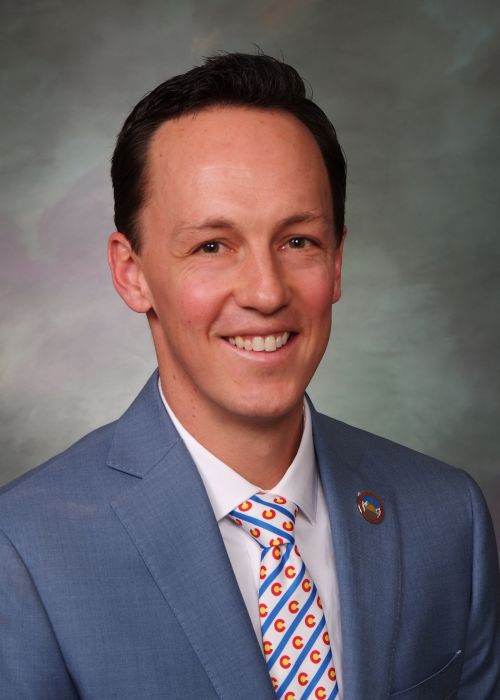
Sen. Dylan Roberts
Sponsored bills
The act requires the transportation commission to annually allocate $1.5 million from the state highway fund to the department of transportation for allocation to the office of transportation safety (office), which will then distribute the money to local governments that implement high-visibility alcohol and drug impaired driving prevention enforcement episodes. The act also requires local law enforcement agencies to follow written policies and procedures about racial profiling and use of force, complete in-service training annually, implement a recognizable pattern by which vehicles are stopped to prevent a bias-motivated stop, and locate checkpoints in areas where drunk or impaired driving crashes are likely to occur. No money may be allocated to a law enforcement agency subject to a judicially-ordered consent decree. In collaboration with the department of public safety, the office will publish an annual report. A law enforcement agency not complying with the requirements of the act may lose funding or be required to pay back funding already received. The attorney general may bring a civil action to enforce the act. APPROVED by Governor June 5, 2023 EFFECTIVE June 5, 2023 (Note: This summary applies to this bill as enacted.)
The act changes the legal representative for the department of revenue (department) in driver's license and identification card denial, cancellation, suspension, and revocation appeals. Under existing law, upon request of the attorney general, a district attorney represents the department in such appeals. On and after 3 specified dates that are designated for 3 groups of judicial districts, the act requires the attorney general to represent the department in all such appeals. The attorney general may appear for such an appeal hearing by telephone, video teleconference, or any other court-authorized means of electronic participation. For the 2023-24 state fiscal year, $47,583 is appropriated from the general fund to the department and reappropriated to the department of law for legal services to be provided to the department in connection with the implementation of the act. APPROVED by Governor June 5, 2023 EFFECTIVE August 7, 2023 NOTE: This act was passed without a safety clause and takes effect 90 days after sine die. (Note: This summary applies to this bill as enacted.)
The act allows the department of transportation (department) to establish steep downhill grade zones within the public highways of the state where the downhill grade is 5% or greater and where there are safety concerns related to commercial motor vehicle drivers exceeding the posted speed limits. If the department establishes a steep downhill grade zone, the department must erect signs identifying the zone and notifying commercial motor vehicle drivers that increased fines are assessed for speeding in the zone. The act subjects a commercial motor vehicle driver who commits a speeding violation in a steep downhill grade zone to doubled fines and surcharges. The act creates the mountain highways commercial motor vehicle safety account (account) within the highway users tax fund and requires the state treasurer to credit one-half of the amount of each doubled fine and surcharge to the account for the department to pay costs associated with the provision of educational outreach and public information about runaway truck events, the purchase and implementation of equipment for the purpose of reducing the frequency of runaway truck events, and the completion of studies of means by which the state may reduce the frequency of runaway truck events and improve overall commercial motor vehicle safety on state highways that pass through the state's mountains. The act appropriates $54,073 to the department of revenue from the Colorado DRIVES vehicle services account in the highway users tax fund for the 2023-24 state fiscal year. The act reappropriates $7,425 of the appropriation to the office of the governor for use by the office of information technology to provide information technology services to the department of revenue. APPROVED by Governor June 5, 2023 EFFECTIVE January 1, 2024 NOTE: This act was passed without a safety clause. (Note: This summary applies to this bill as enacted.)
The act states that the following projects within a natural stream system for certain restoration purposes (stream restoration project) do not cause material injury to a vested water right and are not an unnecessary dam or other obstruction: A stream restoration project that is limited to certain minor restoration activities; and A stream restoration project that has obtained any applicable permits or is under construction or completed by August 1, 2023. The act prohibits the owner or proponent of a stream restoration project from installing the stream restoration project in a manner that adversely affects water diversion or measurement structures without the permission of the owners of the structures. APPROVED by Governor June 5, 2023 EFFECTIVE August 7, 2023 NOTE: This act was passed without a safety clause and takes effect 90 days after sine die. (Note: This summary applies to this bill as enacted.)
The act appropriates the following amounts for the 2023-24 state fiscal year from the Colorado water conservation board (CWCB) construction fund to the CWCB or the division of water resources in the department of natural resources for the following projects: Continuation of the satellite monitoring system, $380,000; Continuation of the floodplain map modernization program, $500,000; Continuation of the weather modification permitting program, $500,000; Continuation of the watershed restoration program, $500,000; Continuation of the Colorado Mesonet project, $150,000; Continuation of the weather forecasting partnership project, $1,000,000; Support for the division of water resources mobile field data collection application project, $800,000; Continuation of the reservoir enlargement assessment project, $1,000,000; Support for the central Colorado water conservancy district augmentation efficiency project, $3,000,000; and Support for the state water plan advancement project, $2,000,000. The act directs the state treasurer to transfer the following amounts on July 1, 2023, from the severance tax perpetual base fund to the CWCB construction fund, and appropriates those amounts from the CWCB construction fund to the CWCB for the following projects: Continuation of the Platte river recovery implementation program, $19,000,000; Support for the upper Colorado river endangered fish recovery program and the San Juan river basin recovery implementation program, $15,000,000; and Additional and continued support for the Frying Pan - Arkansas project, $20,000,000. The act directs the state treasurer to transfer the following amounts from the CWCB construction fund on July 1, 2023: $2,000,000 to restore the fish and wildlife resources fund; Up to $2,000,000 to the CWCB litigation fund to assist in addressing legal issues associated with compact compliance and other litigation activities; and $2,000,000 to the water plan implementation cash fund for continuation of the water plan implementation grant program. The act appropriates $25,200,000 of sports betting revenues from the water plan implementation cash fund to the CWCB to fund grants that will help implement the state water plan. The act appropriates $8,000,000 from the wildlife cash fund to the division of parks and wildlife to purchase up to 924 acre-feet of orphan shares from the CWCB as part of the Chatfield reservoir reallocation project. APPROVED by Governor June 5, 2023 EFFECTIVE June 5, 2023 (Note: This summary applies to this bill as enacted.)
A board of county commissioners is currently authorized to license and regulate an owner or owner's agent of a lodging unit that is rented or advertised for short-term stays, and "owner's agent" expressly excludes an internet hospitality service. The act modifies this regulatory authority by clarifying that it applies to lodging units that are available for short-term rentals, which are rentals for less than 30 days, and by excluding a hotel unit from the scope of the authority. The act also changes "internet hospitality service" to "vacation rental service" (service), defines the term, and provides separate authority for a board of county commissioners to regulate a service. This authority, however, is limited to requiring: An owner or owner's agent to include a rental license or permit number, if applicable, in any listing for a lodging unit on the service's website or other digital platform; and The service to remove a listing from the service's website or other digital platform, if properly notified by a county that the owner of the listed lodging unit has had a local short-term rental license or permit suspended or revoked or has been issued a notice of violation or similar legal process for not possessing a valid local short-term rental license or permit or that the county has a prohibition on short-term rentals that applies to the lodging unit. Upon the request of an owner of a hotel unit that is located in a building with one or more lodging units or a vacation rental service on which the hotel unit is listed, a county is required to provide written verification that the hotel unit is exempt from the ordinance because it is not a lodging unit. APPROVED by Governor June 5, 2023 EFFECTIVE August 7, 2023 NOTE: This act was passed without a safety clause and takes effect 90 days after sine die. (Note: This summary applies to this bill as enacted.)
The act modifies the affordable housing programs (programs) created by Proposition 123, which was approved by voters at the 2022 statewide election, by: Allowing tribal governments to participate in the programs; Requiring the division of local government, rather than the division of housing, to administer the land planning capacity development program; Allowing the office of economic development (office) to use a portion of the money in the affordable housing financing fund (financing fund) for its administrative expenses, without increasing the total amount of money from the fund that may be used for administrative expenses; Modifying the calculation for determining eligibility for some of the programs; Clarifying the description of how money is transferred or allocated; Specifying certain units to be included for purposes of the 3% growth obligation that is a condition for funding for local and tribal governments; Establishing a process for rural resort communities to petition the division of housing to use alternative percentages of area median income for eligibility for certain affordable housing programs for a given funding cycle; Exempting money that was originally from the federal coronavirus state fiscal recovery fund from the appropriations for fiscal year 2022-23 used to determine the state's maintenance of effort requirement for other affordable housing funding; and Requiring the office and the division of housing to provide 3 annual reports to legislative committees about the affordable housing programs. APPROVED by Governor June 5, 2023 EFFECTIVE June 5, 2023 (Note: This summary applies to this bill as enacted.)
The act implements some of the recommendations of the department of regulatory agencies, as contained in the department's sunset review of the "Pesticide Applicators' Act", and makes additional modifications to the "Pesticide Applicators' Act as follows: Sections 1 and 2 of the act continue the "Pesticide Applicators' Act" for 11 years, until September 1, 2034; Section 3 updates the statutory definition of "use" to align with the federal definition adopted by the federal environmental protection agency; The commissioner of agriculture (commissioner) maintains a registry of pesticide-sensitive persons (registry) whose residences are listed in the registry. If a commercial, registered limited commercial, or registered public applicator (applicator) applies a pesticide near the residence of a pesticide-sensitive person included in the registry, the applicator is required to take reasonable actions to notify the pesticide-sensitive person of the pesticide application. Section 4 authorizes a pesticide-sensitive person to apply for inclusion of the person's primary work or school address in the registry as well. In addition, section 4 authorizes an applicator to provide electronic notice to pesticide-sensitive persons. Section 4 also requires that, on or before July 1, 2024, the department of agriculture (department) develop a searchable database of all properties that abut or are entirely located within 250 feet of a residential property listed on the registry for applicators to search. If an applicator will apply pesticides on a property included in the searchable database, the applicator is required to notify the relevant pesticide-sensitive person of the pesticide application. Section 5 increases the maximum civil penalty for a violation of the act from $1,000 to $2,500 for the first violation, which results in the possibility of a maximum civil penalty of $5,000 for a second violation; Section 6 requires that money collected for civil penalties imposed under the "Pesticide Applicators' Act" be credited to the general fund; Section 7 requires the commissioner to publish and periodically update information on the department's website about pesticide applicators' licensing and registration; Section 8 requires the commissioner to establish an online complaint process; Section 9 limits the number of terms that members of the advisory committee, appointed by the state agricultural commission to advise the commissioner, may serve to 2 terms, but allows a member representing the Colorado state university agricultural experiment station or extension service (CSU) or the Colorado department of public health and environment (CDPHE) to serve on the advisory committee for unlimited terms during the duration of the member's employment with CSU or CDPHE; and Sections 10 to 12 amends statutes governing local governments to mirror the language in the "Pesticide Applicators' Act" requiring a local government that adopts an ordinance about pesticides to submit information about the ordinance to the commissioner. Section 13 appropriates $72,150 for the 2023-24 state fiscal year from the plant health, pest control, and environmental protection cash fund to the department, which money is reappropriated to the office of information technology in the office of the governor to provide information technology services to the department. APPROVED by Governor June 5, 2023 EFFECTIVE August 7, 2023 NOTE: This act was passed without a safety clause and takes effect 90 days after sine die.(Note: This summary applies to this bill as enacted.)
The act permits a hospital that has fewer than 50 beds and is a county public hospital, a hospital formed by a health service district, or a hospital affiliated with either such hospital (hospital) to enter into collaborative agreements with one or more hospitals. The act declares the general assembly's intent to exempt from state antitrust laws, and to provide state action immunity from federal antitrust laws for, certain activities that might be characterized as anticompetitive or that might result in displacement of competition in the provision of hospital, physician, or other health-care-related services or administrative or general business services. Further, the general assembly declares its intention to provide a system of review of collaborative agreements by the department of health care policy and financing (department), the division of insurance in the department of regulator agencies (division), if applicable, and the attorney general to ensure that any potential benefits of the collaborative agreements are not outweighed by the harm to competition in rural and frontier communities. Collaborative agreements may include agreements to engage in the following activities: Ancillary clinical services, acquisition of equipment, clinic management, or health-care provider recruitment; Joint purchasing or leasing arrangements, including medical and general supplies, medical and general equipment, pharmaceuticals, or temporary staffing through staffing agencies; Consulting services with a focus on public health in rural and frontier communities and non-hospital-specific innovations in health-care delivery in those communities; Joint purchasing of insurance; Shared back-office services; Shared data services; and Negotiating with health insurance or government payers as described in the act. The act does not grant immunity or other protections to hospitals entering into collaborative agreements that have the effect of setting reimbursement rates or other compensation from any commercial self-insured or commercial health insurance or government payer, dividing or allocating specific markets for the delivery of any general acute care or specialty lines of health-care services, or negotiating compensation for hospital employees that results in a reduction of wages for hospital staff. Prior to engaging in a collaborative agreement, the hospitals shall jointly submit the proposed collaborative agreement for approval to the department and to the division, if applicable. If approved, the proposed agreement must be submitted to the attorney general's office to determine that the benefits of the collaborative activity are not outweighed by any anticompetitive harm that may arise from the collaborative activity. The act includes time frames for the review of collaborative agreements and allows for a request for reconsideration if the collaborative agreement is denied. The department, the division, if applicable, or the attorney general may review a collaborative agreement annually to ensure the outcomes related to the collaborative agreement are consistent with the act. For the 2023-24 state fiscal year, $30,260 is appropriated to the department from the healthcare affordability and sustainability fee cash fund to implement the act. The department anticipates receiving $30,259 in federal funds to implement the act. APPROVED by Governor June 3, 2023 EFFECTIVE August 7, 2023 NOTE: This act was passed without a safety clause and takes effect 90 days after sine die. (Note: This summary applies to this bill as enacted.)