

Current law requires the department of health care policy and financing (state department) to annually prepare a written hospital expenditure report. The act changes the name of the report to the hospital transparency report (transparency report). The act adds specified information that each hospital shall report to the state department for the transparency report. No later than July 1, 2024, the act requires each hospital to provide specified information to the state department for previous fiscal years. The act authorizes the state department to impose certain enforcement mechanisms against a hospital that does not provide all of the information required to be reported to the state department. Current law requires the state department to submit the transparency report to the house of representatives public and behavioral health and human services committee. The act requires the transparency report to also be submitted to the house of representatives health and insurance committee. The act requires the state department to report on the transparency report during the state department's "SMART Act" hearing. Beginning July 1, 2024, the act requires any patient bill to follow industry standard billing practices, including, at a minimum, the date of service, the patient's name, the provider's name, a description of the services provided, and the charges for each service. The act appropriates $75,167 to the state department from the healthcare affordability and sustainability cash fund to implement the act. It is anticipated that the state department will receive an additional $75,165 in federal funds for the implementation of the act. APPROVED by Governor June 2, 2023 EFFECTIVE August 7, 2023 NOTE: This act was passed without a safety clause and takes effect 90 days after sine die. (Note: This summary applies to this bill as enacted.)
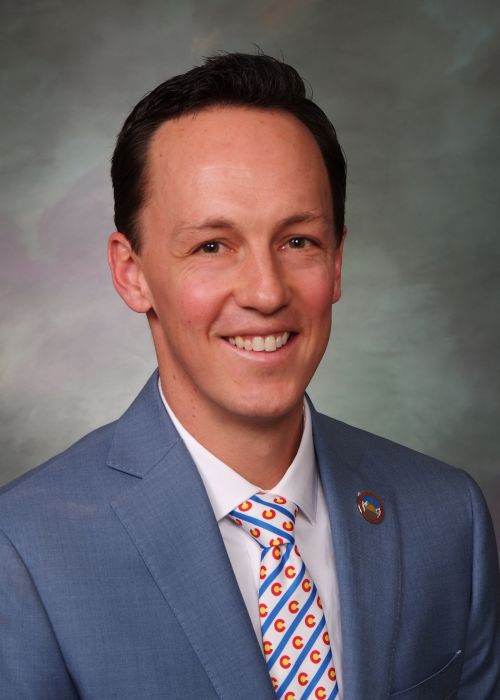
Sen. Dylan Roberts
Sponsored bills
The act codifies the Colorado access to justice commission (commission). The governor, legislative leadership, supreme court of Colorado, and Colorado legal organizations appoint the 17- to 20-member commission, and the Colorado supreme court justice liaison, the executive director of Colorado legal services, the executive director of the legal aid foundation of Colorado, and a representative of the Colorado attorney general serve as ex officio nonvoting members of the commission. The act directs the commission to make recommendations regarding legislative and regulatory changes that could help improve access to justice for all Coloradans, and allows the commission to hire staff. The act creates the Colorado access to justice commission cash fund. The commission is authorized to receive gifts, grants, and donations to fund the commission's duties. APPROVED by Governor June 2, 2023 EFFECTIVE August 7, 2023 NOTE: This act was passed without a safety clause and takes effect 90 days after sine die. (Note: This summary applies to this bill as enacted.)
The act modifies the definition of "qualified local expenditure" for purposes of the performance-based incentive for film production in Colorado to include payment by a production company to a personal services corporation to pay the wages or salaries of an employee-owner of the personal service corporation. "Personal service corporation" and "employee-owner of a personal service corporation" have the same meaning as set forth in the internal revenue code. A payment by a production company to a personal service corporation is a qualified local expenditure only if the production company documents the payment in an information income tax return. Payments in excess of $1 million per calendar year per personal service corporation are excluded from the calculation of the performance-based incentive. The changes related to the definition of employee and withholding requirements made in the act apply to income tax years commencing on or after January 1, 2024. The act adds the new information income tax return requirement for production companies to state income tax law and specifies that a production company is generally not required to deduct and withhold state income tax from a payment to a personal service corporation for services. However, if the information return fails to provide a taxpayer identification number for the personal service corporation that can be validated through the taxpayer identification number matching program administered by the internal revenue service, or provides a taxpayer identification number issued for a nonresident alien, then such deduction, withholding, and payment of state income tax to the department of revenue is required. The act also eliminates the withholding exemption for a payment to a nonresident individual who performs services in connection with a film production for less than 120 days in a calendar year. APPROVED by Governor June 1, 2023 EFFECTIVE August 7, 2023 NOTE: This act was passed without a safety clause and takes effect 90 days after sine die. (Note: This summary applies to this bill as enacted.)
Section 2 of the act clarifies and expands the current property tax exemption for property acquired by nonprofit housing providers for low-income housing. Section 2 also clarifies that property may qualify for the property tax exemption, through construction on the property, until the property is sold or transferred. The act expands the definition of "low-income" applicants to include individuals or families who are at or below 100% of the area median income or, if the property is in a rural resort community, at or below 120% of the area median income, as well as individuals or families who are at or below 80% of the area median income and were already included in the definition. Section 1 of the act requires applicants for the exemption described in section 2 of the act to follow the same process and submit the same forms that are required for applicants for similar exemptions. Section 3 deems certain property held by community land trusts and nonprofit affordable homeownership developers to be used for a strictly charitable purpose and to consequently be exempt from property taxation in accordance with the state constitution. To qualify for the exemption, the property must be split into a separate taxable parcel from the improvements on the property and leased to the owner of the improvements as an affordable homeownership property. APPROVED by Governor May 25, 2023 EFFECTIVE August 7, 2023 NOTE: This act was passed without a safety clause and takes effect 90 days after sine die. (Note: This summary applies to this bill as enacted.)
Beginning January 1, 2024, the act requires a municipality that has a municipal ordinance that criminalizes an act of domestic violence to adopt an ordinance establishing: Protections and rights for victims, victims' families, and witnesses; sentencing guidelines; conditions of probation; conditions of release on bond; and guidelines and standards that are consistent with similar provisions for prosecuting an act of domestic violence in district court; and A requirement that the prosecuting attorney who initially meets with the victim after the charges are filed makes a reasonable effort to remain as the prosecuting attorney throughout the proceeding. In a case involving an alleged violation of a municipal ordinance that criminalizes an act of domestic violence, the act requires a municipal court to issue a protection order; report or cause to be reported the alleged violation to the Colorado bureau of investigation (CBI) and enter the information into the Colorado crime information center (CCIC) database and the national crime information center (NCIC) database; and search the CBI, CCIC database, and the NCIC database to determine if the respondent has a history of domestic violence. The act states that any case involving an alleged violation of a municipal ordinance that criminalizes an act of domestic violence is a misdemeanor for the purposes of complying with federal law. The act authorizes any affected person to enforce compliance with the act by notifying the crime victim services advisory board of any noncompliance. If the board determines that the report of noncompliance has a basis in fact and cannot be resolved, the act requires the board to refer the report to the governor, who shall request that the attorney general file suit to enforce compliance. Beginning January 2025 and each year thereafter until January 2029, the act requires the department of public safety to report during the department's "SMART Act" hearing the total number of reports and inquiries submitted to CBI, the CCIC database, and the NCIC database. APPROVED by Governor May 25, 2023 EFFECTIVE January 1, 2024 NOTE: This act was passed without a safety clause.(Note: This summary applies to this bill as enacted.)
The act creates the wolf depredation compensation fund (fund) to compensate landowners and agricultural producers for wolf depredation of livestock and working animals. For the 2023-24 state fiscal year, the state treasurer is directed to transfer $175,000 from the general fund to the fund, and for each state fiscal year thereafter, the state treasurer is directed to transfer $350,000 from the general fund to the fund. At the end of the 2023-24 and 2024-25 state fiscal years, any unencumbered balance in the fund that exceeds $100,000 is used to implement the gray wolf restoration and management plan (plan). At the end of subsequent state fiscal years, any unencumbered balance in the fund that exceeds 120% of the amount spent from the fund in the previous state fiscal year is used to implement the plan. The parks and wildlife commission may adopt rules establishing criteria for compensation, including criteria for indirect livestock loss. Each year, the director of the division of parks and wildlife will submit a report at the appropriate "SMART Act" hearing. To implement the act, $175,000 is appropriated from the fund to the department of natural resources for use by the division of parks and wildlife. APPROVED by Governor May 23, 2023 EFFECTIVE May 23, 2023 (Note: This summary applies to this bill as enacted.)
The act eliminates the prohibition on persons licensed by the "Limited Gaming Act of 1991" (licensee) from extending credit to another person for participation in limited gaming if: The licensee evaluates the person's credit and establishes the person as credit-worthy; The licensee does not have knowledge of a conviction of the person for committing specified unlawful acts; The licensee determines that the person has no outstanding child support debt or unpaid debt due to the state and does not owe restitution from a Colorado criminal case; and The amount of the extension of credit is at least $1,000. Additionally, the act specifies the documentation the licensee must maintain for any extension of credit and requires the licensee to inform every person to whom credit is extended, orally and in writing, that the financial obligations created must be fully paid to the licensee within 150 days. The act prohibits licensees from reducing their gaming tax burden through deducting unpaid credit from their gross proceeds. The act allows licensees to pursue all civil remedies at law to recover unpaid credit, as well as interest and reasonable recovery costs. Additionally, the act restricts licensees from settling or compromising the amount to be repaid until specific conditions are met. Finally, the act outlines record-keeping requirements for licensees that extend credit. VETOED by Governor May 23, 2023 (Note: This summary applies to this bill as enacted.)
The director of the Colorado energy office or the director's designee (director) is required to conduct studies of electric transmission and advanced energy solutions technologies in rural Colorado. One study must consider ways to assist northwestern and west end of Montrose county, Colorado as it transitions to producing advanced firm dispatchable energy resources. The other study must consider the potential for the development of new energy resources in southeastern Colorado. The act specifies information that the director is required to consider in the studies. On or before July 1, 2025, the director is required to submit the director's findings and conclusions of both studies to the legislative committees of reference with jurisdiction over energy matters and to the just transition office. The act appropriates $50,000 from the just transition cash fund to the office of the governor for use by the Colorado energy office to implement the act. APPROVED by Governor May 20, 2023 EFFECTIVE August 7, 2023 NOTE: This act was passed without a safety clause and takes effect 90 days after sine die. (Note: This summary applies to this bill as enacted.)
Colorado participates in an interstate compact that allows a person convicted of a crime in another state to have the person's probation or parole supervised in Colorado (supervised person) and allows a person convicted in another state who is not required to be supervised to complete the person's court-ordered treatment in Colorado (unsupervised person). The act clarifies the process for treating a supervised or unsupervised person into a private treatment program in Colorado for substance use treatment, sex offender management services, or domestic violence services (program). The act directs the program to assist supervised and unsupervised persons with registering with the interstate compact administrator. The department of corrections (department) is required to complete a criminal history records check of each supervised and unsupervised person to verify that the person is a supervised or unsupervised person. The act specifies requirements for programs when the participant is a supervised person. Current law subjects a program or supervised person to a misdemeanor for violating the provisions of the interstate compact. The act states that a violation may be reported to the program's appropriate licensing, certifying, or approving agency for potential corrective action. The act requires the department to periodically update the out-of-state offender questionnaire used by private treatment program providers. Current law requires a person serving a supervision sentence for a domestic violence-related offense to complete a treatment program that conforms with the standards of the domestic violence offender management board. The act directs a person whose supervision is transferred to another state pursuant to the interstate compact for the supervision of adult offenders to follow the requirements for a treatment program of the state where the person is being supervised. APPROVED by Governor May 20, 2023 EFFECTIVE August 7, 2023 NOTE: This act was passed without a safety clause and takes effect 90 days after sine die. (Note: This summary applies to this bill as enacted.)
The act codifies the rural opportunity office (office), which began its work in the office of economic development in 2019. The director of the office is designated by and reports to the director of the office of economic development. The office is required to serve as Colorado's central coordinator of rural economic development matters with certain staff physically located in rural communities across Colorado, work with coal transitioning communities to explore unique business and economic development opportunities, make recommendations that inform the governor's policy on rural economic development matters, and measure the success of program outreach and determine whether Colorado's rural communities receive more statewide funding as a result of the efforts of the office. For the 2023-24 state fiscal year, $299,193 is appropriated from the general fund to the office of the governor for use by economic development programs for implementation of the act. APPROVED by Governor May 20, 2023 EFFECTIVE August 7, 2023 NOTE: This act was passed without a safety clause and takes effect 90 days after sine die.(Note: This summary applies to this bill as enacted.)