

The act establishes a refundable state income tax credit for active qualified stewardship practices on a farm or ranch for income tax years beginning on or after January 1, 2026, but before January 1, 2031. A qualified taxpayer may earn a state income tax credit equal to: At least $5 and no more than $75 per acre of land covered by one qualified stewardship practice, up to a maximum credit of $150,000 in one income tax year. At least $10 and no more than $100 per acre of land covered by 2 qualified stewardship practices, up to a maximum credit of $200,000 in one income tax year. At least $15 and no more than $150 per acre of land covered by at least 3 qualified stewardship practices, up to a maximum of $300,000 per income tax year. The department of agriculture may issue rules to implement the tax credit, including specifying requirements for implementing and demonstrating qualified stewardship practices. Before issuing any rules, the commissioner of the department of agriculture shall initiate a public stakeholder process to advise the commissioner about the requirements for implementing and demonstrating qualified stewardship practices. To claim the credit, a qualified taxpayer must apply to the department of agriculture for a tax credit certificate. The department of agriculture will evaluate the application and issue the certificate if the taxpayer qualifies for the tax credit. If a tax credit certificate is issued, the qualified taxpayer must attach it to the taxpayer's income tax return and submit it to the department of revenue. The aggregate amount of tax credits issued in one calendar year cannot exceed $3 million. After certificates have been issued for credits that exceed an aggregate of $3 million for all qualified taxpayers during a calendar year, any claims that exceed the amount allowed are placed on a wait list and a certificate is issued for use of the credit in the next income tax year. No more than $2 million in claims shall be placed on the wait list in any given calendar year. Only one tax credit certificate may be issued per qualified taxpayer in an income tax year, and the qualified taxpayer claiming the credit may only receive the tax credit for up to 3 income tax years. No credit may be earned if the qualified taxpayer has received another tax credit, a tax deduction, or a grant related to agricultural land health from any source during the income tax year for which the tax credit is sought. The act appropriates $17,117 to the department of agriculture from the general fund for the 2024-25 state fiscal year for use by the agricultural services division (division) to implement the act. APPROVED by Governor May 24, 2024 EFFECTIVE August 7, 2024(Note: This summary applies to this bill as enacted.)
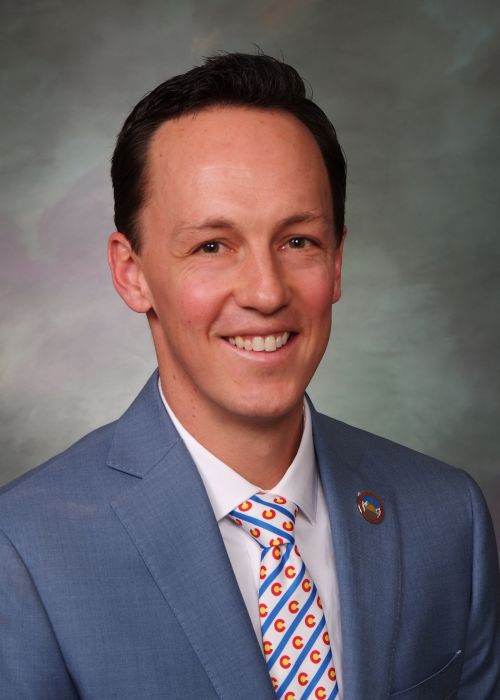
Sen. Dylan Roberts
Sponsored bills
The act updates Colorado state laws concerning insurance company holding systems to align with the National Association of Insurance Commissioners' model act. The changes include updating: The registration requirements for the ultimate controlling person of each insurer by adding new filing requirements to be included with the division of insurance's (division) existing registration requirements; The standards for insurance holding company transactions subject to registration with the division; Language concerning the confidential treatment of documents to include proprietary and trade secret documents and materials; and The regulatory tools that the division may use for the regulation of insurance holding companies. The act authorizes the commissioner of insurance to adopt rules applicable to certain reinsurance arrangements. The act also makes technical amendments. APPROVED by Governor May 24, 2024 EFFECTIVE January 1, 2025(Note: This summary applies to this bill as enacted.)
A fire protection district (fire district) has been authorized to receive and spend an impact fee, or other similar development charge, only in connection with a local government's imposition of such fee or charge to fund expenditures by a fire and emergency services provider. The act repeals this limitation and authorizes a fire district to impose its own impact fee on the construction of new buildings, structures, facilities, or improvements on real property within the fire district's jurisdictional boundaries so long as the fee is imposed pursuant to a legislatively adopted schedule that is: Generally applicable to a broad class of property; and Intended to defray the projected impacts on capital facilities caused by the proposed construction. The act imposes the following limitations on a fire district's authority to impose an impact fee: No individual landowner may be required to provide any site-specific dedication or improvement to meet the same need for capital facilities for which an impact fee is imposed; and An impact fee may not be imposed on construction for which an individual or entity has submitted a completed application for a development permit to an approving local government prior to the fire district's adoption of a schedule of impact fees. Additionally, a fire district may waive an impact fee on the development of low- or moderate-income housing or affordable employee housing, as defined by the fire district. The act gives ambulance districts identical authority to that of a fire district to impose an impact fee on the construction of new buildings, structures, facilities, or improvements on real property within the ambulance district's jurisdictional boundaries. The act also gives fire districts and ambulance districts the additional financial power to levy a sales tax within the district's jurisdiction, at a rate determined by the district's board, upon every transaction or other incident with respect to which a sales tax is levied by the state. The tax must be approved by a majority of the eligible electors within the district voting at a regular special district election or at a special election that complies with section 20 of article X of the state constitution and related statutory requirements. Such a sales tax must be collected, administered, and enforced by the executive director of the department of revenue in the same manner as the state sales tax. APPROVED by Governor May 22, 2024 PORTIONS EFFECTIVE August 7, 2024 PORTIONS EFFECTIVE July 1, 2025(Note: This summary applies to this bill as enacted.)
The act authorizes the reintroduction of the North American wolverine in the state by the division of parks and wildlife (division). As long as the North American wolverine remains on the list of threatened or endangered species pursuant to applicable federal law, the division must not reintroduce the North American wolverine in the state until a final rule designating the North American wolverine in Colorado as a nonessential experimental population pursuant to applicable federal law has taken effect. The act also creates certain requirements for the reintroduction of the North American wolverine. The parks and wildlife commission must adopt rules for the compensation of owners of livestock for losses caused by the North American wolverine. For the 2024-25 state fiscal year, $102,808 is appropriated from the wildlife cash fund to the department of natural resources for use by the division. To implement the act, the division may use the appropriation for wildlife operations. APPROVED by Governor May 20, 2024 EFFECTIVE August 7, 2024(Note: This summary applies to this bill as enacted.)
Under existing law, it is a class A traffic infraction to operate a commercial motor vehicle without a commercial driver's license, to operate a commercial motor vehicle if the operator is under 21 years of age, or to drive a commercial motor vehicle if the person has more than one driver's license. The act makes each a class 1 misdemeanor; except that, if a person presents a valid commercial driver's license to the court within 30 days, the offense is a class A traffic infraction. The act creates the offense of unlawful direction to operate a commercial motor vehicle. An employer who authorizes or permits an employee who the employer knows or reasonably should know does not have a commercial driver's license or is under 21 years of age to operate a commercial motor vehicle commits unlawful direction to operate a commercial motor vehicle, a class 1 misdemeanor traffic offense. The act requires the transportation legislation review committee to study the following issues during the 2024 legislative interim: Enforcement of impaired driving offenses, including situations involving a driver who refuses to take or complete a blood or breath test as required by law; Careless driving that results in accidental death, including whether available civil and criminal charges and penalties for those incidents are appropriate; and The appropriate penalty for failing to maintain motor vehicle or low-powered scooter insurance and failing to present evidence of insurance to a requesting officer. The act appropriates $1,455 from the Colorado DRIVES vehicle services account in the highway users tax fund to the department of revenue to implement the act's provisions. APPROVED by Governor May 20, 2024 PORTIONS EFFECTIVE May 20, 2024 PORTIONS EFFECTIVE August 1, 2024(Note: This summary applies to this bill as enacted.)
Section 1 of the act changes the geographic locations where the department of transportation (department) has authority to require certain traction-enhancing equipment for any commercial vehicle with a declared gross vehicle weight rating of 16,001 pounds or more from September 1 through May 31 of each year during any conditions that exist on the highway to the following corridors located on the western slope: Interstate highway 70 (I-70) west of milepost 259 (Morrison); Colorado state highway 9 from milepost 63 to milepost 97 (Frisco to Fairplay); U.S. Route 40 west of milepost 256 (Empire); U.S. Route 50 west of milepost 225 (Salida); U.S. Route 160 west of milepost 304 (Walsenburg); U.S. Route 285 west of milepost 250 (Morrison); and U.S. Route 550 from milepost 0 to 130. Section 2 allows the department to establish heightened speed limit enforcement zones (zone) within public highways in Glenwood Canyon on I-70 eastbound from milepost 116.0 to milepost 131.0 and westbound from milepost 118.5 to milepost 131.0 where there are safety concerns related to commercial motor vehicle drivers exceeding the posted speed limits. If the department establishes a zone, the department must erect signs identifying the zone and notifying commercial motor vehicle drivers that increased fines are assessed for speeding in the zone. Section 3 makes it a traffic offense for any commercial vehicle to be driving in the farthest left lane on I-70 between milepost 115.5 and milepost 131.0 (Glenwood Springs), between milepost 169.5 and milepost 173.0 (Dowd junction), between milepost 180.0 and milepost 190.5 (Vail pass), between milepost 205.5 and milepost 221.0 (Eisenhower-Johnson tunnel), between milepost 224.0 and milepost 228.5 (Georgetown hill), and between milepost 243.0 and milepost 247.0 (Floyd hill) during all conditions on that highway except to safely pass a vehicle driving under the posted speed limit. Section 4 subjects a commercial motor vehicle driver who commits a speeding violation in a zone to double fines and surcharges except when the driver of a commercial motor vehicle commits the violation within a highway maintenance, repair, or construction zone and is already subject to an increased penalty and surcharge. Section 5 ensures that a port of entry officer has all the powers of a peace officer when enforcing highway closures and the state's winter traction device law. Section 6 requires the freight mobility and safety branch of the department to study potential additional locations of chain-up and chain-down stations and to study what appropriate technology could be added to existing chain-up and chain-down stations to improve safety and mobility. The study must identify existing barriers to building new chain-up and chain-down stations and examine the economic and safety impacts of commercial motor vehicle incidents and closures during inclement weather events and examine commercial motor vehicle parking locations on I-70. Section 7 allows the study on feasibility of new chain-up and chain-down stations to be funded by the fuels impact reduction grant program. Section 8 appropriates $31,684 from the Colorado DRIVES vehicle services account in the highway users tax fund to the department of revenue for implementation of the act. APPROVED by Governor May 20, 2024 EFFECTIVE August 7, 2024(Note: This summary applies to this bill as enacted.)
The act refers a ballot issue to the voters at the November 2024 statewide election to allow the state to keep and spend all revenue from the existing tax on the net proceeds of licensed sports betting (sports betting tax), including revenue in excess of the $29 million fiscal year estimate included in the 2019 ballot question as follows: All revenue from the sports betting tax up to $29 million annually, together with all revenue derived by the division of gaming in the department of revenue, will continue to be used to pay for the regulation of sports betting, to offset losses to other wagering revenue recipients, and to support responsible gaming, with any remaining money being transferred to the water plan implementation cash fund; and All sports betting tax revenue in excess of $29 million annually will be transferred to the water plan implementation cash fund to be used for water conservation and protection projects. If the majority of electors voting at the November 2024 statewide election vote against allowing the state to keep and spend all sports betting tax revenue as outlined above, then any tax revenue collected in excess of $29 million annually will be refunded to the licensed sports betting operations that paid the sports betting tax according to a reasonable method to be determined by the department of revenue. APPROVED by Governor May 20, 2024 EFFECTIVE May 20, 2024(Note: This summary applies to this bill as enacted.)
For state fiscal year 2024-25, the act appropriates $5,000,000 from the species conservation trust fund in the state treasury for various wildlife conservation programs directed at conserving candidate species or species that are likely to become candidate species, as determined by the United States fish and wildlife service, as follows: $1,800,000 for the upper Colorado river endangered fish recovery program; $650,000 for selenium management, research, monitoring, evaluation, and control; $50,000 for 3 species recovery efforts; $1,700,000 for native terrestrial wildlife conservation; and $800,000 for native aquatic wildlife conservation. APPROVED by Governor May 17, 2024 EFFECTIVE May 17, 2024(Note: This summary applies to this bill as enacted.)
No later than July 1, 2025, the bill requires the office of state public defender to implement workload standards for determining when a deputy public defender's workload is excessive pursuant to the federal and state constitutions and the Colorado rules of professional conduct. The bill requires the office of state public defender to consult with employees of the office of state public defender in creating the standards.(Note: This summary applies to this bill as introduced.)
The bill creates a legislative interim committee (committee) to study cell phone connectivity in the state and make legislative recommendations concerning how to improve cell phone connectivity. The committee consists of 6 voting members of the general assembly and 6 nonvoting members, including 4 members of the cell phone industry, a representative of the department of transportation, and a representative of the department of public safety. The committee must begin meeting no later than September 30, 2024, and may hold up to 6 meetings in the 2024 legislative interim and up to 6 meetings in the 2025 legislative interim. During each legislative interim, the committee may recommend up to 3 bills. (Note: This summary applies to this bill as introduced.)