

Section 2 of the act allows the owner of a decreed storage water right to loan water to the Colorado water conservation board (board) to preserve or improve the natural environment to a reasonable degree for a stream reach for which the board does not hold a decreed instream flow water right. Current law requires the board to establish an agricultural water protection program for water divisions 1 and 2. Section 3 changes current law by requiring the board to establish an agricultural water protection program in each water division. Current law allows periods of nonuse of a water right to be tolled in certain circumstances for the purposes of determining whether a water right is abandoned. Section 4 changes current law by allowing a water right to be tolled for the duration that an electric utility that owns a water right in water division 6 decreases use of, or does not use, the water right if the decrease in use or nonuse occurs during the period beginning January 1, 2020, and ending December 31, 2050, and if the water right is owned by the electric utility since January 1, 2019 (abandonment exception). Current law requires an owner of a conditional water right to obtain a finding of reasonable diligence or the conditional water right is considered abandoned. Section 5 allows the water judge, in considering a finding of reasonable diligence for a conditional water right that is owned by an electric utility in water division 6 since January 2019, to consider the following as supporting evidence: The conditional water right may be used to support a specific project or potential future generation technologies or concepts that have the potential to advance progress toward Colorado's clean energy and greenhouse gas emission reduction goals; and The electric utility or another entity has made efforts to investigate or research the viability of future generation technologies that have the potential to advance progress toward Colorado's clean energy and greenhouse gas emission reduction goals. In determining the amount of historical consumptive use for a water right, a water judge is prohibited from considering certain specified uses. Section 6 prohibits the water judge from considering the decrease in use or nonuse of a water right owned by an electric utility in water division 6 since January 1, 2019, which decrease in use or nonuse occurs during the period beginning January 1, 2019, and ending December 31, 2050, in determining the amount of historical consumptive use (historical consumptive use protection). If the water right is leased or loaned by the electric utility to a third party, the water right is not entitled to historical consumptive use protection for the period the water right is subject to the lease or loan. To qualify for historical consumption use protection or the abandonment exception, an electric utility that manages all units of a generating station in water division 6 must file with the water division 6 water court an application seeking quantification of historical consumptive use for the absolute direct flow water rights serving the generating station. The application is a claim for a determination of a water right, and the water division 6 water court has jurisdiction to determine the historical consumptive use for the absolute direct flow water rights serving the generating station. Current law allows the board to approve certain grants related to water conservation and requires the board to establish criteria to require the grant applicant to provide matching funds of at least 25%. Section 8 requires the board to reduce or waive fund matching requirements in the case of a grant to the Ute Mountain Ute Tribe or the Southern Ute Indian Tribe. APPROVED by Governor May 29, 2024 EFFECTIVE August 7, 2024(Note: This summary applies to this bill as enacted.)
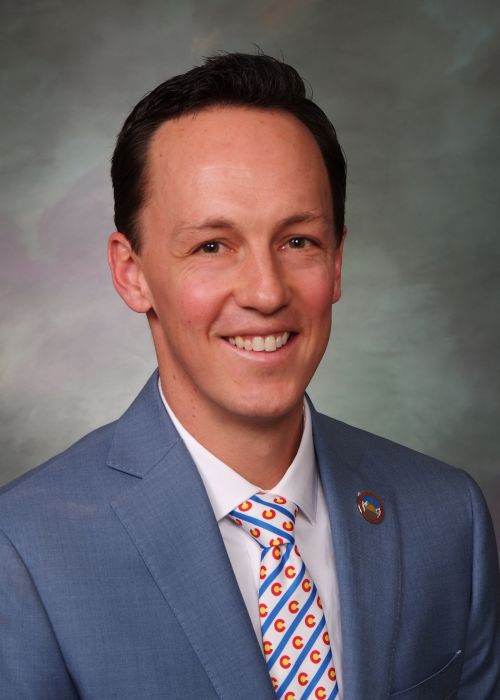
Sen. Dylan Roberts
Sponsored bills
Under current law, a board of county commissioners or governing body of a municipality (local government) may authorize the use of graywater within its jurisdiction. Graywater refers to certain types of wastewater that is collected from fixtures before it is treated and put to certain beneficial uses. The act authorizes the installation of graywater treatment works in new construction projects and the use of graywater statewide; except that a local government: May adopt an ordinance or a resolution prohibiting the installation of graywater treatment works or the use of all graywater or categories of graywater use within its jurisdiction; and Shall notify the division of administration in the department of public health and environment of any such local ordinance or resolution adopted and of any local ordinance or resolution adopted that authorizes a use of graywater previously prohibited. APPROVED by Governor May 29, 2024 EFFECTIVE January 1, 2026(Note: This summary applies to this bill as enacted.)
A coal transition community is a Colorado municipality, county, or region where a Colorado coal-fueled electrical power generating plant that was in operation at any time in 2017, a Colorado coal mine that was actively producing at any time in 2017, or a center for the manufacturing or transportation supply chain of such a plant or coal mine was or is located. Section 2 of the act expands the duties of the rural opportunity office in relation to coal transition communities by requiring the rural opportunity office, in coordination with county commissioners, municipal officials, local chambers of commerce and economic development organizations, institutions of higher education, private industry, and any local organizations dedicated to increased rail usage, to pursue opportunities for new, early stage, and existing businesses and support business and industry development and economic diversification in coordination with workforce training opportunities and existing state and federal programs that are designed for coal transition communities. Section 3 prohibits contracts for the right to use the Moffat tunnel for more than 99 years. Section 4 allows the department of local affairs to convey or transfer ownership of all tangible property, real and personal, or any interest in property owned by the Moffat tunnel improvement district for less than fair market value if the department of local affairs finds that such a conveyance and transfer is in the public interest. Section 5 creates 2 income tax credits. The first income tax credit is a fully refundable income tax credit (freight tax credit). The freight tax credit incentivizes taxpayers to incur costs in the use of freight rail transportation of freight that either originates or terminates at a business located in a coal transition community and on a rail line in this state that the department of transportation has determined is at risk of inactivity or abandonment due to a lack of demand resulting from coal transition (relevant costs). The Colorado office of economic development (office) administers the freight tax credit and may annually reserve up to $5 million worth of tax credits on or after January 1, 2025, but prior to January 1, 2036. A taxpayer must apply to the office for the reservation of the freight tax credit. After the office reserves the freight tax credit for a taxpayer, the office may issue the taxpayer a tax credit certificate in an amount equal to 75% of the relevant costs both stated in the taxpayer's tax credit application and incurred by the taxpayer. The second income tax credit created in section 5 is also a fully refundable income tax credit (operator tax credit). The operator tax credit incentivizes railroad operators to maintain rail line access to coal transition communities. For income tax years 2027 through 2037, a common carrier engaged in the transportation of freight on a rail line designated by the department of transportation (department) as a "qualified rail line" is allowed a credit in an amount stated in a tax credit certificate issued by the department. The amount in a tax credit certificate must not exceed 75% of the direct operating and capital improvements necessary to maintain or improve a qualified rail line as stated in the taxpayer's tax credit application and incurred by the taxpayer. The department is required to designate a rail line as a qualified rail line if the department determines that the rail line is at risk of inactivity or abandonment and is covered by an access agreement for passenger rail access. A taxpayer must apply to the department for the issuance of an operator tax credit certificate. The department may annually issue up to $5 million of operator tax credits. The operator tax credit is subject to recapture if the taxpayer does not meet one or more of the service criteria specified in an access agreement for the qualified rail line. Current law establishes a number of criteria for any municipality, county, or group of contiguous municipalities or counties to propose an area of such municipality, county, or group of municipalities or counties to be designated as an enterprise zone. Section 6 allows an area that is both a rural area and a tier one transition community, as defined by law, to be proposed as an enterprise zone. A business in an enhanced rural enterprise zone can earn a tax credit for hiring new employees. Section 7 designates the portion of any county that is a tier one transition community as an enhanced rural enterprise zone. APPROVED by Governor May 29, 2024 EFFECTIVE August 7, 2024(Note: This summary applies to this bill as enacted.)
Beginning July 1, 2025, the act requires the department of health care policy and financing (state department) to provide reimbursement to certain medicaid members (member) for the use of telehealth remote monitoring for outpatient services. The department shall initiate a stakeholder process to determine the billing structure prior to providing reimbursement. The act creates the telehealth remote monitoring grant program to provide grants to outpatient health-care facilities located in a designated rural county or designated provider shortage area to assist with the costs of providing telehealth remote monitoring for outpatient clinical services. The state department may award up to five grants worth $100,000 each. Beginning November 1, 2025, the act requires the state department to provide coverage for continuous glucose monitors to medicaid medical and pharmacy benefit members. For the 2024-25 state fiscal year, the act appropriates $34,128 to the department of health care policy and financing to implement this act. APPROVED by Governor May 29, 2024 EFFECTIVE August 7, 2024(Note: This summary applies to this bill as enacted.)
The act continues the rural jump-start zone grant program (grant program) until July 1, 2025, and the grant money in the rural jump-start grant fund account reverts to the general fund on June 30, 2025. The act changes the total allowable administrative cost of the grant program from $100,000 per fiscal year to $300,000 total for the sum of all fiscal years that the grant program is in effect. The new business income tax credit and the new hire income tax credit, which are benefits under the grant program, are extended for 5 years and are available for income tax years commencing before January 1, 2031. The act prohibits the Colorado office of economic development (office) from approving more than 3 rural jump-start zones in counties with populations of less than 100,000 in any year. The number of credit certificates that the office may issue in each approved rural jump-start zone in one income tax year for all new hires employed by all new businesses is increased from 300 to 600 for businesses that are in one of the 14 industries that the office targets for economic development in the state. The act appropriates $873,304 from the rural jump-start zone grant fund account to the office of the governor for use by economic development programs. To implement the act, the office may use this appropriation for rural jump-start. APPROVED by Governor May 29, 2024 EFFECTIVE May 29, 2024(Note: This summary applies to this bill as enacted.)
The act requires the water quality control commission (commission) in the department of public health and environment (department) to promulgate rules by December 31, 2025, as necessary to implement a state dredge and fill discharge authorization program (program) and requires the division of administration (division) in the department to administer and enforce authorizations for activities that will result in discharges of dredged or fill material into state waters. The rules must focus on avoidance and minimization of adverse impacts and on compensation for unavoidable adverse impacts of dredge and fill activity (activity) and must incorporate the guidelines developed pursuant to section 404 (b)(1) of the federal "Clean Water Act", unless the commission determines, based on a demonstration at a public rule-making hearing, that the guidelines are not protecting state waters. The act specifies certain content that the commission must include in the rules and other content that the commission may include in the rules. The act establishes duties for the division in administering the program. The division must issue individual authorizations consistent with the rules promulgated by the commission. The division must act upon an application for an individual authorization within 2 years after receiving a complete application, although this period may be extended under certain circumstances. The division must issue general authorizations for the discharge of dredged or fill material into state waters from certain categories of activities that are similar in nature and have minimal individual and cumulative adverse impacts on state waters and the environment. Beginning January 1, 2025, until the rules are promulgated and the division issues general authorizations under the rules, the nationwide and regional general permits issued by the United States Army corps of engineers constitute valid authorizations to discharge dredged or fill material into state waters that are not subject to federal jurisdiction. As expeditiously as is prudent and feasible, the division must issue a statewide general authorization for discharges to isolated wetlands, isolated ponds and impoundments, and isolated ordinary highwater mark reaches (isolated state waters). The statewide general authorization to isolated state waters does not include certain state waters, must identify best management practices to protect isolated state waters, must not require preconstruction notification, and must not authorize a project where the entire project's unavoidable adverse impacts exceed one-tenth of an acre of wetlands or three-hundredths of an acre of streambed. The authorization term of the statewide general authorization for discharges to isolated state waters is 5 years. The division must include compensatory mitigation requirements in all individual authorizations and in general authorizations where the division determines that the proposed discharge of dredged or fill material will result in greater than one-tenth of an acre of unavoidable adverse impacts to wetlands or greater than three-hundredths of an acre of unavoidable impacts to streams. Compensatory mitigation must compensate for all functions of state waters that will be lost as a result of the authorized activity. The division must utilize the existing structure of preconstruction notifications in the nationwide and regional permits established by the United States Army corps of engineers, including general authorizations for categories of activities that do not require preconstruction notification. The division may include conditions in a notice of authorization, on a case-by-case basis, to clarify the terms and conditions of a general authorization or to ensure that an activity will have only minimal individual and cumulative adverse impacts on state waters. The division may establish guidance to assist in administering the program. The division may, to the extent resources allow, establish one or more staff positions in the western slope region of the state to assist with dredge and fill program administration in that geographic area. Until the rules become effective and the division issues general authorizations under the rules: The division's Clean Water Policy 17, "Enforcement of Unpermitted Discharges of Dredged and Fill Material into State Waters", continues to be effective; For certain activities, the division may issue temporary authorizations for the discharge of dredged or fill material into state waters; and Temporary authorizations must not exceed 2 years and must include conditions necessary to protect the public health and the environment and to meet the intent of the act. The act deems certain activities exempt and therefore does not require a discharge authorization for, or otherwise require regulation of, such activities. The act also excludes certain types of waters from the act's regulatory requirements. The act clarifies that "state waters" includes wetlands. For the 2024-25 state fiscal year and for each state fiscal year thereafter, if the total number of issued authorizations exceeds or is projected to exceed 110 authorizations, the department must seek a supplemental appropriation from the general assembly to pay the costs of processing the authorizations and to ensure that authorizations are processed in a timely manner. The act requires the commission to establish by rule on or before December 31, 2025, authorization fees for the program. Collected fees are credited to the existing clean water cash fund. In current law, with certain exceptions, an applicant for any water diversion, delivery, or storage facility that requires an application for a permit, license, or other approval from the United States must inform the Colorado water conservation board, the parks and wildlife commission, and the division of parks and wildlife of its application and submit a mitigation proposal. The act extends the same requirement to applicants for certain activities that require an individual authorization from the division. Current law requires the division to report annually to the general assembly concerning water quality control matters. The act requires the division to include in this annual report certain specific information concerning the implementation of the program. On a quarterly basis, the division must also report to the joint budget committee the number of individual dredge and fill authorizations and notices of authorization that the division projects to issue for the fiscal year. For the 2026-27 state fiscal year and for each state fiscal year thereafter, the state treasurer must transfer $248,304 from the general fund to the clean water cash fund. On July 1, 2024, the state treasurer must transfer $748,000 from the severance tax operational fund to the clean water cash fund for use by the department in administering the program. For the 2024-25 state fiscal year, the act appropriates $747,639 to the department from the clean water cash fund. Any money not expended prior to July 1, 2025, is further appropriated to the department for the 2025-26 state fiscal year. APPROVED by Governor May 29, 2024 EFFECTIVE May 29, 2024(Note: This summary applies to this bill as enacted.)
The act implements the recommendations of the department of regulatory agencies in its sunset review and report on the high cost support mechanism, established by the public utilities commission to support telecommunications service access, by continuing the high cost support mechanism indefinitely and continuing funding for rural telecommunications providers from the high cost support mechanism indefinitely. The act modifies the computation of fees for the public utilities commission fixed utility fund and the telecommunications utility fund. APPROVED by Governor May 28, 2024 EFFECTIVE August 7, 2024(Note: This summary applies to this bill as enacted.)
Before transferring or negotiating to transfer any subdivision or part of a subdivision, a developer is required to apply for registration with the real estate commission (commission). Current law requires that, with permission from the commission, any reservation fees that a developer receives from prospective purchasers while the developer's registration application is pending must be held in trust by a third party and be fully refundable. If the subdivision is a time share estate, the act requires that, after the commission has approved a developer's registration application, any earnest money received by the developer from a prospective purchaser must be held in trust by an independent third party. The act creates an exception to this requirement for earnest money deposits received from an accredited investor. A developer may use funds from an accredited investor's deposit for development purposes only if the purchase contract or other written disclosure clearly sets forth: To whom the funds will be delivered; When the delivery will occur; How the funds will be used; and Any restrictions on the use of the funds. APPROVED by Governor May 28, 2024 EFFECTIVE August 7, 2024(Note: This summary applies to this bill as enacted.)
The act implements the recommendations of the department of regulatory agencies (department) concerning the mortuary science code (code), as the recommendations are specified in the department's sunset review of the registration of funeral establishments and crematories, with amendments, as follows: Continues registration of funeral establishments and crematories and the title protection of mortuary science practitioners, funeral directors, embalmers, and cremationists until 2029; Requires the inspection of funeral homes and crematories on a routine basis, for a period of time after the business has ceased operations, and upon applying for a registration for the purpose of ensuring compliance with the code during this time; Repeals the limitation on the authority of the director of the division of professions and occupations (director) to inspect funeral homes and crematories only during business hours; Expands the director's authority to promulgate rules to include any rules necessary to administer the code; Repeals the code's stakeholder engagement provisions for rule-making to allow the "State Administrative Procedure Act" to control stakeholder engagement; Adds the failure to respond to a complaint within the appropriate time to the grounds for discipline; Repeals the requirement that a letter of admonition be sent by certified mail; Authorizes the director to suspend the registration of a person that fails to comply with a condition of a stipulation or order until the person complies with the condition; Replaces the term "applicant" with the term "person" in the title-protection provisions for funeral directors, embalmers, and cremationists; and Removes gendered language from the code. The act authorizes discipline to be imposed on a registration applicant or holder for the acts of a person acting on behalf of the applicant or holder and who is an officer, a director, a member, a partner, or an owner and holds an interest in the applicant or holder. The interest must be at least 10% if the applicant or holder is publicly traded. The act also requires a funeral establishments to: Have a written contract with all subcontractors or agents and update the language required in contracts for funeral services, respectively; Maintain a sanitary preparation room; Refrain from taking custody of more human remains than the funeral establishment has capacity to refrigerate; and Obtain and maintain professional liability insurance with liability limits of at least $1,000,000. The act requires a cremationist to remove all of the recoverable residue of the cremation process from the crematory and place the residue in a separate container so that the residue does not commingle with the cremated remains of other individuals. For the 2024-25 state fiscal year, $339,196 is appropriated to the department from the division of professions and occupations cash fund to implement the act. APPROVED by Governor May 24, 2024 EFFECTIVE May 24, 2024(Note: This summary applies to this bill as enacted.)
The act requires an individual to obtain a license to practice as a funeral director, a mortuary science practitioner, an embalmer, a cremationist, or a natural reductionist (mortuary science professional). The director of the division of professions and occupations (director) is required to promulgate rules for such licensing. To be licensed, an individual must submit an application, pay an application fee, obtain a fingerprint-based criminal history record check, not have been subject to discipline in another state or convicted of a disqualifying crime, and meet the following qualifications: For a funeral director, the applicant must have graduated from an accredited mortuary science school, have successfully passed the arts section of a national board examination, and have received workplace learning experience of one year or longer; For a mortuary science practitioner, the applicant must have graduated from an accredited mortuary science school, have successfully passed both the arts and science sections of a national board examination, and have received workplace learning experience of one year or longer; For an embalmer, the applicant must have graduated from an accredited mortuary science school, have successfully passed the science section of a national board examination, and have received workplace learning experience of one year or longer; and For a cremationist or natural reductionist, the applicant must have received official certification as a crematory operator from the Cremation Association of North America, the International Cemetery, Cremation and Funeral Association, the National Funeral Directors Association, or a successor organization. An applicant may file for a waiver of the educational requirements and obtain full licensure upon completion of an examination. A current practitioner may apply for a provisional license if the practitioner does not meet the new requirements. To obtain a provisional license, an applicant must have obtained at least 4,000 hours of work experience, have received workplace learning experience of one year or longer, and pass a fingerprint-based criminal history record check. An individual who holds a provisional license without being subject to discipline may obtain full licensure by satisfying certain criteria. A provisional license expires after 3 years unless the director approves a reinstatement or extension of the provisional license. The act establishes administrative procedures for renewing a license. To renew a license, a license holder must obtain 6 hours of continuing education including: One hour covering the applicable law; One hour covering applicable ethics; and One hour covering public health requirements. The act updates existing law concerning title protection to require a person to hold the appropriate license in order to use the title "funeral director", "mortuary science practitioner", "embalmer", "cremationist", or "natural reductionist". The act establishes grounds for disciplining an applicant or license holder and authorizes the director to take disciplinary actions against an applicant or a license holder. The director may also seek an injunction to enforce the act. An employer of a mortuary science professional must report to the director any termination, disciplinary action, or resignation if any of these actions were taken for conduct that violates the act. The director may bring an action for the enforcement of an order of the director. The act repeals the regulation of the practice of mortuary science professionals, effective September 1, 2031. Before the repeal, the regulation will undergo a sunset review and report. The act appropriates $121,166 to the department of regulatory agencies from the division of professions and occupations cash fund to implement the act. APPROVED by Governor May 24, 2024 EFFECTIVE May 24, 2024(Note: This summary applies to this bill as enacted.)