

The bill creates a tax incentive program to be administered by the department of agriculture and the department of revenue to encourage local food and beverage retailers to purchase agricultural commodities from local producers practicing regenerative agriculture. For income tax years commencing on or after January 1, 2024, but before January 1, 2029, January 1, 2026, but before January 1, 2031, qualifying retailers that purchase produce and animal products from qualifying local producers are allowed an income tax credit in an amount equal to 25% of the total amount paid for all such purchases by the qualifying retailer in the income tax year in accordance with the requirements and limitations set forth in section 2 of the bill. Section 3 makes a conforming amendment to allow the exchange between the department of agriculture and the department of revenue of otherwise confidential tax information pertinent to an income tax credit claim allowed pursuant to section 2. To claim the credit, a qualifying retailer must annually apply for and receive a tax credit certificate from the department of agriculture, which tax credit certificate must then be filed with the department of revenue. The department of agriculture shall not issue tax credit certificates that exceed an aggregate amount of $2,500,000 in a calendar year. Moreover, notwithstanding any other provision of the bill, if the June 2025 revenue forecast and each June revenue forecast thereafter through the June 2029 forecast, as prepared by either legislative council staff or the office of state planning and budgeting, projects that state revenues will not increase by at least 4% for the next fiscal year, then the amount of the credit any qualifying retailer may claim pursuant to the bill in said next fiscal year is reduced by 50%; except that, if the amount of a reduced tax credit is equal to or less than $500, then the department of agriculture shall not issue a tax credit certificate at all. (Note: Italicized words indicate new material added to the original summary; dashes through words indicate deletions from the original summary.) (Note: This summary applies to the reengrossed version of this bill as introduced in the second house.)
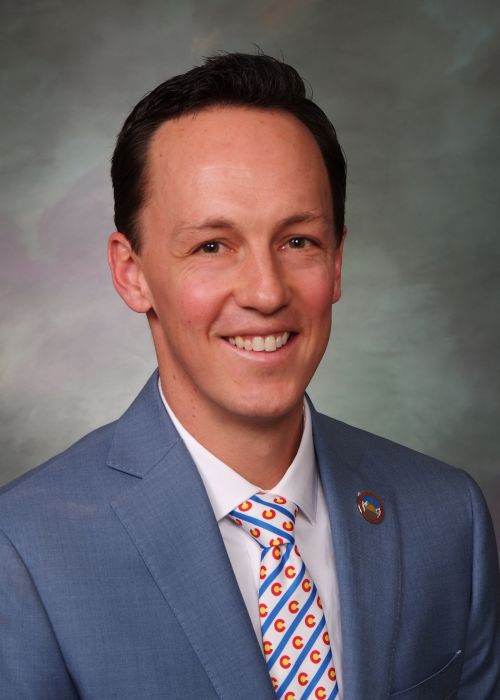
Sen. Dylan Roberts
Sponsored bills
The act removes an automatic repeal to permit businesses licensed to sell alcohol beverages at retail by the drink to deliver these beverages or to allow the customer to take these beverages from the licensed premises after July 1, 2025. A hotel and restaurant licensee or tavern licensee is prohibited from allowing takeout and delivery of alcohol beverages in a sealed manufacturer's container without the assistance of the license holder's employee, unless the license holder is a lodging establishment. APPROVED by Governor May 10, 2024 EFFECTIVE August 7, 2024(Note: This summary applies to this bill as enacted.)
Sections 1 and 2 of the bill eliminate the liquor-licensed drugstore license, effective January 1, 2025. All active liquor-licensed drugstore licenses will convert to a fermented malt beverage and wine retailer license on that date; except that a licensee with a single location may choose to convert the liquor-licensed drugstore license to a retail liquor store license. Section 3 of the bill prohibits the state and local licensing authorities from issuing new liquor-licensed drugstore licenses. The state and local licensing authorities may renew liquor-licensed drugstore licenses that are in effect on the effective date of the bill. Sections 18 21 through 29 make conforming amendments to account for the removal of the liquor-licensed drugstore license prohibition on the issuance of new liquor-licensed drugstore licenses . Sections 3 and 4 require 4 and 5 prohibit fermented malt beverage and wine retailers to display from displaying alcohol beverages for sale in a single location in certain locations on the licensed premises and prohibit fermented malt beverage and wine retailers from selling alcohol fermented malt beverages with greater than 14% 17% alcohol by volume. Sections 5 and 6 6 and 7 expand on a wholesaler's duty not to discriminate when selling products to retailers and allows the state licensing authority to recover the cost of enforcing the anti-discrimination laws from a person found in violation of the anti-discrimination laws. Current law limits the amount of alcohol beverages certain retailers can purchase from retail liquor stores, liquor-licensed drugstores, and fermented malt beverage and wine retailers to $2,000 dollars' worth of alcohol beverages each calendar year . Sections 7 through 17 remove 8 through 18 and 22 increase the cap as it applies purchases by certain retailers from retail liquor stores to $5,000 worth of alcohol beverages each calendar month . Section 22 allows retail liquor stores to purchase $5,000 worth of alcohol beverages from other licensed retail stores each calendar month. For the delivery of alcohol beverages: Section 4 5 prohibits fermented malt beverage and wine retailers from delivering alcohol beverages to another person licensed to sell alcohol beverages; and Section 24 22 removes the prohibition on a retail liquor store delivering alcohol beverages to another retail liquor store. Section 18 19 allows automated teller machine (ATM) cards associated with public assistance programs to be used at ATMs in grocery stores. (Note: Italicized words indicate new material added to the original summary; dashes through words indicate deletions from the original summary.) (Note: This summary applies to the reengrossed version of this bill as introduced in the second house.)
The act extends immunity from civil liability for damage or injury, other than that which arises from gross negligence or willful misconduct, to an individual, nonprofit organization, for-profit corporation, private organization, or other person (person) that voluntarily operates or arranges for the use of a helicopter, or assists as a helicopter crew member, during backcountry search and rescue operations (search and rescue operations), if the person: Arranges for the use of or operates, or assists as a crew member of, the helicopter on behalf of the governmental entity that is leading the search and rescue operation; Has an agreement with the governmental entity; Is, employs, or otherwise contracts with a pilot that is properly licensed to operate the helicopter; Is not compensated by the governmental entity for assisting in the search and rescue operation, other than reimbursement for actual expenses incurred; and Meets certain safety and training certifications and requirements. The act also establishes criteria that volunteer helicopter pilots and the helicopters used in search and rescue operations must satisfy in order for the volunteer helicopter owner or operator to qualify for immunity under the act. The act establishes the airspace deconfliction working group within the department of public safety. The working group consists of representatives from the department of public safety, the department of military and veterans affairs, and county sheriffs' offices. The working group must develop guidelines for airspace deconfliction when there could be multiple aircraft involved in a search and rescue operation. APPROVED by Governor May 3, 2024 EFFECTIVE May 3, 2024(Note: This summary applies to this bill as enacted.)
Prior to the consolidation of the division of wildlife and the division of parks and recreation and their respective commissions in Senate Bill 11-208, concerning the consolidation of wildlife entities with parks and outdoor recreation entities under the department of natural resources, enacted in 2011, members of the wildlife commission were required to hold at least 2 public meetings per year in their respective geographic districts. The act renews the public engagement requirement for the members of the parks and wildlife commission in the department of natural resources who are appointed by the governor and adds the same public engagement requirement for members of the state agricultural commission and the Colorado water conservation board who are appointed by the governor. Commission and board members subject to the public engagement requirement are entitled to reimbursement for their reasonable costs in participating in public meetings. Status updates on the commission and board members' compliance with the public engagement requirement must be reported to the chair of each member's respective commission or board and included in each member's respective executive department's annual "SMART Act" presentation to the general assembly. For the 2024-25 state fiscal year, $10,504 is appropriated to the department of natural resources for use by the division of parks and wildlife to implement the act, with $6,828 of the money appropriated from the wildlife cash fund and $3,676 from the parks and outdoor recreation cash fund. APPROVED by Governor May 1, 2024 EFFECTIVE January 1, 2025(Note: This summary applies to this bill as enacted.)
The Colorado supreme court approved the licensure of legal paraprofessionals (LLPs), which allows LLPs to represent clients and perform certain types of legal services related to domestic relations matters, including: Legal separations, declarations of invalidity of marriage, or dissolutions of marriage or a civil union; Initial allocations or modifications of an allocation of parental responsibility, including parentage determinations; Matters involving establishment or modification of child support or maintenance; Seeking, modifying, or terminating a civil protection order; Matters involving a name change; and Matters involving a request for an amended birth certificate to change the sex designation of an adult. The act amends the relevant statutory provisions to align with the Colorado supreme court rule authorizing the licensure of LLPs. APPROVED by Governor April 29, 2024 EFFECTIVE August 7, 2024(Note: This summary applies to this bill as enacted.)
The act adopts, in part, the National Association of Insurance Commissioners' travel insurance model act (model act), which provides a legal framework within which travel insurance must be sold in Colorado. The "Travel Insurance Model Act" applies to travel insurance that covers a resident of Colorado; that is sold, solicited, negotiated, or offered in Colorado; and for which the policies and certificates are delivered or issued for delivery in Colorado. With respect to the model act, the act: Requires an insurer to pay premium tax on travel insurance premiums paid by specified persons; Requires consumer disclosures for travel protection plans and requires insurers to send fulfillment materials and specific contact information for persons providing travel assistance services and cancellation fee waivers; Declares the following practices unfair or deceptive practices: Offering or selling travel insurance that could never result in the payment of any claims for the insured; and Marketing blanket travel insurance coverage as free; Requires travel insurance documents to be consistent with the travel insurance policy, including forms, rate filings, and certificates of insurance; Requires disclosure of preexisting condition exclusions prior to the purchase of travel insurance and in the coverage fulfillment materials; Unless the trip for which the travel insurance was purchased has commenced or the policyholder has filed a claim, allows the policy to be cancelled and the cost refunded within a specified time period; Prohibits the use of a negative option or "opt out" that requires the consumer to take affirmative action to deselect coverage; Allows mandated coverage when the consumer's travel destination requires travel insurance as a condition of purchasing the trip or travel package; Prohibits a person from acting as or representing that the person is a travel administrator, unless the person is a licensed insurance producer for property and casualty insurance in Colorado for activities permitted under that license; and Allows travel insurance that provides certain coverage to be filed under either an accident and health line of insurance or an inland marine line of insurance. Further, the act makes conforming changes to existing law relating to licensing limited lines travel insurance producers and registering travel retailers. Specifically, the act: Expands the definition of "limited lines travel insurance producer" to include a "travel administrator"; Includes in the definition of "travel insurance", coverage for emergency evacuation, repatriation of remains, and, as approved by the commissioner of insurance, any other personal risks relating to travel; Prohibits a person from acting as a limited lines travel insurance producer or travel retailer unless the person is licensed or registered, respectively; Specifies that the grounds for suspension and revocation and the penalties applicable to resident insurance producers are applicable to limited lines travel insurance producers and travel retailers; and Authorizes a person licensed in a major line of authority as an insurance producer to sell, solicit, and negotiate travel insurance under an individual, group, or blanket policy. The model act codified in this act does not include provisions that are inapplicable to Colorado, including provisions relating to third-party administrators and managing general agents. Further, unlike the model act, the act requires that an insurer offering or selling travel insurance that provides coverage for sickness, accident, disability, or death occurring during travel, emergency evacuation, or repatriation of remains hold both property and casualty and accident and health lines of authority. APPROVED by Governor April 29, 2024 EFFECTIVE August 7, 2024(Note: This summary applies to this bill as enacted.)
Water Resources and Agriculture Review Committee. The bill authorizes a raw milk producer (producer) that registers with the department of public health and environment (department) to engage in direct-to-consumer sales of raw milk in the state if the producer complies with certain labeling, storage, handling, and transportation requirements. The direct-to-consumer sales may take place at the location where the raw milk is produced, at the consumer's residence, or at a farmers' market or roadside market. The bill authorizes the department of agriculture to: Adopt rules related to the storage, handling, and transportation of raw milk intended for sale directly to consumers; Inspect producers' raw milk and operations; Enforce against a violation in court or by imposition of a civil penalty.(Note: This summary applies to this bill as introduced.)
The act limits the sale or transfer of a product containing sodium nitrite in a concentration greater than 10% of the mass or volume of the product (covered product) to commercial businesses that are verified to require a covered product. The act requires covered products to meet specified labeling requirements. A person who violates the requirements of the act is subject to a civil penalty of $10,000 for a first offense and up to $1,000,000 for a second or subsequent violation. The attorney general or an aggrieved individual may bring a civil action to enforce the act and, if an aggrieved individual prevails in a civil action, the aggrieved individual is entitled to the greater of actual economic damages or $3,000, attorney fees, and costs. APPROVED by Governor April 17, 2024 EFFECTIVE July 1, 2024(Note: This summary applies to this bill as enacted.)