

Under current law, each member of a board of directors of an irrigation district (board of directors) and each judge of election of an irrigation district (judge of election) receives compensation of not more than $100 per day. In addition, a contract entered into by a board of directors that involves a consideration that exceeds $250,000 but does not exceed $400,000 must be authorized and ratified in writing by no less than one-third of the electors of the irrigation district according to the number of votes cast at the last district election. A contract that exceeds $400,000 must be authorized and ratified at an election in the manner provided for the issuance of bonds. To account for inflation, the act: Increases the amount of compensation for members of a board of directors and judges of election to up to $150 per day; and Requires that, to be binding, a contract entered into by a board of directors that exceeds $400,000 but does not exceed $650,000 must be authorized and ratified in writing by no less than one-third of the electors of the irrigation district according to the number of votes cast at the last district election, and a contract that exceeds $650,000 must be authorized and ratified at an election in the manner provided for the issuance of bonds. The act requires that the dollar amounts related to compensation of members of a board of directors and judges of election, as well as those related to contracts entered into by a board of directors, must be increased for inflation every 5 years, beginning July 1, 2029. (Note: This summary applies to this bill as enacted.)
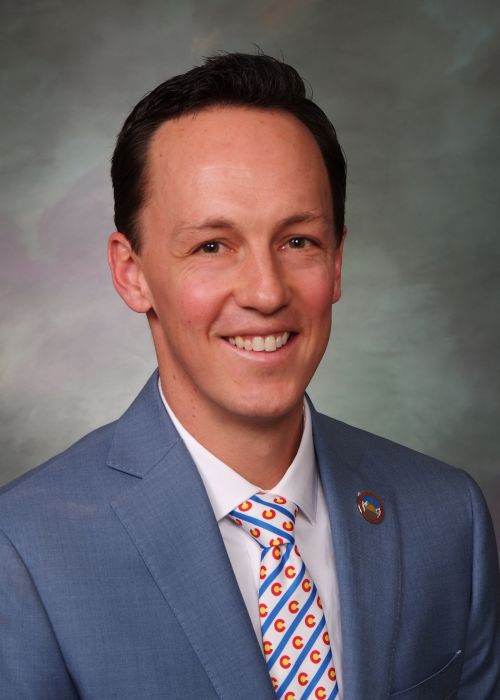
Sen. Dylan Roberts
Sponsored bills
The prosecution fellowship program in the department of higher education provides money to the Colorado district attorneys' council (CDAC) to fund fellowships for persons who have recently graduated from a law school in Colorado to allow them to pursue careers as prosecutors in rural Colorado. The program, through a prosecution fellowship committee, places up to 6 fellows in rural district attorneys' offices throughout the state each year. The act changes the prosecutor fellowship program to provide fellowship funding to rural district attorneys' offices to recruit and hire new deputy district attorneys rather than selecting and placing fellows in rural district attorneys' offices. The selected offices then use the money to recruit and hire new district attorneys. The act requires the prosecution fellowship committee to determine which rural district attorneys' offices receive funding. On or before January 1, 2028, CDAC shall provide a report to the judiciary committees regarding the prosecutor fellowship program. (Note: This summary applies to this bill as enacted.)
Colorado statute states that a marriage is valid only if it is between one man and one woman. That provision has been unenforceable since the United States Supreme Court decision in Obergefell v. Hodges , 576 U.S. 644 (2015), in which the Court ruled that same-sex couples have a fundamental right to marry. The act repeals the provision.(Note: This summary applies to this bill as enacted.)
Current law authorizes public hospitals with fewer than 50 beds to enter into collaborative agreements with other hospitals or hospital affiliates to engage in activities to increase access to health care. The act changes the law to allow public and private, nonprofit hospitals that are not owned by or affiliated with a health system that is comprised of 3 or more hospitals to enter into collaborative agreements. (Note: This summary applies to this bill as enacted.)
The act requires an individual who is licensed to practice medicine or licensed to practice as an advanced practice registered nurse to make certain disclosures to patients if the individual delegates medical-aesthetic services to an individual who is not a licensed health-care provider. (Note: This summary applies to this bill as enacted.)
Maddy summarySJR 25-008 designates March 3, 2025, as "Buy Colorado Day" (also called "303 Day") and March 3-10, 2025, as "Buy Colorado Week" to encourage Coloradans to support local businesses. The resolution urges residents to spend money at homegrown Colorado brands and enterprises, highlighting the state's diverse business community including restaurants, breweries, agricultural producers, and retailers. This symbolic measure has no legal force and serves as a recognition of Colorado's economic contributions, not a new policy or requirement. It directly affects all Coloradans by promoting a voluntary shift in consumer behavior toward local spending.
Maddy summarySJR 25-018 recognizes April 2025 as Sexual Assault Awareness Month and designates April 30, 2025, as Colorado Denim Day. The resolution symbolically supports the annual Denim Day observance, which began in Colorado in 2013, to raise awareness about sexual violence and honor the work of organizations like the Colorado Coalition Against Sexual Assault (CCASA). It highlights ongoing challenges such as evidence kit backlogs and the need for survivor support services, without creating new laws or funding. This is a ceremonial resolution, not a policy change, aligning Colorado with the global Denim Day movement that uses wearing jeans to protest attitudes condoning sexual assault.
Maddy summaryThis symbolic resolution designates March 21 as "Single Parent Day in Colorado" to recognize single parents' efforts in raising children. It directly honors single parents across the state, referencing U.S. Census data showing over 10 million single-parent households nationwide. The resolution continues Colorado's recognition of the day, aligning with President Reagan's 1984 national declaration. It has no policy or funding provisions - it is purely a commemorative gesture without legal or financial impact.
Maddy summarySenate Resolution 25-008 designates March 31 of each year as "Transgender Day of Visibility" in Colorado. The resolution commits the Colorado Senate to defending transgender rights in health care, education, employment, housing, and civic participation while acknowledging Colorado's historical role in providing gender-affirming care. It also expresses solidarity with transgender people and other marginalized groups facing rights challenges. This symbolic resolution does not create new laws or funding but serves as a formal public affirmation of support for transgender Coloradans.
The act eliminates the statutory cap on the number of veterinary students permitted to attend Colorado state university at one time. The act eliminates additional financial limitations related to the professional veterinary medicine program at Colorado state university, including eliminating the university's bonding authority with respect to the veterinary medicine program. (Note: This summary applies to this bill as enacted.)