

Under current law, an investor-owned electric utility (utility) may apply to the public utilities commission (commission) for approval to charge certain commercial or industrial customers of the utility an economic development rate (economic development rate), which is a reduced rate offered to a commercial or industrial customer that locates or expands their operations in Colorado, that adds at least 3 megawatts of new load at a single location within the utility's service territory, and that demonstrates certain other requirements to the satisfaction of the utility (qualifying commercial or industrial customer). The act makes adjustments to the requirements for an economic development rate by: Requiring that an approved economic development rate not increase costs of electric service for other customers; Clarifying that an approved economic development rate does not relieve a utility of its obligation to achieve compliance with greenhouse gas emission reduction requirements; Authorizing a utility to apply to the commission for an expansion of the maximum duration of the economic development rate from 10 years to 25 years; Expanding the maximum load at a single location of a qualifying commercial or industrial customer for an individual project that does not require commission approval from 20 megawatts to 40 megawatts; and Updating the application process required for seeking approval of an economic development rate by requiring that the commission: Approve or deny an application within 120 days after a notice period of 14 business days after the application was filed; except that, if the load is more than 150 megawatts, the commission shall approve or deny the application within 210 days after the notice period; and Consider the broader economic benefits associated with the application for other classes of utility customers and for the surrounding community.(Note: This summary applies to this bill as enacted.)
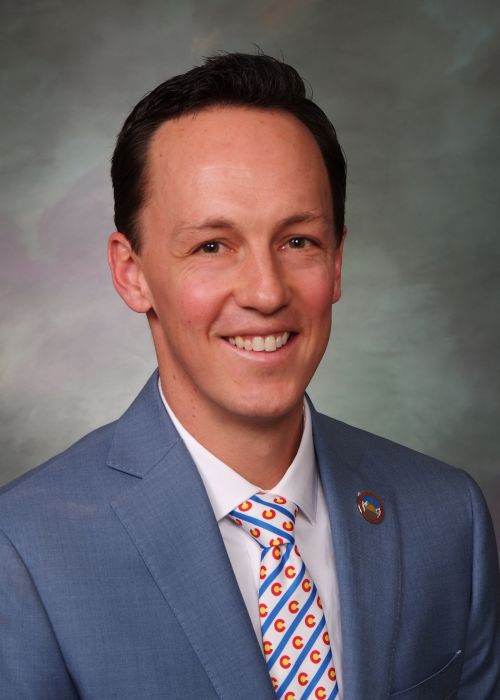
Sen. Dylan Roberts
Sponsored bills
The act authorizes the state treasurer to invest up to $50 million of state money in bonds, which may have below-market interest rates, that are issued by a quasi-governmental authority to create or finance new affordable, income-restricted for-sale housing that would not be made available at similar rates and terms without the state's investment. The housing must remain affordable long-term and be available to borrowers earning no more than 140% of the statewide area median income. The bonds may have a term of up to 45 years and must have at least 2 credit ratings at or above A- or A3 or its equivalent from nationally recognized rating organizations. Money from principal proceeds of such bonds must be reinvested by the state treasurer for the same purpose once the state treasurer has received repayment of 50% of the principal amount invested. The quasi-governmental authority issuing the bonds shall provide an annual report to the treasurer and the general assembly that includes specified information about the affordable housing created with bond proceeds. (Note: This summary applies to this bill as enacted.)
Individuals applying for hunting or fishing licenses in Colorado must also purchase a Colorado wildlife habitat stamp. The division of parks and wildlife in the department of natural resources uses the money collected from the Colorado wildlife habitat stamp for the benefit of wildlife habitat or access to wildlife habitat in the state. The Colorado wildlife habitat stamp program (program) is scheduled to repeal, subject to a sunset review by the department of regulatory agencies, on July 1, 2027. The act continues the program indefinitely. (Note: This summary applies to this bill as enacted.)
The act authorizes the Colorado water conservation board (board) to administer a water supply measurement and forecasting program to collect and disseminate data on snowpack levels, investigate technological advances in snowpack measurement and water supply forecasting, and collect other data that the board determines will assist in those efforts. For the 2025-26 state fiscal year, $104,608 is appropriated to the department of natural resources (department) from the Colorado water conservation board construction fund for the department to implement the act. Of the money appropriated, $15,960 is reappropriated to the office of the governor for use by the office of information technology to provide information technology services for the department. (Note: This summary applies to this bill as enacted.)
The act appropriates the following amounts for the 2025-26 state fiscal year from the Colorado water conservation board (CWCB) construction fund to the CWCB or the division of water resources in the department of natural resources for the following projects: Continuation of the satellite monitoring system, $380,000 (section 1 of the act); Continuation of the floodplain map modernization program, $500,000 (section 2); Continuation of the weather modification permitting program, $500,000 (section 3); Continuation of the Colorado Mesonet project, $200,000 (section 5); Continuation of the water forecasting partnership project, $2,000,000 (section 6); Continuation of the Arkansas river decision support program, $300,000 (section 7); Continuation of technical assistance for the federal irrigation improvement cost-sharing program, $500,000 (section 8); Decision support systems model enhancements to support the Colorado water plan, $1,000,000 (section 9); Support for the basin implementation plan analysis and updates, $4,500,000 (section 10); Continuation of the Colorado watershed restoration and wildfire ready watershed programs, $5,000,000 (section 11); Support for a statewide turf analysis, $1,400,000 (section 12); Support for the Yampa river and Walton creek confluence restoration project, $2,000,000 (section 14); and Support for the south fork focus zone irrigated acreage retirement, $6,000,000 (section 15). Section 4 directs the state treasurer to transfer up to $2,000,000 from the CWCB construction fund to the CWCB litigation fund on July 1, 2025. Section 13 directs the state treasurer to transfer $500,000 from the CWCB construction fund to the plant health, pest control, and environmental protection cash fund on July 1, 2025, and makes an appropriation of that amount to the department of agriculture for use by the conservation services division for the Colorado soil health program. Section 16 authorizes the CWCB to make a loan in an amount of $12,978,500 from the severance tax perpetual base fund to the North Poudre Irrigation Company to support the park creek expansion project. Section 17 appropriates $29,200,000 from the water plan implementation cash fund to the CWCB to award grants that will help implement the state water plan. Sections 18, 19, 20, and 21 eliminate the office of water conservation under the CWCB and the water efficiency grant program, transfer remaining money from the water efficiency grant program cash fund to the severance tax perpetual base fund, and make conforming amendments accordingly. Current law authorizes the governor to appoint a director of compact negotiations. Section 22 states that the governor or the executive director of the department of natural resources shall appoint the director of compact negotiations within 30 days after a vacancy of the position. (Note: This summary applies to this bill as enacted.)
The act creates a permit that is issued by the department of transportation (department). The permit authorizes the holder to, for a fee, install or remove tire chains or alternate traction devices at a location designated in the permit. The department may place conditions on the permit concerning the safe and orderly movement of traffic. The department is instructed to avoid issuing permits in a manner that creates a monopoly-type situation for a permit holder at a specific location. The department may charge a fee to issue a permit to an applicant. The fee must be set in an amount to offset the direct and indirect costs of issuing these permits. The department will adopt rules to implement the act. The rules must include: The procedures for issuing a permit, the procedures for revoking a permit, and the qualifications to be issued a permit; and A requirement that the individuals installing tire chains or alternate traction devices wear reflective clothing and use appropriate signs and traffic control devices. A rental car company is required to notify its car renters of the requirements of and penalties for violating the chain law. Colorado law already authorizes the department to close roads during winter weather conditions unless a motor vehicle meets traction equipment requirements. The act also authorizes a 4-wheel-drive vehicle with tires that are imprinted by a manufacturer with a mountain-snowflake, "M&S", "M+S", or "M/S" symbol or that are all-weather rated by the manufacturer to travel on roads that the department restricts for winter weather conditions. (Note: This summary applies to this bill as enacted.)
As approved by voters in 2019, a tax of 10% is imposed on net sports betting proceeds. For the purpose of calculating its net sports betting proceeds, a sports betting operator or internet sports betting operator (sports betting operator) has been allowed to deduct all payments to players, all federal excise taxes paid, and a certain percentage of free bets placed by players as follows: Between July 1, 2025, and June 30, 2026, no more than 2% of total free bets placed each month; and On and after July 1, 2026, no more than 1.75% of total free bets placed each month. The act alters the percentage of free bets that a sports betting operator is allowed to deduct so that: Between July 1, 2025, and December 31, 2025, no more than 2% of total free bets placed each month may be deducted; and Between January 1, 2026, and June 30, 2026, no more than 1% of total free bets placed each month may be deducted. Beginning on July 1, 2026, the act removes the deduction for all free bets placed. For the 2025-2026 state fiscal year, $17,135 is appropriated from the sports betting fund to the department of revenue for personal services and tax administration IT system support. (Note: This summary applies to this bill as enacted.)
The act creates the future of severance taxes and water funding task force (task force). The department of natural resources is required to contract with a third party to conduct a study on severance taxes and water funding and develop recommendations for ways to continue funding water needs and energy impact grants in the face of decreasing severance tax revenue (study). The study must focus on identifying ways to alleviate the need to transfer revenues derived from severance taxes to the general fund and to replace severance tax revenue that was previously transferred to the general fund. The purpose of the task force is to work with the third party to conduct the study and develop recommendations. No later than January 15, 2026, the third party must submit a draft report, detailing the results of the study and any recommendations, to the department of natural resources and the task force for review. The task force is required to provide input on the draft report. No later than July 15, 2026, the third party must submit a final report, which incorporates the input of the task force, to the water resources and agriculture review committee (committee). The task force must present the final report to the committee during the 2026 legislative interim. The act changes the manner in which a credit allowed against severance tax in taxable years commencing January 1, 2026, but prior to January 1, 2028, is calculated. For the 2025-26 state fiscal year, $198,592 is appropriated from the severance tax operational fund to the department of natural resources to implement the act. (Note: This summary applies to this bill as enacted.)
The act requires all commercial vehicles to have a muffler. The muffler must be located so that it may be visually inspected to ensure it is present, intact, and functioning properly; except that a muffler need not be visible for inspection if certain documentation is present in the commercial vehicle and available for inspection by a peace officer. Standards are set for the necessary documentation. The act increases the fine for a violation from $500 to $1,000. The fine is not imposed if the owner or operator can show that a muffler was installed before the citation was issued and that the muffler complied with the manufacturing noise standards for the model year of the commercial vehicle. The fine is decreased by 50% if a muffler is installed within 30 days after the citation is written. The act applies to commercial vehicles with an internal combustion engine and does not apply to farm vehicles. State agencies must include language in construction contracts stating that a contractor's or subcontractor's commercial vehicle that enters a public project site is required to comply with the act. (Note: This summary applies to this bill as enacted.)
The act requires hospitals, freestanding emergency departments, and licensed health-care facilities that hold themselves out to the public as providing emergency care (facility) to provide emergency medical services to a person who presents to the facility when the person requests or a request is made on the person's behalf for emergency medical services. For each person who presents to a facility and requests emergency medical services or for each request made on the person's behalf for emergency medical services, the act requires the facility to input into a central log whether the person refused treatment or was denied treatment; whether no treatment was required; or whether the person was transferred, admitted and treated, stabilized and transferred, or discharged. The act prohibits a facility from: Denying or discriminating in providing emergency medical services to a patient for a discriminatory or unlawful reason; Penalizing or taking adverse action against a health-care provider for refusing to transfer a patient with an emergency medical condition that has not been stabilized; Delaying providing emergency medical services to a person in order to inquire about the person's ability to pay for the services; and Transferring or discharging a patient with an emergency medical condition unless certain conditions are met. A facility or health-care provider does not violate the act's requirements if certain conditions are met. The act authorizes the department of public health and environment to investigate a facility that negligently violates the requirements of the act. A physician who negligently violates the act engages in unprofessional conduct and is subject to professional discipline. If a civil monetary penalty is imposed, the act requires the maximum civil monetary penalty to be reduced by any civil monetary penalty imposed pursuant to the federal "Emergency Medical Treatment and Active Labor Act" for the same violation. The act appropriates $82,768 from the health facilities general licensure cash fund to the department of public health and environment for use by the health facilities and emergency medical services division. (Note: This summary applies to this bill as enacted.)