

The bill creates the septic-system replacement enterprise (enterprise), which operates as a government-owned business imposing and collecting a fee charged on septic-system permits and using the fee revenue to provide loans to replace failing septic systems (loan program). The enterprise is governed by a board that consists of 7 members appointed by the governor as follows: One member who is a county commissioner in a county that has rural areas; One member who is a member of a county board of health in a county that has rural areas; One member who is a member of a governing body of a municipality that has septic systems; One member who represents the department of public health and environment (department); One member who represents the department of local affairs; One member who represents an association of counties within Colorado and who lives in a rural area; and One member who is a rural homeowner with a septic system. Each member of the board serves at the pleasure of the governor. The term of appointment is 4 years, with some members having staggered terms. Members of the board serve without compensation but are entitled to receive reimbursement for actual and necessary expenses incurred in the performance of the members' duties on the board. The board will meet as necessary. The enterprise will impose a fee on septic-system permits and administer the collection of the fee, and the enterprise may issue revenue bonds, buy and sell property, enter into contracts, sue or be sued, hire employees, set up an office, place liens on property, adopt rules, and take any action necessary to implement the bill. Starting January 15, 2027, and by January 15 each year through 2029, the enterprise will submit a written report to the governor, the joint budget committee, the house of representatives transportation, housing, and local government committee, and the senate local government and housing committee. The report must include: An accounting of the number of loans made under the loan program, the total amount of the loans, the average amount of a loan, and the number of septic systems replaced as a result of the loan program; An evaluation of the loan program; and Any legislative recommendations for the loan program. The enterprise will impose a septic-system enterprise fee on each permit to install or replace a septic system. The fee is: $10 if the fee for the septic-system permit is less than $500; $50 if the fee for the septic-system permit is $500 or more but less than $1,000; $100 if the fee for the septic-system permit is $1,000 or more but less than $1,400; and $200 if the fee for the septic-system permit is $1,400 or more. The enterprise must consult with and coordinate with the water quality control commission (commission) and local boards of health that issue septic-system permits. The division of administration within the department and the local government that issues the permit may retain up to 5% of the fee to cover administrative costs. When the fee revenue is projected to exceed the amount reasonably necessary to implement the loan program and administer the bill, the enterprise shall adjust the amount of the fee so that the revenue will equal the amount of money needed to reasonably administer the loan program. The commission may adopt rules to implement the division of administration's collection of the fee. The fee will be used by the enterprise to establish the loan program, which makes interest-free or low-interest loans to low-income or low-credit-score households to replace failing septic systems. The enterprise will contract with at least 2 community development financial institutions (financial institutions) to administer the loan program. Standards are set for a financial institution to qualify to administer the loan program. The financial institution must enter into a contract with the enterprise. The bill sets contract standards, including authorization for a financial institution to include an administration fee in an amount reasonably calculated to cover the costs to implement the contract. A financial institution will use the money collected from the fee to make loans to eligible homeowners in low-income or low-credit-score households for the purpose of replacing septic systems. The financial institution may establish reasonable standards and procedures to make loans in compliance with the bill and the contract. The enterprise or the department may seek, accept, and expend gifts, grants, or donations from private or public sources to fund the bill. (Note: This summary applies to this bill as introduced.)
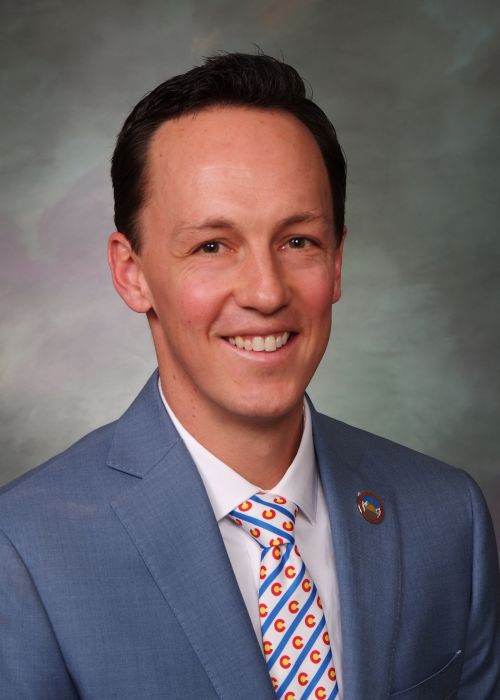
Sen. Dylan Roberts
Sponsored bills
Subject to local voter approval, the act increases the maximum allowed rate of a county lodging tax levied on the purchase price paid or charged to persons for rooms or accommodations from 2% to 6% and expands the allowed uses of lodging tax revenue to include: Public infrastructure maintenance or improvements; or Enhancing public safety measures by funding local law enforcement, fire protection services, and emergency medical services. If a county received voter approval before January 1, 2025, to specifically allocate portions of revenue from the lodging tax to allowed uses for designated purposes, the act clarifies how those previously approved allocations are preserved and how revenue attributable to an increase in the tax rate may be allocated by the county. (Note: This summary applies to this bill as enacted.)
The state board of land commissioners (state board) serves as the trustee for lands granted to the state in public trust for the support of public schools (state trust lands). The state board is responsible for the management and protection of the state trust lands, including by protecting and enhancing the natural features, open space, and wildlife habitat of the state trust lands. The act requires various appointing authorities to appoint members to a state trust lands conservation and recreation work group (work group) to study opportunities to advance conservation and recreation activities on state trust lands as part of the state board's long-term stewardship of the state trust lands while maintaining the state board's fiduciary responsibilities regarding its management of the state trust lands. On or before September 1, 2026, the work group is required to make recommendations to the state board, the governor, the committees of the general assembly with jurisdiction over natural resources matters, and the executive director of the department of natural resources (department) based on the study. On or before February 15, 2027, the state board must take into consideration the work group's recommendations and adopt an administrative policy or rules to establish: A process governing the implementation of conservation leases and related instruments on state trust lands; A process to substantiate how the state board balances revenue generation with conserving the long-term value of state trust lands; A schedule to review and update by December 2028, if necessary, all existing stewardship trust management plans or other applicable plans; and Any other policies or rules the state board deems necessary to implement section 10 of article IX of the state constitution. For the 2025-26 state fiscal year, the act appropriates $393,506 from the state land board trust administration fund to the department for use by the state board. (Note: This summary applies to this bill as enacted.)
The bill creates the Colorado nuclear workforce development and education program (program) in the department of higher education (department) council (council) in the Colorado school of mines to help meet growing workforce demand in the nuclear energy sector. The bill establishes a related grant program (grant program) to provide grants to institutions of higher education for the development or expansion of nuclear engineering degree or certificate programs or course offerings. The Colorado nuclear workforce development and education council shall advise and assist the department regarding the grant program's implementation and evaluation convene advisory sessions with stakeholders from the nuclear, educational, and workforce development sectors; implement the grant program; and contract with one or more third-party entities for staffing and operational assistance . The department may seek, accept, and expend gifts, grants, and donations for program-related council-related purposes. The state treasurer shall credit the gifts, grants, and donations to the Colorado nuclear workforce development and education cash fund (cash fund) , which is created in the bill . The general assembly shall not appropriate general fund dollars to implement or maintain program council operations or grant awards. The department council shall convene and begin awarding grants only after the balance of the cash fund reaches or exceeds $500,000. The bill imposes requirements to report to the general assembly about the program's council's funding sources, grant program implementation , and use other uses of funds. The bill repeals the program council , effective September 1, 2032, unless the program council is extended pursuant to a sunset review. Conditional upon the receipt of sufficient gifts, grants, and donations, for the 2025-26 state fiscal year, the bill appropriates $500,000 from the cash fund to the department of higher education for use by the trustees of the Colorado school of mines. (Note: Italicized words indicate new material added to the original summary; dashes through words indicate deletions from the original summary.) (Note: This summary applies to the reengrossed version of this bill as introduced in the second house.)
The act creates the Colorado Voting Rights Act (state voting rights act) and modifies certain election-related statutes in the following areas: Tribal voting; Ensuring voter access to methods of selecting candidates for the general election; Restrictions on electioneering and election-related activity near voting locations; Election and voting notices in facilities serving individuals with disabilities; Recounts; Election-related language access; and Election-related data collection. Creation of the state voting rights act. The act creates the state voting rights act, which prohibits political subdivisions from: Engaging in voter suppression by taking any action that results in, will result in, or is intended to result in a material disparity between electors who are members of a protected race, color, or language minority group or other minority reporting group (protected class members) and other eligible electors in regard to voter participation, access to voting opportunities, or the opportunity or ability to participate in the political process; Engaging in voter dilution by enacting or employing any method of election that has the effect of, or is motivated in part by the intention of, disparately impairing the opportunity or ability of protected class members to elect the candidates of their choice or otherwise influence the outcome of elections as a result of diluting the vote of protected class members ; Implementing, imposing, or enforcing a voting qualification or another prerequisite to voting based on an individual's actual or perceived gender identity, gender expression, or sexual orientation; or Implementing, imposing, or enforcing an additional voting qualification or another prerequisite to voting based on an individual's confinement to a local jail, other than those eligibility qualifications that already exist. An aggrieved individual or organization (aggrieved person) may file a civil suit alleging voter suppression; voter dilution; an unlawful voting prerequisite based on gender identity, gender expression, or sexual orientation; or an unlawful voting prerequisite based on confinement to a local jail. The attorney general may investigate potential violations of the act and may file suit to enforce the act or may intervene in an aggrieved individual's or organization's civil suit. Except under specific circumstances, before filing suit, an aggrieved person or the attorney general must send a notification letter describing the alleged violation of the act to the political subdivision. The political subdivision is given 60 or 180 days to adopt a resolution providing for a solution to the alleged violation. Tribal voting. The act clarifies that an identification card, which need not contain a photograph, that is issued by the federal bureau of Indian affairs, Indian health service, or any other federal agency that issues identification certifying tribal membership and that includes an address in Colorado constitutes a valid identification for registration purposes and, upon request of a tribal council, requires a county to establish a drop box, rather than a drop-off location as was previously the case, within the boundaries of a federal reservation. Ensuring voter access to methods of selecting candidates for a general election. The act requires each major political party to ensure that any future alternative process by which a party may select candidates for a general election allows voters not able to attend in person to participate to the same extent as those voting in person, including requiring a process for individuals to vote that does not require in-person voting. Restrictions on electioneering and election-related activity near voting locations. The act clarifies that the restrictions on electioneering and election-related activity conducted within 100 feet of a polling location or drop-off location also apply to drop boxes. Election and voting notices in facilities serving individuals with disabilities. The act imposes a requirement on specified care facilities that provide services primarily to individuals with disabilities to publicly display, in each building in which they serve clients, notices related to voting during the 30 days preceding a general or coordinated election. Recounts. Before a recount, a canvass board has been required to test at least one ballot scanner with a group of 10 test ballots marked by at least 2 canvass board members of different party affiliations. The act changes this process so that each canvass board member, other than the clerk, must separately mark their own group of 10 test ballots. The act also clarifies the duties of a canvass board and a county clerk and recorder in conducting a recount. Election-related language access. The act expands existing requirements for the creation of multilingual ballots from only applying to qualifying counties to also applying to qualifying municipalities. The county clerk and recorder for a county that meets certain requirements for the population or percentage of the voting-age population within the relevant jurisdiction who are minority language speakers and who speak English less than very well has been required to provide multilingual ballots. The act requires a municipal clerk to provide multilingual ballot access if the municipality has a population of at least 3,000 and the municipality exists partially or wholly within a county covered by the existing multilingual ballot requirements. Election-related data collection. The act requires the secretary of state to collect, maintain, and make publicly available data related to elections, including demographics, election results, and voting information. After each election, political subdivisions are required to submit election-related information to the secretary of state. The department of local affairs is also required to annually provide certain demographic information to the secretary of state. The act also changes current law from allowing a custodian of records to deny the right of inspection of certain records and information maintained by the department of revenue to requiring the denial of such inspection. For the 2025-26 fiscal year, $75,432 is appropriated from the department of state cash fund to the department of state for use by the elections division for implementation of the act. The act applies to elections and election-related activities occurring on or after January 1, 2026. (Note: This summary applies to this bill as enacted.)
The act requires a form issued by the state or a local government that requests that the individual completing the form disclose the individual's race or ethnicity to include, in addition to spaces for any other racial or ethnic categories required by the federal office of management and budget, a space to indicate if the individual's race or ethnicity is Middle Eastern, North African, or South Asian. The state and local governments are exempt from the act's requirements if: The demographic data collected in the form is reported by the state or a local government to the federal government; and The federal government rejects or will reject the demographic data reported by the state or a local government because it includes Middle Eastern, North African, or South Asian as a primary demographic category. When exercising the exemption, the state and local governments shall include Middle Eastern, North African, or South Asian as a demographic subcategory of the nonspecific racial category on the form. (Note: This summary applies to this bill as enacted.)
Current law mandates insurance coverage of certain preventive health-care services (preventive services) in accordance with the recommendations of the United States preventive services task force, recommendations established by the advisory committee on immunization practices, or preventive care or screening as provided in the comprehensive guidelines supported by the health resources and services administration in the United States department of health and human services (authorities). The act requires that, in the event that any of these authorities is repealed, modified, or otherwise no longer in effect, the commissioner of insurance may adopt rules that require compliance with the recommendations and comprehensive guidelines regarding the coverage of those preventive services as the recommendations and guidelines existed in January 2025 or that comply with the recommendations of the nurse-physician advisory task force for Colorado health care (NPATCH). The act also tasks the NPATCH with making recommendations regarding updates or modifications to the current list of covered preventive health-care services. (Note: This summary applies to this bill as enacted.)
For construction of multifamily, attached housing of 2 or more units, the act creates the multifamily construction incentive program (program). A builder may chose to participate in the program by: Providing a warranty that covers any defect and damage at no cost to the homeowner for specified periods; Having a third-party inspection performed on the property; and Recording a notice of election to participate in the program in the real property records before the property is offered for sale. For construction defect claims brought for the construction of housing for which the builder is a participant in the program, the act: Requires a claimant to file a certificate of review with the complaint, if the complaint is against an architect or engineer; Limits actions to claims that have resulted in: Actual damage to real or personal property; actual loss of the use of real or personal property; actual bodily injury or wrongful death; an unreasonable reduction in the capability of, or an actual failure of, a building component to perform an intended function or purpose; or an unreasonable risk of bodily injury or death to, or a threat to the life, health, or safety of, the occupants of the residential property; and Requires that a construction professional must send or deliver to the claimant an offer to settle the claim or a written response that identifies the standards that apply to the claim and explains why the defect does not require repair. For all construction defect claims, the act: Establishes a claimant's duty to mitigate an alleged construction defect and specifies how a claimant may satisfy this duty and the consequences to a claimant that fails to satisfy this duty; Requires a construction professional who is the defendant in a construction defect action to submit specified information to the claimant; Prohibits an insurer from cancelling, denying, or reducing coverage based on any claim for benefits covered by an existing liability insurance policy issued to a construction professional based on the construction professional's offer to repair or settle a construction defect claim; Tolls the statute of limitations or repose during a claimant's mitigation of an alleged construction defect; Increases the percentage of owners that an executive board of a unit owners' association (executive board) must obtain approval from before initiating a construction defect claim on behalf of the owners from a majority to 65%; and Requires an executive board that is successful in a construction defect claim or settlement to first use the net monetary damages or net proceeds received as a result of the claim to repair the construction defect. The act requires a local government to establish a fast-track approval process for an application for for-sale multifamily condominium projects in order to qualify for assistance from the state affordable housing fund. (Note: This summary applies to this bill as enacted.)
Maddy summarySenate Joint Resolution 25-021 reaffirms the critical importance of fully funding public schools in Colorado. It declares the Colorado Senate's intent to develop a multi-year implementation plan, including revenue triggers, to phase in recommendations from recently commissioned adequacy studies on school funding.
Maddy summarySJR 25-024 is a procedural resolution that establishes the final adjournment date for the First Regular Session of the Seventy-fifth General Assembly. It declares that when the session concludes on May 7, 2025, it will stand adjourned "sine die," meaning it will be the final adjournment without a set date to reconvene. This directly affects the members of the General Assembly by formalizing the end of their legislative session.