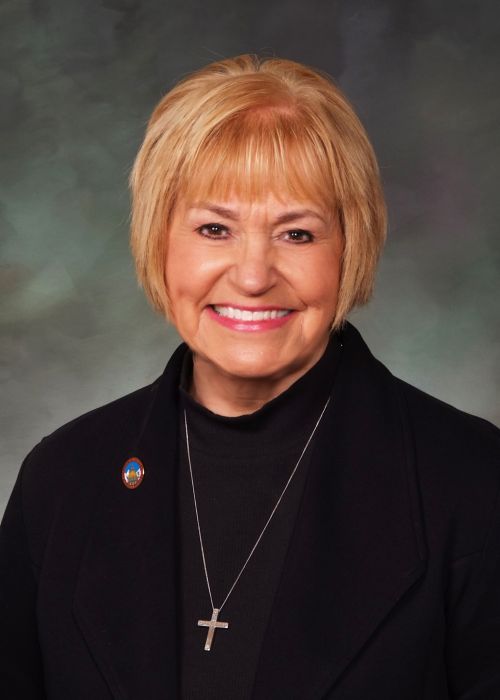
Photo of Janice Rich
R Colorado Senate · District 7 On the 2026 ballot

Sen. Janice Rich

Compare
Total votes
1,906
all sessions
Attendance
90%
197 missed
Near the chamber average
With party
93%
of cast votes
Near the chamber average
Bipartisan score
5%
crosses aisle rarely
Near the chamber average
Sponsored
210
bills & resolutions
Lower than 92% of chamber peers
Committees
6
assignments
210 bills and resolutions

Sponsored bills

Total
210
Primary
71
Co-sponsor
139
This page
210
matching current filters
Primary SB 111
In committee · Colorado Senate · Lead sponsor
Protections Against Child Rape

Current law permits a court to sentence a sex offender to probation for an indeterminate period that can range from 10 years for a class 4 felony and 20 years for a class 3 felony to a maximum of the sex offender's natural life.The bill prohibits a court from sentencing to probation a sex offender convicted of:Class 4 felony sexual assault on a child;Class 4 felony sexual assault on a child by one in a position of trust; orClass 3 felony sexual assault on a child by one in a position of trust when the child is under 15 years old.(Note: This summary applies to this bill as introduced.)

In committee Mar 18, 2026 0 co-sponsors
Co-sponsor SJR 1
Signed into law · Colorado Senate · Co-sponsor
Water Projects Eligibility Lists

Maddy summaryThis bill approves specific updates to eligibility lists for two Colorado water funding programs. It adds new drinking water projects (like Delta County's distribution system) and modifies existing entries (such as adding "green infrastructure" to Loveland's project), while deleting completed projects (like Kiowa's). These changes determine which local water districts, municipalities, and property associations can access financial assistance from the Drinking Water Revolving Fund and Water Pollution Control Revolving Fund. The bill does not create new funding rules but formally adopts the Commission's proposed list adjustments.

Signed into law Mar 13, 2026 1 co-sponsor
Co-sponsor SJR 11
Passed · Colorado Senate · Co-sponsor
Designate Sergeant John "Jack" Thurman Memorial Highway

Maddy summarySJR 11 is a commemorative resolution designating a specific segment of U.S. Highway 34 (between Wilson Ave. and North County Rd. 23H) as the "Sgt. John 'Jack' Thurman Memorial Highway" in honor of a World War II Marine Corps veteran. The bill, which has no policy or funding provisions, simply names the highway section to recognize Sergeant Thurman's service at Iwo Jima, his military awards, and his post-war contributions as an architect and community leader in Colorado. It authorizes the Colorado Department of Transportation to accept donations for signage and explore maintenance agreements with local governments. This is a ceremonial designation with no direct impact on residents or new laws.

Passed Mar 10, 2026 1 co-sponsor
Co-sponsor SB 10
Signed into law · Colorado Senate · Co-sponsor
Agricultural Property Tax Definitions

The act broadens the definition of 'ranch' for purposes of property taxation to mean a parcel of land that is predominantly used for grazing livestock for the primary purpose of obtaining a monetary profit. A ranch must operate through a pasture-based operation, which is newly defined as a method of livestock management where pasture-grazed livestock have regular access to open pasture and derive a majority of their diet through grazing.     The act also broadens the definition of 'farm' for purposes of property taxation to mirror the predominant use language in the definition of 'ranch'. With this change, a farm means a parcel of land that is predominantly used to produce agricultural products that originate from the land's productivity for the primary purpose of obtaining a monetary profit.(Note: This summary applies to this bill as enacted.)

Signed into law Mar 9, 2026 1 co-sponsor
Primary SB 107
In committee · Colorado Senate · Lead sponsor
Modify Colorado Open Records Act

The bill makes the following changes to the "Colorado Open Records Act" (CORA):Excludes from the definition of a "public record" a written document or electronic record that is produced by a device or application that is used to assist an individual with a disability or individuals with language barriers to facilitate communication if the written document or electronic record has been produced to facilitate communication in lieu of verbal communication;Requires a public entity to post any rules or policies adopted pursuant to CORA, including any records retention policy, and to post information for members of the public regarding how to make a public records request; Changes the reasonable time to respond to a CORA request from 3 to 5 working days and changes the extension of time for the response period if extenuating circumstances exist from not exceeding 7 additional days to not exceeding 10 additional days;Adds an extenuating circumstance that allows extension of the response period when the custodian is not scheduled to work within the response period;If public records are in the sole and exclusive custody and control of a person who is not scheduled to work within the response period, requires a custodian to provide all other available responsive public records within the response period and to notify the requester of the earliest date on which the person is expected to be available or that the person is not expected to return. The requester may make a subsequent request for additional responsive records, if any, on or after the date the custodian provides.Allows a custodian to determine that a request, other than a request for a contract or other information delivered using computer data extraction methods that require minimal human intervention for retrieval, is made for the direct solicitation of business for pecuniary gain and provides a 30-day response period for such request; requires the custodian to provide written notice of the custodian's determination to the requester and permits the requester to appeal the determination to the district court; and allows a custodian to charge the requester for the reasonable cost of directly responding to the request notwithstanding the allowance for the first hour of research and retrieval to be free of charge and notwithstanding the statutory cap on fees which otherwise would apply;In addition to the prohibition on disclosing public elementary or secondary school students' addresses and telephone numbers, prohibits disclosure of any other student information that could be used to directly contact, address, or send a message to a student through any means or method;Allows a requester to ask a custodian for a reasonable breakdown of costs that comprise the fee charged for the research and retrieval of requested public records and requires a custodian to provide such a breakdown upon request;Clarifies that the custodian of records for a public entity must allow a requester to pay any fee or deposit associated with a request for public records with a credit card or electronic payment if the public entity allows members of the public to pay in this manner for any other service or product provided by the public entity;Allows a custodian to treat a CORA request received within 14 calendar days of another CORA request for information pertaining to facially similar content and made by the same person as one request for purposes of calculating the fee that the custodian may charge the requester for research and retrieval of responsive public records;Requires a custodian who fails to respond to a request for inspection within the applicable time period to provide the requester with one additional hour of research and retrieval time without charge for each calendar day that the response is late; andClarifies that if a custodian imposes any requirements concerning the prepayment or payment of a fee in connection with a request for inspection of public records, the requirements must be in accordance with the custodian's adopted rules or written policies and must not be inconsistent with the provisions of CORA.(Note: This summary applies to this bill as introduced.)


In committee Mar 5, 2026 0 co-sponsors
Co-sponsor SJR 4
Passed · Colorado Senate · Co-sponsor
Frontotemporal Degeneration Awareness Week

Maddy summarySJR 4 designates September 20-26, 2026, as "Frontotemporal Degeneration (FTD) Awareness Week" in Colorado. This symbolic resolution recognizes FTD - a terminal, incurable neurodegenerative disease affecting speech, behavior, and motor skills - and aims to increase public awareness of the condition. It directly supports Coloradans living with FTD, their families, and advocacy groups like the Association for Frontotemporal Degeneration, which focuses on research and care. The bill has no funding or regulatory provisions, as it is purely a recognition measure.

Passed Mar 4, 2026 1 co-sponsor
Co-sponsor SR 3
Passed · Colorado Senate · Co-sponsor
Designate March Arts Education Month

Maddy summaryThis Senate Resolution (SR 3) designates March as "Arts Education Month" in Colorado. It does not create new laws or funding but symbolically recognizes the importance of arts education (including dance, music, theater, and visual arts) for students' development and academic success. The resolution aligns Colorado with national observances in March and acknowledges the state's lack of data on arts education access and the need to expand equitable opportunities. It is a non-binding recognition, sent to the Governor and State Board of Education, with no direct policy changes or requirements for schools.

Passed Mar 3, 2026 1 co-sponsor
Co-sponsor HJR 1018
Passed · Colorado House · Co-sponsor
Plains-to-Pines Scenic Corridor

Maddy summaryHJR 1018 designates the 61-mile stretch of State Highway 86 through Elbert County, Colorado, as the "Plains-to-Pines Scenic Corridor." The resolution authorizes the Colorado Department of Transportation (CDOT) to accept donations for signage, markers, and landscaping to promote this scenic route connecting the eastern plains to the Rocky Mountain foothills. It specifically enables CDOT to collaborate with Elbert County and the towns of Kiowa and Elizabeth for maintenance of these promotional elements. This is a commemorative designation without new regulatory requirements, focusing on tourism and regional identity.

Passed Mar 3, 2026 1 co-sponsor
Co-sponsor HJR 1019
Passed · Colorado House · Co-sponsor
Recognize Caregiving Youth Day

Maddy summaryHJR 1019 designates February 20, 2026, as Caregiving Youth Day in Colorado, with an official observance on February 27, 2026. The resolution recognizes children and adolescents under 18 who provide care for family members with health needs (such as chronic illness, disability, or aging-related care) and encourages schools, healthcare providers, and community organizations to identify these young caregivers and offer appropriate support. It does not create new laws or funding but aims to increase awareness of this underserved population.

Passed Mar 3, 2026 1 co-sponsor
Co-sponsor SJR 13
Passed · Colorado Senate · Co-sponsor
Recognize Youth Mental Health Action Day

Maddy summarySJR 13 is a symbolic resolution recognizing February 26, 2026, as "Youth Mental Health Action Day" in Colorado. It does not create new laws or allocate funding but formally honors pediatric health-care providers working to support youth mental health. The resolution cites Colorado's high rates of youth mental health challenges (including suicide being a leading cause of death for children under 18) and emphasizes collaboration with providers, agencies, and communities. It commits the General Assembly to "promoting child and youth well-being" through existing mental health system efforts. This is a non-binding recognition, not a policy change.

Passed Mar 3, 2026 1 co-sponsor
Showing 71 to 80 of 210 bills
Previous 1 7 8 9 21 Next