

Current law requires a testing entity to provide accommodations for an individual with a disability who is taking an exam for professional licensing. The current definition of 'testing entity' includes a private entity or a state or local governmental entity offering such an exam and having control over testing accommodation decisions. The act changes the definition of 'testing entity' to include any person, business, or state or local government agency that offers an examination or course related to an application, license, certification, or credential for secondary or postsecondary education, professional, or trade purposes. The act further requires a testing entity to offer the exam or course in a place and manner that is accessible to an individual with a disability or offer an alternative accessible arrangement in order to accommodate an individual with a disability who has met the requirements to receive the accommodation.(Note: This summary applies to this bill as enacted.)
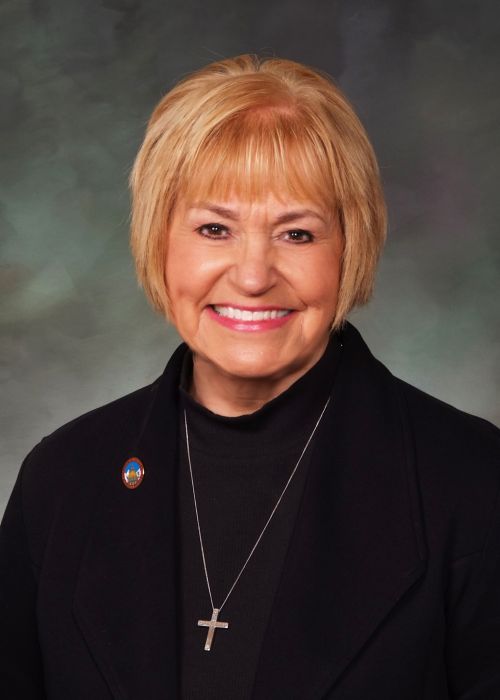
Sen. Janice Rich
Sponsored bills
Maddy summarySB 132, known as the "Magnus Law," requires Colorado law enforcement officers to offer drivers involved in collisions resulting in death or suspected serious injury the opportunity to voluntarily take a breath test for alcohol. The bill mandates officers provide clear, plain-language advisement that the test is voluntary, refusal carries no penalty, and results cannot be used in court. It applies when officers reasonably suspect the driver was at fault and the driver isn't critically injured, creating a standardized protocol to ensure consistent investigation of potential impairment at serious crash scenes. This change aims to preserve evidence that might otherwise be lost, without altering existing legal standards for driving under the influence.
Maddy summaryThis bill designates a two-mile stretch of Colorado Highway 14 in Weld County as 'Mono & Matt Road' to honor Edwardo 'Mono' Hernandez and Matthew Garcia, two high school basketball players who died in a 2014 traffic accident. The legislation authorizes the Colorado Department of Transportation to install signs for the new name and allows the department to accept donations for this purpose while exploring a cooperative agreement with Weld County for future maintenance. By placing the names on a specific roadway, the bill creates a permanent physical tribute to the students in the location where the accident occurred.
The act changes terminology related to child prostitution to commercial sexual activity with a child in the crimes of soliciting for child prostitution, pandering of a child, keeping a place of child prostitution, pimping a child, inducement of child prostitution, and patronizing a prostituted child, including changing the name of the offenses for soliciting for child prostitution, keeping a place of child prostitution, inducement of child prostitution, and patronizing a prostituted child. A court is required to sentence an offender convicted of one of the listed offenses, other than soliciting for commercial sexual activity with a child, to at least the minimum of the presumptive range for the level of offense associated with the crime. For an offense of soliciting for commercial sexual activity with a child, if the court sentences the person to probation, the court shall order as a condition of probation that the person serve 364 days in the county jail. In the crime of soliciting for commercial sexual activity with a child, the act adds knowingly soliciting a child for commercial sexual activity as a means of committing the offense and requires that when arranging or offering to arrange a meeting, the offender must know that meeting will facilitate commercial sexual activity with a child. The act removes the spousal exception from the crime of engaging in commercial sexual activity with a child. The act makes the penalty for internet luring of a child a class 3 felony when the offense is committed with the intent to meet for the purpose of engaging in commercial sexual activity. In this circumstance, a court is required to sentence the offender to at least the minimum of the presumptive range for the class 3 felony.(Note: This summary applies to this bill as enacted.)
The act creates the 'Colorado Mandatory Lethality Assessment Act', which requires peace officers to conduct a lethality assessment when responding to a domestic violence incident and include the completed lethality assessment in the incident report. A peace officer is not required to administer a lethality assessment if a victim is unavailable, not at the scene, incapacitated, or if circumstances otherwise make the administration of the lethality assessment impossible or impracticable. If the lethality assessment indicates that an individual is a high-risk victim, or if the lethality assessment does not indicate a victim is high-risk but a peace officer determines an individual is a high-risk victim based on the totality of the circumstances, the peace officer is required to immediately contact a community-based victim's advocate either by phone or in person and provide the high-risk victim the opportunity to speak with the advocate. The act requires the attorney general's office, in consultation with a Colorado-based coalition that advocates for survivors of domestic violence, to develop a mandatory training for peace officers to learn how to administer the lethality assessment and provide victim referrals. No later than June 1, 2027, the attorney general is required to make the training available and offer assistance to law enforcement agencies in providing the training. Beginning July 1, 2027, the act requires each law enforcement agency to ensure that each peace officer employed by the agency has completed the mandatory training; except that a law enforcement agency that has provided training on the administration of lethality assessments prior to July 1, 2027, is not required to provide additional training. Beginning January 2028, and each January thereafter, the act requires the attorney general's office to report to the general assembly certain information related to lethality assessments conducted in the previous calendar year. No later than January 31, 2030, the domestic violence fatality review board shall evaluate the effectiveness of mandatory lethality assessments and referrals to resources and submit the evaluation to the general assembly. The act does not impose criminal, administrative, or civil liability on any person for an act or omission made in good faith related to administering a lethality assessment.(Note: This summary applies to this bill as enacted.)
For purposes of the 'Victim Rights Act', the act prohibits a defendant or alleged offender in the underlying case from being the 'lawful representative' of a victim or the victim's designee if the victim is a child or an at-risk adult. The act creates new rights for a victim under the 'Victim Rights Act', including the right to:Be notified by the district attorney if the district attorney receives a notice that a crime laboratory employee engaged in a wrongful action that includes a crime against the victim and a notice that an evidentiary hearing on post-conviction petition for relief is held;Request to be referred to by an abbreviation, pseudonym, initials, or another preferred name during hearings; andBe heard at a restitution assessment hearing.(Note: This summary applies to this bill as enacted.)
Current law requires counties to offer Colorado works program (works program) applicants and participants that demonstrate good cause an extension beyond the 60-month lifetime maximum. Good cause includes an applicant or participant who is a child-only case, who is the head of a single parent household unit and has a child less than one year old, or who is experiencing hardship. The act makes the extension permissible rather than a requirement and removes an applicant or participant who is a child-only case or experiencing hardship from the good cause determination. The act suspends the works program basic cash assistance grant cost of living adjustment during the 2026-27 and 2027-28 state fiscal years. Current law establishes minimum reserve balances for the total statewide county temporary assistance for needy families (TANF) reserve and the Colorado long-term works reserve (reserves). The act removes those reserve minimums. The act eliminates a requirement for each reserve to replenish money in the other under certain conditions and for the general assembly to effectively backfill the balances of both reserves if their balances fall below specified minimums.(Note: This summary applies to this bill as enacted.)
The act extends the availability of the conservation easement tax credit from income tax year 2031 through income tax year 2036. The act also prohibits the division of conservation from issuing any additional credit certificates or amending previously issued credit certificates as a result of the additional authority granted by the act for a donation made prior to the effective date of the act.(Note: This summary applies to this bill as enacted.)
The act requires a volunteer lobbyist to register and file a registration statement attesting they are not being compensated. The act exempts volunteer lobbyists from registration fees. The act provides that the judicial department may designate one individual for the judicial department and one individual for each independent agency in the judicial department who may lobby on behalf of the judicial department or an independent agency in the judicial department (judicial lobbyist). A person designated by a principal executive department to be responsible for lobbying a state official or employee on behalf of the department (legislative liaison), a judicial lobbyist, or an individual who lobbies on behalf of the offices of the governor or lieutenant governor as a member of the governor's cabinet or as a personal staff employee in the offices of the governor or the lieutenant governor (governor's lobbyist) must register with the secretary of state annually. In addition to annually registering with the secretary of state, a legislative liaison, judicial lobbyist, or a governor's lobbyist must file a monthly disclosure statement with the secretary of state (disclosure statement). The act provides that a legislative liaison, judicial lobbyist, or a governor's lobbyist must indicate on the disclosure statement the bill number of any legislation for which they have lobbied or will lobby a covered official and their position regarding the legislation. The legislative liaison, judicial lobbyist, or a governor's lobbyist must update their position on the disclosure statement within 72 hours of a change in position. The act prohibits a statewide elected official or member of the general assembly from being a legislative liaison or governor's lobbyist for a period of 2 years following vacation of office. $91,000 is appropriated from the department of state cash fund to the department of state.(Note: This summary applies to this bill as enacted.)
Maddy summaryHB 1307 extends the Colorado Medical Board's existence until September 1, 2035 (replacing a prior 2026 sunset date) and implements several specific changes to medical licensing. It creates a new "administrative license" for physicians performing non-patient work (like research design or quality management) starting January 1, 2027, exempting them from continuing medical education requirements. The bill also exempts natural medicine facilitators (with a specific license) from needing a medical license to facilitate certain services, and modifies renewal rules for foreign teaching physicians and board procedures. These changes directly affect physicians seeking administrative roles, natural medicine facilitators, and the Medical Board’s operational structure.