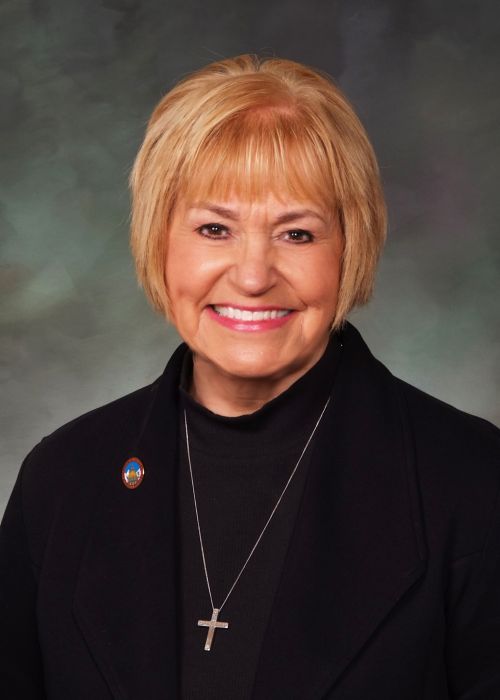
Photo of Janice Rich
R Colorado Senate · District 7 On the 2026 ballot

Sen. Janice Rich

Compare
Total votes
1,906
all sessions
Attendance
90%
197 missed
Near the chamber average
With party
93%
of cast votes
Near the chamber average
Bipartisan score
5%
crosses aisle rarely
Near the chamber average
Sponsored
210
bills & resolutions
Lower than 92% of chamber peers
Committees
6
assignments
210 bills and resolutions

Sponsored bills

Total
210
Primary
71
Co-sponsor
139
This page
210
matching current filters
Primary SB 25-019
Signed into law · Colorado Senate · Lead sponsor
Modernization of the State Plane Coordinate System

Current law allows the use of the Colorado coordinate system of 1927 and the Colorado coordinate system of 1983 established by the national geodetic survey to state the geographic positions or locations of points on the surface of the earth within the state. The act allows the use of the most recent or a prior version of the state plane coordinate system for the same purpose. (Note: This summary applies to this bill as enacted.)

Signed into law Mar 14, 2025 0 co-sponsors
Co-sponsor HJR 25-1021
Passed · Colorado House · Co-sponsor
February 28 Rare Disease Day

Maddy summaryThis joint resolution declares February 28, 2025, as Rare Disease Day in Colorado to raise awareness about rare diseases. It directly affects Colorado residents living with rare diseases - over 500,000 people - and their families, recognizing the challenges they face, including high medical costs and limited treatments. The resolution makes no new policy changes but symbolically honors those impacted by urging the state to "show our stripes" in solidarity. It references national statistics (e.g., 1 in 10 Americans affected) and the "zebra" awareness symbol for rare conditions, without creating any legal obligations or funding.

Passed Mar 13, 2025 1 co-sponsor
Primary HB 25-1073
In committee · Colorado House · Lead sponsor
Protections Against Child Rape

Under current law, sexual assault on a child is a class 4 felony if the victim is under 15 years of age, the actor is at least 4 years older than the victim, and specified aggravating circumstances do not apply. Sexual assault on a child by one in a position of trust is a class 4 felony if the actor is in a position of trust with respect to the victim, the victim is 15 years of age or older but under 18 years of age, and the offense is not committed as part of a pattern of sexual abuse. If the offense is committed as part of a pattern of sexual abuse or the victim is less than 15 years of age, sexual assault on a child by one in a position of trust is a class 3 felony. The presumptive range of penalties for a class 4 felony under current law is 2 to 6 years of imprisonment. The presumptive range of penalties for a class 3 felony under current law is 4 to 12 years of imprisonment. Under current law, a court shall sentence a sex offender to an indeterminate term in the custody of the department of corrections that can range from the applicable presumptive range minimum to a maximum of the sex offender's natural life. However, current law permits the court to sentence a sex offender to probation for an indeterminate period that can range from 10 years for a class 4 felony and 20 years for a class 3 felony to a maximum of the sex offender's natural life. The bill requires a court to sentence an offender convicted of a class 4 felony sexual assault on a child or sexual assault on a child by one in a position of trust to an indeterminate term of incarceration that can range from the presumptive range minimum of 2 years to a maximum of the offender's natural life. The bill requires a court to sentence an offender convicted of a class 3 felony sexual assault on a child by one in a position of trust when the child is less than 15 years of age to an indeterminate term of incarceration that can range from the presumptive range minimum of 4 years to a maximum of the offender's natural life. The bill prohibits a court from sentencing these types of offenders to probation. (Note: This summary applies to this bill as introduced.)

In committee Mar 12, 2025 0 co-sponsors
Primary HB 25-1257
In committee · Colorado House · Lead sponsor
Relinquishment of Child in Newborn Safety Device

The bill authorizes a fire station, hospital, or community clinic emergency center (authorized facility) to install a newborn safety device on its premises for parents who voluntarily relinquish their child who is 60 days old or younger. A newborn safety device must be installed in a conspicuous location at the authorized facility and be equipped with a dual alarm system. An authorized facility that installs a newborn safety device is responsible for the cost of the installation and maintenance, shall ensure the dual alarm system is functioning, and shall make information available to the relinquishing parent. Under current law, parents can voluntarily relinquish their child if the child is less than 72 hours old. The bill allows voluntary relinquishment up to 60 days. The bill makes conforming amendments. (Note: This summary applies to this bill as introduced.)

In committee Mar 5, 2025 0 co-sponsors
Primary SB 25-156
In committee · Colorado Senate · Lead sponsor
Reducing Costs of State Regulation

Sections 1 and 2 of the bill prohibit a state agency from imposing a personal qualification requirement in order to engage in a profession or occupation unless the agency can show that the requirement is demonstrably necessary and narrowly tailored to address a specific, legitimate public health, safety, or welfare objective. On or before July 1, 2026, every agency must review occupational regulations and determine whether the regulation should be repealed or amended. Any person may file a petition with an agency requesting that an occupational regulation be repealed or amended. Regardless of whether a petition is filed with an agency, any person may file a civil suit requesting that the court enjoin the adoption or enforcement of an occupational regulation. When an agency files a notice of proposed rule-making with the secretary of state, if the proposed rule-making includes a proposed occupational regulation, the agency must also submit a statement to the secretary of state describing how the proposed occupational regulation complies with the bill's requirements. Section 3 repeals the industrial and manufacturing operations clean air grant program, the cannabis resource optimization cash fund, the community access to electric bicycles grant program, and the electrifying school buses grant program, which were enacted in 2022 by Senate Bill 22-193. Section 4 repeals the energy code board and its associated model codes, an energy code training grant program, the building electrification for public buildings grant program, the high-efficiency electric heating and appliances grant program, and the clean air building investments fund, which were enacted in 2022 by House Bill 22-1362. Section 5 repeals the air quality enterprise, which was enacted in 2020 by Senate Bill 20-204. Section 6 repeals the environmental response surcharge, the perfluoroalkyl and polyfluoroalkyl substances cash fund, the perfluoroalkyl and polyfluoroalkyl substances grant program, the perfluoroalkyl and polyfluoroalkyl substances take-back program, and certain civil penalties for violations of certain air quality control regulations, which were enacted in 2020 by Senate Bill 20-218. Section 7 repeals certain requirements, including requirements regarding fenceline monitoring and community-based monitoring of air toxics, for covered facilities, which requirements were enacted in 2021 by House Bill 21-1189. Sections 8 through 20 make necessary conforming amendments. (Note: This summary applies to this bill as introduced.)


In committee Mar 4, 2025 0 co-sponsors
Co-sponsor SB 25-139
In committee · Colorado Senate · Co-sponsor
Grocery & Utility Bill Reduction Measures

Sections 1 through 3 of the bill include nuclear energy in the definitions of "clean energy" and "clean energy resource". Sections 4 and 5 repeal the Colorado circular communities enterprise and user fees created in House Bill 24-1449, enacted in 2024, to replace the front range waste diversion enterprise and user fees created in Senate Bill 19-192, enacted in 2019. Section 6 repeals the 10-cent paper carryout bag fee created in House Bill 21-1162, enacted in 2021. Section 7 repeals the confinement standards for egg-laying hens whose eggs are sold in Colorado, which standards were created in House Bill 20-1343, enacted in 2020. Section 8 repeals the authorization for counties and municipalities to collect special sales taxes on nicotine products, which authorization was created in House Bill 19-1033, enacted in 2019. Section 9 repeals the energy assistance system benefit charge created in House Bill 21-1105, enacted in 2021. Section 10 repeals the retail delivery fee created in Senate Bill 21-260, enacted in 2021. Sections 11 through 45 make conforming amendments. (Note: This summary applies to this bill as introduced.)
In committee Mar 4, 2025 1 co-sponsor
Co-sponsor HJR 25-1018
Passed · Colorado House · Co-sponsor
Latino & Latina Veterans

Maddy summaryHJR 25-1018 is a Colorado legislative resolution recognizing the service of Latina and Latino veterans who have served in the U.S. Armed Forces. It formally commends their contributions across military conflicts from the Revolutionary War through modern operations, highlighting historical units like the "Borinqueneers" and the American GI Forum. The resolution does not create new policies, benefits, or legal obligations - instead, it serves as a symbolic gesture of appreciation. A copy will be sent to the American GI Forum of Colorado, as specified in the resolution.

Passed Feb 27, 2025 1 co-sponsor
Co-sponsor HJR 25-1017
Passed · Colorado House · Co-sponsor
Tenth Mountain Division

Maddy summaryThis House Joint Resolution (HJR 25-1017) is a ceremonial resolution honoring the historical legacy of the 10th Mountain Division, a U.S. Army unit that trained at Camp Hale in Colorado during World War II. It recognizes the division’s combat service in the Italian Alps, its postwar conservation efforts by veterans through the 10th Mountain Division Hut Association, and President Biden’s 2022 designation of Camp Hale as a national monument. The resolution expresses the Colorado General Assembly’s appreciation for the division’s bravery and its enduring connection to Colorado’s history and landscape. As a symbolic gesture, it does not create new laws or obligations but serves to memorialize the unit’s contributions.

Passed Feb 27, 2025 1 co-sponsor
Co-sponsor HJR 25-1004
Signed into law · Colorado House · Co-sponsor
Water Project Eligibility Lists

Maddy summaryHJR 25-1004 is a procedural resolution approving specific additions to Colorado's Drinking Water Project Eligibility List and Water Pollution Control Project Eligibility List. It directly affects water providers like Allenspark Water and Sanitation District, East Boulder County Water District, and Grizzly Peak Water Sales and Distribution LLC, enabling them to qualify for funding from the state's Drinking Water Revolving Fund (DWRF) and Water Pollution Control Revolving Fund (WPCRF). The resolution formally adopts the Water Quality Control Commission's approved project additions, modifications, and deletions for these lists. This allows eligible water and wastewater infrastructure projects to access state financial assistance for facilities such as treatment plants, distribution systems, and storage.

Signed into law Feb 27, 2025 1 co-sponsor
Co-sponsor HJR 25-1011
Passed · Colorado House · Co-sponsor
Gold Star Families

Maddy summaryHJR 25-1011 is a Colorado legislative resolution honoring Gold Star Families - those who have lost a family member in military service - by expressing the state's gratitude and respect for their sacrifice. It does not create new programs or benefits but symbolically recognizes these families through a formal statement from the Colorado General Assembly. The resolution directs copies to be sent to veterans' organizations including American Gold Star Mothers, Gold Star Wives, and Blue Star Mothers chapters across Colorado. This is a commemorative gesture without concrete policy changes or direct impact on affected individuals.

Passed Feb 27, 2025 1 co-sponsor
Showing 161 to 170 of 210 bills
Previous 1 16 17 18 21 Next