Maddy summaryHouse Joint Resolution 25-1022 designates May 2025 as "Motorcycle Safety Awareness Month" in Colorado. This resolution, affecting motorcycle riders and all motorists, aims to promote safety through education and training and encourages motorists to "share the road."
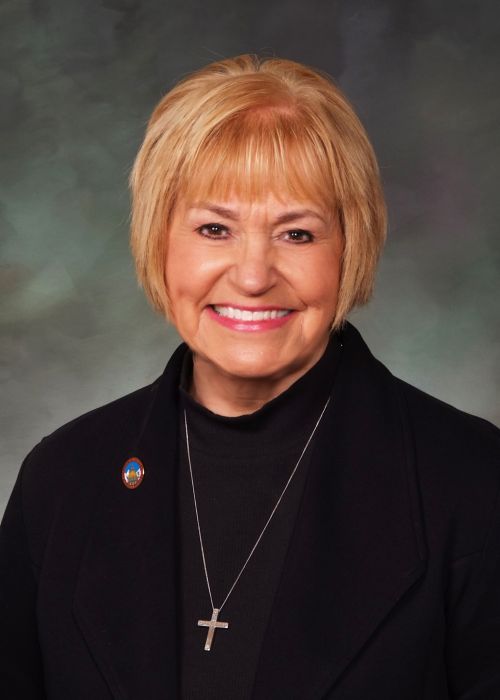
Sen. Janice Rich
Sponsored bills
Maddy summarySenate Joint Resolution 25-017 designates the North Academy Bridge spanning Interstate 25 in Colorado Springs as the "Naval Aviation Pilot and Aviation Machinist Mate Petty Officer First Class Daniel T. Griffin Bridge." This resolution honors Daniel T. Griffin, recognized as the first Coloradan killed during the attack on Pearl Harbor. It also allows the Colorado Department of Transportation to explore a cooperative agreement with the Colorado Springs City Council for the maintenance of the bridge's signs.
The act makes the following changes to the "Colorado Open Records Act" (CORA): Excludes from the definition of a "public record" a written document or electronic record that is produced by a device or application that is used to assist an individual with a disability or individuals with a language barrier to facilitate communication if the written document or electronic record has been produced to facilitate communication in lieu of verbal communication; Changes the reasonable time to respond to a CORA request, except for requests from a mass medium or a newsperson, from 3 working days to 5 working days and changes the extension of time for the response period if extenuating circumstances exist from not exceeding 7 additional days to not exceeding 10 additional days; Adds an extenuating circumstance that allows for an extension of the response period when the custodian is not scheduled to work within the response period; Requires public entities to post any rules or policies adopted pursuant to CORA, including, if the public entity has one, the public entity's records retention policy, and to post information for members of the public regarding how to make a public records request; If public records are in the sole and exclusive custody and control of someone who is not scheduled to work within the response period, requires a custodian to provide all other available responsive public records within the response period and notify the requester of the earliest date on which the person is expected to be available or that the person is not expected to return to work. The requester may make a subsequent request for additional responsive records, if any, on or after the date the custodian provides. Allows a custodian, subject to certain exceptions, to determine that a request is made for the direct solicitation of business for pecuniary gain, requires the custodian to provide written notice of the determination to the requester, allows the custodian a 30-day response period for such a request, permits the requester to submit a signed statement affirming that the request is not for the direct solicitation of business for pecuniary gain that the custodian must consider in making their determination, permits the requester to appeal the determination that the request is made for the direct solicitation of business for pecuniary gain to the district court, and allows a custodian to charge the requester for the reasonable cost of directly responding to the request notwithstanding the allowance for the first hour of research and retrieval to otherwise be free of charge and notwithstanding the statutory cap on fees, which otherwise would apply; In addition to the prohibition on disclosing public elementary or secondary school students' addresses and telephone numbers, prohibits disclosure of any other information of such a student that could be used by a person to directly contact, address, or send a message to the student through any means or method; Clarifies that if a custodian imposes any requirements concerning the prepayment of fees or the payment of fees in connection with a request for inspection of public records, the requirements must be in accordance with the custodian's adopted rules or written policies and must not be inconsistent with the provisions of CORA; Allows a requester to ask a custodian for a reasonable break-down of costs that comprises the fee charged for the research and retrieval of the requested public records; Modifies the requirement that, if a custodian of records for a public entity allows members of the public to pay for any other service or product provided by the custodian with a credit card or electronic payment, then the custodian must allow a requester of a public record to pay any fee or deposit associated with the request with a credit card or electronic payment, to instead require that the custodian allow for payment in this manner if the public entity allows members of the public to pay for any other service or product provided by the public entity; and Allows a custodian to treat a CORA request made within 14 calendar days of another CORA request for information pertaining to facially similar content made by the same person as one request for purposes of calculating the fee that the custodian may charge the requester for research and retrieval of responsive public records. VETOED by Governor April 17, 2025(Note: This summary applies to this bill as enacted.)

The act encourages each local education provider to adopt a policy to reduce food waste in school cafeterias and food preparation facilities (policy). The policy may address food waste diversion and aversion initiatives, including composting, donation of excess food to local nonprofits, or share table programs that permit students to return whole food or beverage items for redistribution to other students. A local education provider that implements a policy shall comply with all applicable sanitation and health requirements, including protocols to prevent student exposure to allergens, and shall require school personnel to complete related safety training. Current law establishes the Colorado circular communities enterprise (enterprise) to award grants and other funding and to provide technical assistance to certain entities throughout the state that pursue a circular economy for waste management, including waste diversion and aversion. The act requires the enterprise to consider reducing food waste by incentivizing public schools to develop and implement effective composting, excess food donation, or share table programs. The act extends limited immunity from civil and criminal liability to school personnel and local education providers that supervise food and beverage redistribution in accordance with policies that include share tables. (Note: This summary applies to this bill as enacted.)

Maddy summarySenate Joint Resolution 25-016 is a commemorative resolution from the Colorado General Assembly expressing strong support for strengthening the sister-state relationship between Colorado and Taiwan. It reaffirms the 42-year relationship and advocates for enhanced trade relations and academic exchanges between the two entities. The resolution also calls for the signing of a U.S.-Taiwan agreement on avoiding double taxation to promote bilateral investment. Additionally, it supports Taiwan's meaningful inclusion in various international organizations.
Maddy summarySJR 25-010 designates March 17, 2025, as "Colorado Aerospace Day" to recognize the state's leadership in the aerospace industry. The resolution highlights Colorado's status as the nation's top aerospace employment hub (with 33,000 direct jobs and 240,000 supporting jobs), home to major companies like Lockheed Martin and Boeing, and key military space operations. It does not create new laws but serves as a symbolic declaration urging federal support for space exploration and celebrating the industry's economic and educational contributions. This resolution is addressed to state and federal officials, educational institutions, and aerospace organizations.
The act creates a new refundable tax credit only if at least one qualified film festival entity with a multi-decade operating history and a verifiable track record of attracting 100,000 or more in-person ticket sales and over 10,000 out-of-state and international attendees (global film festival entity) commences the relocation of the festival to Colorado by January 1, 2026. Upon relocation, for calendar years commencing on or after January 1, 2027, but before January 1, 2037, the maximum aggregate amount of refundable tax credits that any qualified global film festival entity is eligible to receive is $34 million and the maximum aggregate amount that all existing or small Colorado festival entities collectively may receive is $5 million. A film festival entity is allowed a tax credit for each tax year in which the film festival entity hosts a film festival in Colorado, and may be allowed an additional tax credit in the subsequent tax year with respect to any qualified expenditures incurred in the year the film festival entity hosted the film festival in Colorado. (Note: This summary applies to this bill as enacted.)
The prosecution fellowship program in the department of higher education provides money to the Colorado district attorneys' council (CDAC) to fund fellowships for persons who have recently graduated from a law school in Colorado to allow them to pursue careers as prosecutors in rural Colorado. The program, through a prosecution fellowship committee, places up to 6 fellows in rural district attorneys' offices throughout the state each year. The act changes the prosecutor fellowship program to provide fellowship funding to rural district attorneys' offices to recruit and hire new deputy district attorneys rather than selecting and placing fellows in rural district attorneys' offices. The selected offices then use the money to recruit and hire new district attorneys. The act requires the prosecution fellowship committee to determine which rural district attorneys' offices receive funding. On or before January 1, 2028, CDAC shall provide a report to the judiciary committees regarding the prosecutor fellowship program. (Note: This summary applies to this bill as enacted.)
Maddy summarySJR 25-008 designates March 3, 2025, as "Buy Colorado Day" (also called "303 Day") and March 3-10, 2025, as "Buy Colorado Week" to encourage Coloradans to support local businesses. The resolution urges residents to spend money at homegrown Colorado brands and enterprises, highlighting the state's diverse business community including restaurants, breweries, agricultural producers, and retailers. This symbolic measure has no legal force and serves as a recognition of Colorado's economic contributions, not a new policy or requirement. It directly affects all Coloradans by promoting a voluntary shift in consumer behavior toward local spending.
Maddy summarySJR 25-018 recognizes April 2025 as Sexual Assault Awareness Month and designates April 30, 2025, as Colorado Denim Day. The resolution symbolically supports the annual Denim Day observance, which began in Colorado in 2013, to raise awareness about sexual violence and honor the work of organizations like the Colorado Coalition Against Sexual Assault (CCASA). It highlights ongoing challenges such as evidence kit backlogs and the need for survivor support services, without creating new laws or funding. This is a ceremonial resolution, not a policy change, aligning Colorado with the global Denim Day movement that uses wearing jeans to protest attitudes condoning sexual assault.