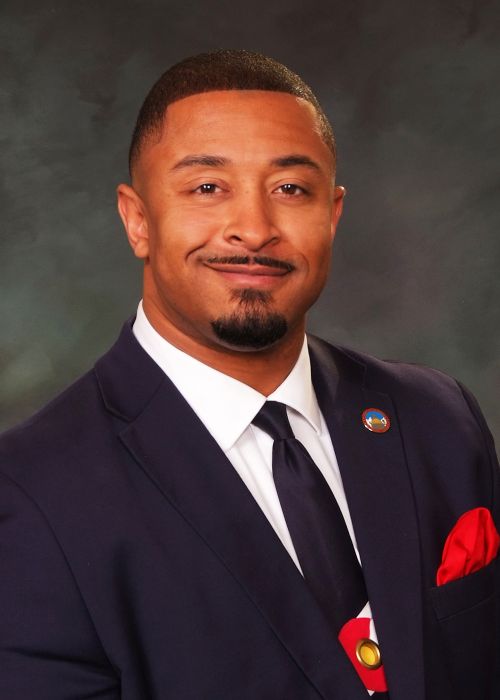
Photo of James Coleman
D Colorado Senate · District 33

Sen. James Coleman

Compare
Total votes
6,842
all sessions
Attendance
89%
792 missed
Near the chamber average
With party
99%
of cast votes
Higher than 91% of chamber peers
Bipartisan score
0%
crosses aisle rarely
Near the chamber average
Sponsored
744
bills & resolutions
Higher than 97% of chamber peers
Committees
3
assignments
744 bills and resolutions

Sponsored bills

Total
744
Primary
152
Co-sponsor
592
This page
744
matching current filters
Primary HB 18-1117
Signed into law · Colorado House · Lead sponsor
Self-service Storage Facility Personal Property Liens

The bill modifies the law governing the statutory lien that an owner of a self-storage facility has for the occupant's late payment of rent or other charges by: Specifically including late fees in the lien; Allowing the rental agreement to limit the aggregate value of the property that may be stored in the occupant's storage space; and Specifying that property stored in the occupant's storage space may be sold at an online auction website to satisfy the lien.(Note: This summary applies to the reengrossed version of this bill as introduced in the second house.) , Read More

Signed into law Mar 22, 2018 0 co-sponsors
Primary SB 18-025
Signed into law · Colorado Senate · Lead sponsor
Urban Drainage Flood Control District Elections

The election provisions for the urban drainage and flood control district (district) have not been changed since 1992. The bill makes the following changes to provisions relating to district elections: Section 1 of the bill adds definitions of 'elector' or 'registered elector' and 'special election' or 'election' to conform the district's laws with the 'Uniform Election Code' (code). The bill clarifies the definition of 'publication' so that it conforms with the code. The bill amends the definition of 'taxpaying elector,' eliminating the ability to vote based on a spouse or civil union partner owning taxable property within the district. Section 2 clarifies that district elections may be held independently at a special election in conformance with the 'Colorado Local Government Election Code' or in coordination with the county clerk and recorders of counties included in the district. It also calls for the district to pay the district's costs related to a coordinated election. Section 3 deletes an obsolete provision specifying the date in advance of an election that the board of directors of the district must adopt a resolution calling a district election. Section 4 conforms annexation elections to current requirements of the 'Colorado Local Government Election Code' and makes ballot questions for district annexation elections similar to the procedures used for special district inclusion elections.(Note: This summary applies to the reengrossed version of this bill as introduced in the second house.) , Read More

Signed into law Mar 7, 2018 0 co-sponsors
Primary SB 18-050
Signed into law · Colorado Senate · Lead sponsor
Free-standing Emergency Facility As Safe Haven

The bill expands Colorado's safe haven laws to include staff members of community clinic emergency centers as persons allowed to take temporary physical custody of infants 72 hours old or younger when the infant is voluntarily surrendered by its parent or parents. (Note: This summary applies to the reengrossed version of this bill as introduced in the second house.) Read More

Signed into law Mar 7, 2018 0 co-sponsors
Primary SB 17-252
Signed into law · Colorado Senate · Lead sponsor
Utility Cost-saving Contract For Local Governments

Current law allows boards of political subdivisions to enter into energy cost-savings contracts for utility cost savings. Utility cost savings are defined in law to include an installation, modification, or service that is designed to reduce energy consumption and related operating costs in buildings and other facilities. The bill specifies that the boards may also enter into energy cost-savings contracts for increasing meter accuracy, which is defined as a utility cost-savings measure. The bill also changes the definition of 'operation and maintenance cost savings' to clarify that the calculation must be made on a net basis. (Note: This summary applies to the reengrossed version of this bill as introduced in the second house.)


Signed into law Jun 5, 2017 0 co-sponsors
Primary HB 17-1201
Signed into law · Colorado House · Lead sponsor
Science Technology Engineering Math Diploma Endorsement

The bill authorizes a school district, board of cooperative services, district charter high school, or institute charter high school (local education provider) to grant a high school diploma endorsement in science, technology, engineering, and mathematics (STEM) to students who demonstrate mastery in STEM. To obtain the endorsement, a student must complete the high school graduation requirements at a high level of proficiency, successfully complete 4 STEM courses selected by the local education provider in addition to the high school graduation requirements in these subjects, achieve a minimum score specified in the bill on one of several specified mathematics assessments, and successfully complete a final capstone project. To successfully complete the capstone project, the student must achieve a high proficiency level of mastery, as set by the local education provider, for each of the competencies specified in the bill. The local education provider is required to work with STEM-related business and industrial leaders and institutions of higher education in setting the high proficiency levels of mastery. The local education provider must annually notify students and their parents beginning in sixth grade of the requirements for obtaining a STEM diploma endorsement. (Note: This summary applies to the reengrossed version of this bill as introduced in the second house.)
Signed into law May 18, 2017 0 co-sponsors
Primary HB 17-1214
Signed into law · Colorado House · Lead sponsor
Encourage Employee Ownership Of Existing Small Business

The bill requires the Colorado office of economic development (office) to engage the services of a local nonprofit organization that supports and promotes the employee-owned business model to educate the staff at the office on the forms and merits of employee ownership in order for the office to promote employee ownership as part of its small business assistance center. The bill requires the office to establish and administer a revolving loan program to assist transitions of existing businesses to employee-owned businesses. The bill specifies that the office may enter into a contract, following an open and competitive process, with a local nondepository nonprofit organization that supports and promotes the employee-owned business model, a bank, or a nondepository community development financial institution to establish and administer the revolving loan program. The bill allows the office to work with the Colorado housing and finance authority to assist in offering loans under the program. The bill specifies the types of businesses that may qualify for the program, sets a maximum amount of any loan, and specifies what the loans may and may not be used for. The bill also allows the office to seek matching private sector money to help capitalize the program. The bill authorizes the office to accept and expend gifts, grants, and donations to capitalize the program, and may annually keep the first 15% of the money raised for administration purposes. The bill creates the revolving loan program cash fund and the money in the fund is continuously appropriated to the office. The bill also specifies that the office is required to establish guidelines and post on its website administrative details about the revolving loan program, such as fees, costs, interest rates, and loan terms. The bill includes a repeal of the section of law creating the program, effective July 1, 2022. (Note: This summary applies to the reengrossed version of this bill as introduced in the second house.)

Signed into law May 18, 2017 0 co-sponsors
Primary HB 17-1211
Signed into law · Colorado House · Lead sponsor
Educators Professional Development Discipline Strategies

The bill creates the discipline strategies pilot program (pilot program) to provide money to school districts, boards of cooperative services, and charter schools for professional development for educators in the use of culturally responsive methods of student discipline for students enrolled in preschool through third grade and developmentally appropriate responses to the behavioral issues of students enrolled in preschool through third grade. The department of education (department) and the state board of education (state board) must implement the pilot program by reviewing applications, awarding grants, and preparing a report concerning implementation of the pilot program, including its success in reducing the use of exclusionary discipline practices. The department must submit the report to the state board, the joint budget committee, and the education committees of the general assembly. The pilot program must be paid for exclusively with gifts, grants, and donations, and the department and the state board are not required to implement the pilot program in a year in which they do not receive a sufficient amount in gifts, grants, and donations. (Note: This summary applies to the reengrossed version of this bill as introduced in the second house.)

Signed into law May 18, 2017 0 co-sponsors
Primary HB 17-1299
Passed · Colorado House · Lead sponsor
Transportation Legislation Review Committee Interim Hearing Electric Utility Energy Storage

The bill directs the transportation legislation review committee (TLRC) to conduct a hearing during the 2017 interim on the potential economic benefits and costs of energy storage systems (e.g., batteries, heat sinks, pumped storage hydroelectric systems) that an electric utility may incorporate into its electric resource acquisition plans. The hearing must take place on or before December 1, 2017. (Note: This summary applies to the reengrossed version of this bill as introduced in the second house.)

Passed Apr 26, 2017 0 co-sponsors
Primary HB 17-1215
Signed into law · Colorado House · Lead sponsor
Mental Health Support For Peace Officers

The bill encourages each sheriff's office and each municipal police department to adopt a policy whereby mental health professionals, to the extent practicable, provide: On-scene response services to support officers' handling of persons with mental health disorders; and Counseling services to officers. The bill creates the peace officers mental health support grant program (grant program) in the department of local affairs (department) to provide grants of money to county sheriffs' offices and municipal police departments to help them engage mental health professionals. Each sheriff's office and each municipal police department is encouraged to apply annually for a grant from the grant program. The bill creates the peace officers mental health support fund (fund), which consists of gifts, grants, and donations and any other money that the general assembly may appropriate or transfer to the fund. The executive director of the department, or his or her designee, may expend money from the fund for the purposes of the grant program. The grant program repeals September 1, 2027. (Note: This summary applies to the reengrossed version of this bill as introduced in the second house.)

Signed into law Apr 24, 2017 0 co-sponsors
Showing 731 to 740 of 744 bills