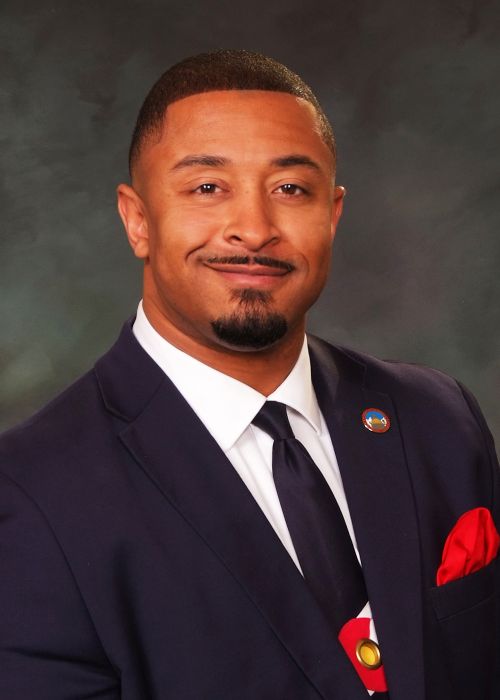
Photo of James Coleman
D Colorado Senate · District 33

Sen. James Coleman

Compare
Total votes
7,878
all sessions
Attendance
99%
44 missed
Near the chamber average
With party
99%
of cast votes
Higher than 91% of chamber peers
Bipartisan score
0%
crosses aisle rarely
Lower than 95% of chamber peers
Sponsored
744
bills & resolutions
Higher than 97% of chamber peers
Committees
3
assignments
744 bills and resolutions

Sponsored bills

Total
744
Primary
152
Co-sponsor
592
This page
744
matching current filters
Primary HB 22-1409
Signed into law · Colorado House · Lead sponsor
Community Revitalization Grant Program Funding

To provide additional funding for the community revitalization grant program, the act requires the state treasurer to transfer $20 million from the economic recovery and relief cash fund to the community revitalization fund on July 1, 2022. On and after the effective date of the act, for-profit entities and organizations are no longer eligible to receive grants through the program. (Note: This summary applies to this bill as enacted.)

Signed into law Jun 3, 2022 0 co-sponsors
Primary SB 22-197
Signed into law · Colorado Senate · Lead sponsor
Innovation School Zones With Alternative Governance

The act allows an innovation school zone (innovation zone) to use an alternative governance structure by which the school district board of education (local school board) delegates management activities of schools within the innovation zone to another organization and the organization forms a partnership with the local school board. An innovation zone is required to submit information regarding the alternative governance structure in the innovation zone's innovation plan (plan) to the local school board. The act requires that the local school board and an innovation zone with alternative governance as a whole, or a school within the innovation zone with alternative governance, use a dispute resolution process to resolve disagreements regarding the administration of the plan. The act outlines the dispute resolution process. The act requires a local school board to review the level of performance of an innovation zone with alternative governance as a whole, and each school within the innovation zone with alternative governance, at the same time. The act clarifies that when a vote is required and concerns consent for a plan revision in an innovation zone with alternative governance as a whole, or a school within the innovation zone with alternative governance, the vote must occur within 30 days. Within the 30-day time frame or if approval is not secured, the initial plan must remain in effect. If a local school board votes to revoke the status of an innovation zone with alternative governance, or a school within the innovation zone with alternative governance, or to remove a school within the innovation zone with alternative governance from the innovation zone based on insufficient academic progress of the students enrolled in the innovation zone with alternative governance, an innovation zone with alternative governance may submit a written request to the state board of education and commissioner of education to review and comment on the local school board's determination. The act outlines the review and comment process. (Note: This summary applies to this bill as enacted.)

Signed into law Jun 2, 2022 0 co-sponsors
Primary HB 22-1304
Signed into law · Colorado House · Lead sponsor
State Grants Investments Local Affordable Housing

The act creates 2 state grant programs: The local investments in transformational affordable housing grant program (affordable housing grant program), administered by the division of housing (DOH) in the department of local affairs (department); and The infrastructure and strong communities grant program (strong communities grant program), administered by the division of local government (DLG) in the department. The affordable housing grant program provides grants to local governments and nonprofit organizations to enable such entities to make investments in their communities or regions of the state in transformational affordable housing and housing related matters. The strong communities grant program provides grants to eligible local governments to enable local governments to invest in infill infrastructure projects that support affordable housing. The strong communities grant program requires a multi-agency group, comprised of DLG, the state energy office, and the department of transportation, with the assistance of stakeholders, to develop a list of sustainable land use best practices that will accomplish the goals of the grant program and improve a local government's viability in being considered for a grant award. The act requires both DOH and DLG to develop policies, procedures, and guidelines governing the administration of the respective grant programs. The act specifies how grant funding is to be prioritized and eligible uses of grant money awarded under the grant programs. The act creates 2 funds in the state treasury: The local investments in transformational affordable housing fund and the infrastructure and strong communities grant program fund. The act specifies requirements pertaining to the administration of these funds. The affordable housing grant program is initially funded by a transfer to the local investments in transformational affordable housing fund of $138 million of money from the affordable housing and home ownership cash fund that originated from the federal coronavirus state fiscal recovery fund. The strong communities grant program is initially funded by a transfer to the infrastructure and strong communities grant program fund of $40 million of money from the affordable housing and home ownership cash fund that originated from the federal coronavirus state fiscal recovery fund. Both grant programs are subject to reporting requirements specified in the act, and both grant programs are repealed, effective December 31, 2026. For the 2022-23 state fiscal year, $431,985 is appropriated from various sources to the governor's office to implement the act. (Note: This summary applies to this bill as enacted.)

Signed into law Jun 1, 2022 0 co-sponsors
Primary HB 22-1378
Signed into law · Colorado House · Lead sponsor
Denver-metro Regional Navigation Campus Grant

The act directs the division of housing in the department of local affairs (division) to award a grant to a local government in the Denver metropolitan area or a community partner in conjunction with a local government in order to build or acquire, and then facilitate, a regional navigation campus to respond to and prevent homelessness. The act requires the division, in collaboration with the department of human services and the behavioral health administration in the department of human services, to establish application requirements, review applications, select a grant recipient, and ensure the grant is only awarded after a fair and rigorous open competition among eligible applicants. The act creates the regional navigation campus cash fund (cash fund) and requires the state treasurer to transfer $50 million from the economic recovery and relief cash fund to the regional navigation campus cash fund on July 1, 2022. For the 2022-23 state fiscal year, the act appropriates $44,557 to the department of human services for use by the behavioral health administration from the funds transferred to the cash fund. (Note: This summary applies to this bill as enacted.)

Signed into law May 31, 2022 0 co-sponsors
Primary HB 22-1098
Signed into law · Colorado House · Lead sponsor
Department Of Regulatory Agencies Barriers To Practice Regulated Professions

The act requires the director of the division of professions and occupations (director) in the department of regulatory agencies to complete, on or before June 1, 2023, an audit of the regulated professions and occupations and the regulation of various professions and occupations by regulators of a specific profession or occupation (regulator) to determine what barriers exist for licensing, certification, and registration of individuals with criminal history records and, on or before July 1, 2023, to report the findings to the general assembly. The act limits the authority of a regulator to deny a license, certification, or registration based on an applicant's criminal history record on by requiring the hearing and mediation process established in current law. A regulator is required to document the grounds for the denial of the license, certification, or registration in writing to the applicant. The act clarifies that a regulator may grant a conditional license, certification, or registration to an applicant with a criminal history record consistent with the process established in current law. The director is required to compile de-identified information regarding the reasons why a license, certification, or registration was denied and make this information available to the public on the division's website. The act requires state and local agencies responsible for issuing occupational or professional credentials (occupational agency), before making a final determination that an applicant's criminal conviction disqualifies the applicant from receiving a license, certification, permit, or registration, to provide a written notice to the applicant specifying the reason for the disqualification and the right of the applicant to submit additional evidence for the occupational agency to consider before making a final determination. A final determination to disqualify an applicant based on a criminal conviction must be issued in writing and include notice of the applicant's right to appeal the determination and the earliest date on which the applicant may reapply. The act appropriates $11,036 from the division of professions and occupations cash fund to the department of regulatory agencies for use by the division of professions and occupations. (Note: This summary applies to this bill as enacted.)


Signed into law May 25, 2022 0 co-sponsors
Primary HB 22-1003
Signed into law · Colorado House · Lead sponsor
Youth Delinquency Prevention And Intervention Grants

The bill establishes the delinquency prevention and young offender intervention pilot grant program (program) in the division of criminal justice (division) within the department of public safety (department). The program awards 2-year grants to local governments, American Indian tribes, school districts and charter schools, and nonprofit organizations to fund projects to reduce crime among youth. Preference is given to applicants whose projects demonstrate a community-based response in which multiple agencies community-based partners coordinate to reduce crime among youth and those in areas with high rates of crime among youth involvement in the juvenile justice system . The division administers the program. The juvenile justice and delinquency prevention council serves as an advisory board for the program. The program is a 2-year pilot program. The bill requires the general assembly to appropriate $2.1 million for the program in each of the next 2 fiscal years. The division provides annual reports to the general assembly about the program. In its hearing pursuant to the "State Measurement for Accountable, Responsive, and Transparent (SMART) Government Act" for the 2024 legislative session, the department shall report on the program and make a recommendation of whether to continue the program. (Note: Italicized words indicate new material added to the original summary; dashes through words indicate deletions from the original summary.) (Note: This summary applies to the reengrossed version of this bill as introduced in the second house.)

Signed into law May 19, 2022 0 co-sponsors
Primary HB 22-1202
Signed into law · Colorado House · Lead sponsor
At-risk Student Measure For School Finance

The act identifies a new at-risk measure to identify students who are at risk of below-average academic outcomes because of socioeconomic disadvantage or poverty in order to allocate resources through the state's public school funding formula to serve those students. The new at-risk measure includes: The percentage of students certified as eligible for the school lunch program based on documentation of benefit receipt or categorical eligibility, supplemented by the expansion of direct certification to participants in the medical assistance program and the children's basic health plan; and A neighborhood socioeconomic-status index that weights student needs based on socioeconomic-status index neighborhood factors linked to each student's census block group. The commissioner of education (commissioner) shall convene a working group to prepare for the implementation of the new at-risk measure in the 2023-24 budget year. The act specifies the membership of the working group. The act includes issues that the working group may consider in constructing and implementing the new at-risk measure, including collecting necessary data, constructing a neighborhood socioeconomic-status index linked to students' addresses, and testing the at-risk measure with actual student data, if available. Not later than January 31, 2023, the commissioner shall report findings and recommendations for the construction and implementation of the new at-risk measure to the education committees of the general assembly and the joint budget committee. The act requires the department of education to apply to the United States department of agriculture to obtain authorization for direct certification of students participating in the medical assistance program and the children's basic health plan. For the 2022-23 state fiscal year, to implement the act, the act appropriates $34,997 to the department of education from the general fund and provides an additional .01 FTE for administration related to public school finance; and appropriates $128,341 from the general fund to the department and provides 0.4 FTE for federal nutrition programs. (Note: This summary applies to this bill as enacted.)
Signed into law May 3, 2022 0 co-sponsors
Primary HB 22-1305
Passed · Colorado House · Lead sponsor
Paid Family Medical Leave Premium Reduction

The bill reduces the premium paid by employers for the state's paid family and medical leave program, starting January 1, 2023, through June 30, 2023, from nine-tenths of 1% of wages per employee to eighty-one hundredths of 1% of wages per employee. The bill requires the state treasurer to transfer $57.5 million from the general fund to the family and medical leave insurance fund. (Note: This summary applies to the reengrossed version of this bill as introduced in the second house.)

Passed May 2, 2022 0 co-sponsors
Primary SB 22-139
Signed into law · Colorado Senate · Lead sponsor
Juneteenth New State Holiday

The act establishes Juneteenth, which is the nineteenth day of June, as a state legal holiday. (Note: This summary applies to this bill as enacted.)

Signed into law May 2, 2022 0 co-sponsors
Primary HB 22-1054
Passed · Colorado House · Lead sponsor
Fund Indian Economic Condition Improvement

To provide funding to improve economic conditions for Native Americans, if the federal government provides funding for the existing statutorily mandated and state-funded Native American tuition waiver program that allows a Native American who is either an enrolled member of an American Indian Tribal Nation or an Alaska Native Village recognized by the federal government or is a child or grandchild of such an enrolled member to attend Fort Lewis college on a tuition-free basis, the bill: Requires the statutorily mandated annual general fund appropriation to Fort Lewis college to pay the full cost of tuition for such students to be reduced by an amount equal to the amount of the federal funding; Requires an amount of general fund money equal to the amount of the reduction in the annual general fund appropriation to be appropriated to the commission of Indian affairs (commission); Requires the commission to use the money to contract with a Colorado-based nonprofit organization that has a primary mission of improving economic socioeconomic conditions for Indians for coordination, oversight, and provision of programs and grants that support that mission; andRequires the commission and the nonprofit organization that it contracts with to jointly convene an advisory group to advise the commission and the nonprofit organization in establishing initial guidelines for programs and grants to be coordinated, overseen, or provided by the nonprofit organization and to provide ongoing advice to the commission and the nonprofit organization concerning the provision of such programs and grants; and Requires the nonprofit organization to report to the commission regarding its implementation of the contract at least once per year and to detail in its reports how it has expended the money provided to it by the commission. (Note: Italicized words indicate new material added to the original summary; dashes through words indicate deletions from the original summary.) (Note: This summary applies to the reengrossed version of this bill as introduced in the second house.)

Passed Apr 26, 2022 0 co-sponsors
Showing 681 to 690 of 744 bills
Previous 1 … 68 69 70 … 75 Next