

The act increases the penalties for improperly passing a vehicle in a no-passing zone and clarifies that no-passing zones are indicated by a solid yellow line or line pavement markings. The act requires the Colorado department of transportation to prioritize installing signage on roadways with increased incidents of crashes resulting from illegal overtaking on the left. The act increases the points assessed for multiple speeding violations within a one-year, 2-year, or 5-year period for driving 20 miles per hour or more in excess of the reasonable and prudent speed or driving in excess of a 75 miles per hour speed limit and requires drivers driving a vehicle 100 miles per hour or greater be assessed 4 additional points. The act requires that drivers who have multiple speeding violations within a one-year, 2-year, or 5-year period receive a summons and complaint upon committing their violation instead of a penalty assessment notice. The act increases the fine for violating regulations regarding transporting hazardous materials by motor vehicle to $500 and increases the fine range for a second or subsequent violation to $500 to $1,000. The act appropriates $30,943 to the Colorado department of revenue from the Colorado DRIVES vehicle services account.(Note: This summary applies to this bill as enacted.)
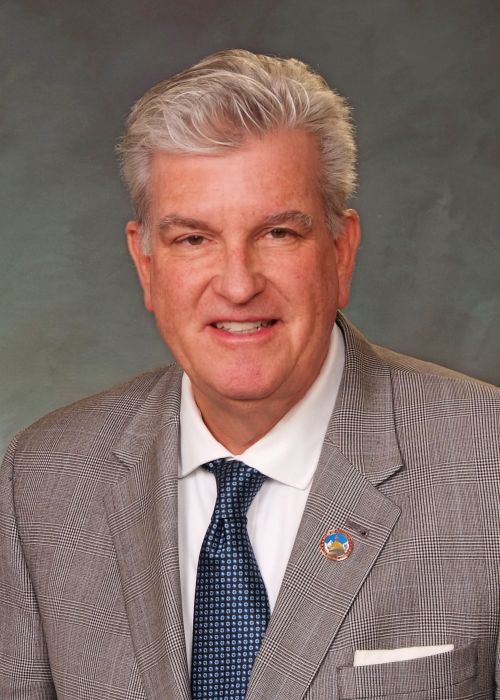
Sen. John Carson
Sponsored bills
The act allows for a county, a landowner in the town, or a registered elector in the town to apply to the secretary of state (secretary) to determine a town is abandoned when a town:Has no board of trustees or town clerk;Is unable to hold an election; andOwns or operates infrastructure critical for the treatment or delivery of water to residents. The act authorizes the department of public health and environment to transfer up to $100,000 from the small communities water and wastewater grant fund to the department of public safety to cover the cost of operation and maintenance of a town's water system if an application for abandonment of the town has been filed with the secretary and the town has a water system that is failing or is likely to fail.(Note: This summary applies to this bill as enacted.)
The act allows an applicant for licensure as a marriage and family therapist (LMFT) whose master's or doctoral degree program did not include an internship or practicum to also be registered as an LMFT candidate but requires these candidates to complete an additional 700 supervised clinical hours to become an LMFT.(Note: This summary applies to this bill as enacted.)
The act creates the 'Adults' Security and Safeguards from Exploitation in Transactions Act' or the 'ASSET Act'. The act requires or authorizes a qualified individual at a bank or credit union (financial institution) to do the following when the individual reasonably and in good faith suspects that a vulnerable adult is the victim of financial exploitation:The qualified individual must notify appropriate local law enforcement or the county agency handling adult protective services; andThe qualified individual may notify a third party previously designated by or reasonably associated with the vulnerable adult. A financial institution or qualified individual may delay a disbursement from an account if the financial institution or qualified individual:Reasonably believes that the vulnerable adult is subject to financial exploitation;Provides written notification of the delay and the reason for the delay to all parties authorized to transact business on the account within 2 business days after the requested disbursement; except that a party who is reasonably believed to have engaged in financial exploitation of the vulnerable adult need not be notified; andContinues its internal review of the suspected or attempted financial exploitation. The delay may continue until:The financial institution or qualified individual reasonably believes that the vulnerable adult is not subject to financial exploitation;Local law enforcement or the county agency handling adult protective services concludes its investigation; orA court orders that the delay be removed. A financial institution or qualified individual must make a determination within 90 days after beginning the delay of a disbursement or, if waiting on the investigation of local law enforcement or a county agency handling adult protective services, within 180 days. The disbursement must be made or refused based on the conclusions of the investigation or the expiration of the time. A financial institution and qualified individual are immune from liability arising from the actions or from failing to take the actions authorized in the act if the act or failure to act was made in good faith and exercising reasonable care. A financial institution must provide access to or copies of records that are relevant to the suspected or attempted financial exploitation of an vulnerable adult to agencies charged with administering state adult protective services laws and to law enforcement. The records made available to agencies are not public records, as defined in the 'Colorado Open Records Act'.(Note: This summary applies to this bill as enacted.)
Current law requires certain entities to file, or allows certain entities to voluntarily file, a clean energy plan to achieve an 80% reduction in greenhouse gas emissions caused by the entity's electricity sales in Colorado by 2030, relative to 2005 levels (2030 emission reductions). The act repeals current law stating that clean energy plans submitted by a cooperative electric association or a municipally owned utility under certain circumstances are deemed approved by the public utilities commission (commission) and requiring the division of administration in the department of public health and environment (division) to consult with the commission in verifying a clean energy plan submitted by a cooperative electric association or a municipally owned utility. The act also repeals current law stating that voluntary submission of a clean energy plan by a cooperative electric association or a municipally owned utility does not alter the entity's regulatory status with respect to the commission. A municipally owned utility that has encountered challenges in achieving the 2030 emission reductions may submit to the division, no later than December 31, 2026, an updated clean energy plan that demonstrates achievement of the 2030 emission reductions by the earliest date possible on or after December 31, 2029, but no later than December 31, 2032. A municipally owned utility that submits an updated clean energy plan to the division must:Provide a detailed generation and transmission plan to the division with the updated clean energy plan;Provide an annual report to the division beginning January 1, 2028, and continuing each year until December 31, 2033, that contains certain information related to the updated clean energy plan;Cease burning coal by December 31, 2032; andSeek to achieve certain additional reductions in greenhouse gas emissions without impairing the municipally owned utility's ability to maintain certain electric reliability standards. The updated clean energy plan must be verified by the division.(Note: This summary applies to this bill as enacted.)
Under current law, if a defendant is found incompetent to proceed and the defendant will not be restored to competency in the foreseeable future, the court is required to dismiss charges against the defendant and the defendant, in limited circumstances, may be referred for certification for short-term treatment through a civil court process. The act maintains the requirement for the court to dismiss the charges against a defendant if the defendant's highest charged offense is among certain misdemeanor offenses, and the act maintains certification for short-term treatment as an option for the defendant. However, if the defendant is unrestorable or the defendant has reached the statutory maximum time permitted to be restored, the act authorizes the district attorney or county attorney (prosecution) to notify the court that the prosecution seeks civil commitment or an enhanced protective placement of a defendant if the prosecution can prove by clear and convincing evidence that the defendant:Has a mental disability or developmental disability;Committed an act that, in the absence of any mental disability or developmental disability, would constitute homicide, a crime of violence, or a felony that constitutes unlawful sexual behavior, and the act is or was charged in a criminal case in Colorado in which competency was raised; and Poses a substantial risk of serious harm to others. If the prosecution seeks civil commitment or an enhanced protective placement, the court is required to stay the order dismissing the defendant's case, set a trial within 91 days after the date the written notice was filed, and order the department of human services (CDHS) to identify an appropriate provider and placement for the defendant in the event a civil commitment or enhanced protective placement is granted. The defendant may stipulate that the court order a civil commitment or enhanced protective placement. If the court finds the prosecution has not met its burden, the court is required to deny the prosecution's request to civilly commit the defendant or order an enhanced protective placement of the defendant; except that the court may consider whether to order other civil proceedings. If the court finds the prosecution has met its burden, the court is required to order the civil commitment or enhanced protective placement of the defendant, place the defendant and issue any related orders, transfer jurisdiction of the civil commitment or enhanced protective placement to an appropriate civil court with jurisdiction, and dismiss the defendant's criminal case. When the court orders the civil commitment or enhanced protective placement, the court shall make a finding of the defendant's primary diagnosis that constitutes the mental disability or developmental disability. The court shall order the defendant civilly committed to the legal custody of CDHS unless the defendant's primary diagnosis is an intellectual and developmental disability (IDD) or a neurocognitive disorder, in which case, the court shall order an enhanced protective placement and legal custody of the defendant to the department of health care policy and financing (HCPF). If CDHS proposes placing the defendant into inpatient care, the court shall order, without further court review, that the defendant be placed into inpatient care at the discretion of CDHS if the court ordered a civil commitment or that the defendant be placed into inpatient care at the discretion of HCPF if the court ordered an enhanced protective placement. If CDHS has not identified an appropriate provider that is willing to accept placement of the defendant, the court shall set a review hearing within 35 days after the order for civil commitment or enhanced protective placement and order CDHS, in consultation with the behavioral health administration (BHA), to identify at least one appropriate provider. Upon receiving jurisdiction of a civil commitment or enhanced protective placement, the act requires the civil court to supervise the civil commitment or enhanced protective placement by notifying the county attorney, appointing an attorney to represent the respondent, and setting a review hearing. At the hearing, the respondent has the right to request modification of the terms of the civil commitment or enhanced protective placement and the right to periodic review, including whether the respondent qualifies for termination of the civil commitment or enhanced protective placement. The court is required to ensure the respondent is placed in the least-restrictive setting adequate to protect the victims and community. If the respondent is not placed into inpatient care at the discretion of CDHS, or if CDHS proposes to move the respondent into or out of inpatient care, the court shall, prior to modifying the civil commitment or enhanced protective placement to change the respondent's provider or placement, review the appropriateness of the proposed provider or placement. The provider charged with the physical care and custody of the respondent is required to submit a report to the court and the parties annually by the date the respondent was civilly committed or ordered into enhanced protective placement unless a substantially similar examination was ordered by the court within the previous 12 months. The act requires the court to terminate the respondent's civil commitment or enhanced protective placement if the respondent no longer poses a substantial risk of serious harm to others or the respondent does not have the applicable disorder or disability that is likely to cause the respondent to be a danger to the respondent's self or a danger to others and the respondent has demonstrated sufficient capacity and willingness to conform their conduct to the requirements of the law. If the respondent does not meet the criteria for termination, the respondent is not entitled to another termination trial within one year after the conclusion of the previous trial. The court shall convert a civil commitment to an enhanced protective placement if the respondent does not meet the criteria for termination but the respondent has a mental health disorder that is an IDD or a neurocognitive disorder, without having any other mental health disorder that is not an IDD or a neurocognitive disorder and that substantially contributes to whether the respondent is a danger to the respondent's self or a danger to others, or is gravely disabled. If the defendant does not meet the criteria for termination and has co-occurring mental health disorders that include an IDD or a neurocognitive disorder, the court may, upon the recommendation of CDHS, convert the civil commitment to an enhanced protective placement. The court shall convert an enhanced protective placement to a civil commitment if the respondent does not meet the criteria for termination and the respondent no longer has an IDD or a neurocognitive disorder that substantially contributes to whether the respondent is a danger to the respondent's self or a danger to others, or is gravely disabled. If the defendant does not meet the criteria for termination and has co-occurring mental health disorders that do not include an IDD or a neurocognitive disorder, the court may, upon the recommendation of CDHS, convert the enhanced protective placement to a civil commitment. Under current law, an emergency mental health hold (M1 hold) may be initiated against a person for not more than 72 hours if the person appears to have a mental health disorder and, as a result of the mental health disorder, appears to be a danger to the person's self or others, or appears to be gravely disabled. A person detained for an M1 hold and transported to an emergency medical services facility or facility designated by the commissioner (facility) of the BHA is required to receive an evaluation as soon as possible after the person presents to the facility. The act authorizes a person who has an M1 hold initiated against them while in confinement to receive an evaluation at the person's place of confinement rather than being transported to a facility. If the person is released from confinement while under an M1 hold, the person responsible for the confinement is required to coordinate with the BHA to transfer the person to a facility. Under current law, if a person under an M1 hold meets the criteria for certification for short-term treatment, the person may be certified for not more than 3 months. Rather than requiring an M1 hold as a prerequisite to short-term certification or certification for long-term care and treatment, the act authorizes a person to be certified if the person:Has been advised of the availability of, but has not accepted, voluntary treatment or with consideration of all reasonably available information, is believed will not remain in voluntary treatment; and By clear and convincing evidence, has a mental health disorder and, as a result of the mental health disorder, the person is a danger to the person's self, a danger to others, or gravely disabled. A person may not be certified for short-term treatment or long-term care and treatment if the person has an IDD or neurocognitive disorder without any other mental health disorder that is not an IDD or neurocognitive disorder and that substantially contributes to whether the respondent is a danger to the respondent's self or a danger to others, or is gravely disabled. If a respondent is certified, the court shall order CDHS to provide care coordination and make diligent efforts to find a provider for the respondent that is willing to hold the certification. The respondent may be certified for long-term care and treatment if the respondent continues to meet the criteria and standards for certification for short-term treatment. The certification terminates when the professional person in charge of the respondent's treatment and the BHA determine the respondent no longer meets the criteria for certification. To terminate a short-term treatment certification less than 30 days after the initial certification, two professional persons are required to individually consult and review the respondent's case and agree that the respondent no longer meets the criteria for certification. A court may order the short-term or long-term protective placement of a person:Who, by clear and convincing evidence, has a neurocognitive disorder;When reasonable grounds exist to believe that the person will not remain in a voluntary treatment program; andWho, by clear and convincing evidence, is a danger to the person's self, a danger to others. The act aligns the provisions for short-term and long-term protective placement with certifications for short-term treatment and long-term care and treatment. No later than October 1, 2027, the act requires CDHS to construct and operate an outpatient treatment facility for adults with behavioral health needs, including adults who are found incompetent to proceed and unlikely to be restored to competency. To implement the act, for the 2025-26 state fiscal year, the act appropriates to CDHS $535,934 from the general fund and $4,777,898 from the capital construction fund. To implement the act, the act makes the following appropriations for state fiscal year 2026-27:$17,802,360 to CDHS from the general fund, of which $242,323 is reappropriated to the department of law and $52,644 to the office of information technology;To the judicial department, $26,296 from the judicial department information technology cash fund and $5,401,437 from the general fund, of which $1,719,409 is for use by the office of state public defender and specified independent agencies;$842,808 to HCPF from the general fund; and$150,000 to the department of law from the general fund.(Note: This summary applies to this bill as enacted.)
Maddy summaryThis bill formally declares that the Colorado General Assembly's Second Regular Session will end on May 13, 2026, when it adjourns sine die. The measure directly affects the state legislature by establishing the official conclusion date for the current session of lawmakers. It does not create new laws or change policies, but rather sets the procedural timeline for when the legislative body will stop meeting for this session.
Maddy summarySJR 23 is a recognition bill that formally commends Young Americans Bank and the Young Americans Center for Financial Education for their long-term work in teaching financial literacy to students in Colorado. The measure highlights how these organizations provide real-world banking experiences and educational programs that support the state's new high school financial literacy requirements. This legislative action does not change any laws or allocate funding; instead, it simply acknowledges the contributions of these specific institutions to youth economic education.
Maddy summaryThis bill designates May 2026 as "Motorcycle Safety Awareness Month" in Colorado to promote rider safety and encourage shared road awareness. The resolution aims to highlight the importance of motorcycle rider training and education while reminding all drivers to be alert around motorcycles. It does not create new laws or change existing regulations but serves as a formal recognition to raise public awareness about motorcycle safety.
Maddy summaryThis bill memorializes former Senator MaryAnne Tebedo, honoring her life and contributions to Colorado public service. The legislation formally recognizes her decades of work in politics, including her roles as a campaign staffer, state representative, and state senator, as well as her efforts in passing funeral contract laws and her work as a mediator. It expresses the General Assembly's gratitude for her public service and extends sympathy to her surviving family members. Copies of the memorial will be sent to her children as a gesture of respect.