

The act eliminates the requirement for the department of education (department) to administer a state assessment in social studies to elementary school students and specifies that the department is only required to administer a state assessment in social studies to students enrolled in seventh grade in a public school. The act also eliminates the requirement that the department administer a state assessment in social studies in a representative sample of public schools each year. The act reduces by the appropriation made in the annual general appropriation act for the 2026-27 state fiscal year to the department of education from the state education fund for the statewide assessment program by $302,835.(Note: This summary applies to this bill as enacted.)
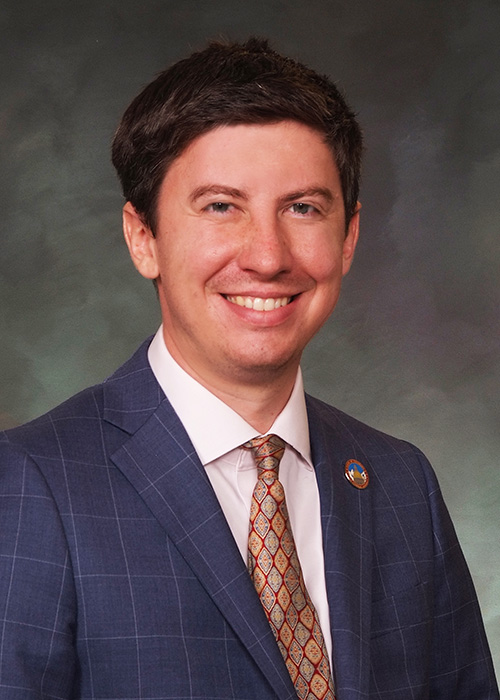
Sen. William Lindstedt
Sponsored bills
The act exempts pilates and barre teacher training courses, programs, and schools from regulation under the 'Private Occupational Education Act of 1981'.(Note: This summary applies to this bill as enacted.)
Beginning June 1, 2027, a person convicted for the first time of certain offenses related to driving while under the influence of drugs or alcohol is required to hold an interlock-restricted license for a consecutive period of nine months following reinstatement of the person's driver's license prior to being eligible to obtain any other driver's license, except in limited circumstances. If a person's driving privileges have been revoked for one year or more because of a refusal related to certain offenses related to driving while under the influence of drugs or alcohol, current law authorizes the person to apply for early reinstatement with an interlock-restricted license after the driving privilege has been revoked for 2 months. Beginning June 1, 2027, the 2-month waiting period is repealed. Under current law, a financial assistance program (assistance program) is available to assist people who apply for an interlock-restricted license and are unable to pay the full cost of an approved ignition interlock device. The act restricts eligibility for the program to those who satisfy certain income criteria. A certified ignition interlock manufacturer (manufacturer) must provide a person who is eligible for the assistance program certain discounts on installation of, lease charges for, and removal of an interlock device. The manufacturer must provide certain information regarding the assistance program at the time the interlock device installation appointment is scheduled and when a person executes an interlock device lease or service agreement. The act appropriates $15,225 to the department of revenue to implement the act.(Note: This summary applies to this bill as enacted.)
The act extends for an additional 10 years the availability of the state income tax credit allowed to a taxpayer who makes a qualifying monetary contribution to promote child care in the state equal to 50% of the total value of the contribution, not to exceed $100,000, through income tax years commencing prior to January 1, 2038.(Note: This summary applies to this bill as enacted.)
The act makes the following changes to the 'Labor Peace Act':Specifies that employees' right to bargain collectively includes the right to bargain collectively concerning any mandatory subject of bargaining;Eliminates the requirement for a second election to negotiate a union security agreement clause in the collective bargaining process;Declares that it is not an unfair labor practice for an employer to refuse to agree to a lawful proposal made by the exclusive representative of the employees, or for the exclusive representative of the employees to refuse to agree to a lawful proposal made by the employer, concerning a mandatory subject of bargaining if the refusing party has bargained in good faith with the other party; andRequires employers and employees, through their exclusive representative, to bargain in good faith.(Note: This summary applies to this bill as enacted.)
The act requires an institution of higher education (institution) that operates a student health center to provide abortion medication to all students enrolled at the institution. The act requires an institution that has an on-site prescription drug outlet or other outlet to maintain a stock of and provide access to abortion medication to students enrolled at the institution. The act requires an institution that does not have an on-site prescription drug outlet or other outlet to either submit a prescription for abortion medication to an off-campus prescription drug outlet or other outlet or dispense abortion medication through the institution's student health center if permitted by the student health center's licensure. The act prohibits an institution from knowingly providing personally identifiable information contained in a student's patient records, billing records, or precise location data related to accessing abortion medication in response to a request from another state seeking to impose liability for accessing abortion medication. An institution is not required to provide access to or stock abortion medication if doing so would jeopardize an institution's federal grant participation, require the institution to deviate from generally accepted billing practices, modify the generally accepted standards of medical practice, or conflict with the institution's sincerely held religious beliefs or practices.(Note: This summary applies to this bill as enacted.)
Beginning on January 1, 2027, the act authorizes an optional collision prevention fee (fee), which is collected at the time of registration of a passenger motor vehicle, light-weight truck, motorcycle, or recreational vehicle (motor vehicle). An individual may decline to pay the fee when registering a motor vehicle, and nonpayment of the fee does not affect the individual's ability to register the motor vehicle. In connection with imposing the fee, the statewide bridge and tunnel enterprise (enterprise) within the department of transportation (department) is required to collaborate with:The department of revenue and county clerks to develop language to notify individuals about the fee, including explicit language regarding the ability to decline to pay the fee and the fact that nonpayment of the fee will not affect an individual's ability to register a motor vehicle; andThe department of revenue, the department, county clerks, the division of parks and wildlife, and other impacted stakeholders to conduct a public outreach campaign to educate the public about the fee and what benefits the fee will provide. The enterprise is required to initiate the public outreach campaign as soon as practicable and must develop and deliver customer-facing educational materials to county clerks on or before December 1, 2026.The fee amount is set at $5 and, beginning in state fiscal year 2028-29, the enterprise is allowed to adjust this fee amount upward for inflation. 75% of the revenue from the fee is credited to the newly created collision prevention fund (fund), which is continuously appropriated to the enterprise for use in the following ways:To fund wildlife safe passage projects, defined as one or more projects that reduce wildlife-vehicle collisions and improve habitat connectivity by providing wildlife road crossings;To provide matching money as required by federal grant programs relating to wildlife safe passage projects; To expend for administrative and personnel expenses related to those purposes; andTo promote the fee and fund to maximize participation in the optional fee, in collaboration with the department of revenue, impacted stakeholders, and interested organizations.In determining which wildlife safe passage projects the enterprise will undertake, the enterprise is required to:Consult with the division of parks and wildlife (division) and the Colorado wildlife and transportation alliance;Consult with the tribal government if the project is on or adjacent to tribal land;Consult with relevant local governments with jurisdiction over the area of the proposed project and any relevant local organizations engaging in work to reduce vehicle collisions;Consider studies concerning the prioritization of wildlife within the state;Consider whether the wildlife safe passage project is related to a bridge or tunnel project undertaken by the enterprise; andIn consultation with the division, consider opportunities for landowner agreements or additional conservation efforts that may be necessary to ensure the continued functionality of infrastructure associated with a proposed wildlife safe passage project. 25% of the revenue from the fee is credited to the wildlife cash fund and continuously appropriated to the division to provide services related to wildlife connectivity and wildlife crossing-related conservation efforts. The act also modifies the process for the keep Colorado wild pass fee, which is an existing optional fee paid at the time an individual registers a motor vehicle, to align with the process for the collision prevention fee by removing the presumption that an individual who declines to pay the keep Colorado wild pass fee is presumed to decline to pay that fee in subsequent years with respect to registration of the same motor vehicle. With this change, an individual must affirmatively opt out of the payment of both the keep Colorado wild pass fee and the collision prevention fee each year that the individual registers the motor vehicle. For the 2026-27 state fiscal year:$53,516 is appropriated from the DRIVES cash fund to the department of revenue for use by the division of motor vehicles; Of funds appropriated from the parks and outdoor recreation cash fund to the department of natural resources for use by the division, $778 is reappropriated to the department of revenue for use by the division of motor vehicles; and$19,940 is appropriated from the legal services cash fund, from revenue received from the department from the collision prevention fund, to the department of law to provide legal services for the department.(Note: This summary applies to this bill as enacted.)
The act clarifies that, for the purposes of the 'Uniform Dissolution of Marriage Act', domestic violence includes specified acts or threatened acts of harm or property damage against a family or household member; and clarifies that the conduct in the definition of domestic violence is domestic violence regardless of whether it constitutes a criminal offense. A person's protective behaviors do not constitute domestic violence. For purposes of determining the allocation of parental responsibilities based on the best interests of the child, the act requires that for any evidence submitted to the court concerning whether a party has committed domestic violence, child abuse or neglect, or sexual assault that resulted in the conception of a child, the court may consider any relevant and admissible evidence, and the court shall make findings on the record by a preponderance of the evidence whether the party has committed domestic violence, child abuse or neglect, or sexual assault that resulted in the conception of a child. If the court determines by a preponderance of the evidence that a party has committed domestic violence, child abuse or neglect, or sexual assault that resulted in the conception of a child, the act outlines the considerations that the court must undertake when determining decision-making responsibility and parenting time. Under current law, prior to a court ordering a party accused of domestic violence or child abuse to take steps to improve a relationship with a protected party, a mental health professional who is approved by the domestic violence offender management board must verify the accused party's behavior. Instead, the act requires that the accused party participate in treatment with a mental health professional who holds a master's or doctoral degree and a mental health professional license and has specialized training and expertise in treating survivors and perpetrators of domestic violence and child abuse and the effects of domestic violence and child abuse.(Note: This summary applies to this bill as enacted.)
The act authorizes a local government with permitting authority over land uses (local government) to designate one or more areas within the jurisdiction of the local government as renewable energy reinvestment areas for the siting of renewable energy and energy storage system projects (eligible projects). In designating an area as a renewable energy reinvestment area, the local government must hold at least one public hearing and hold at least one public hearing for any construction permit applications required for a proposed eligible project in the renewable energy reinvestment area or must designate the area as part of an urban renewal plan or county revitalization plan and ensure that any outreach to and engagement of disproportionately impacted communities is consistent with statutory requirements. A local government cannot designate an eligible site within tribal lands without first consulting with the tribe with jurisdiction over the lands. If an eligible project is sited in a renewable energy reinvestment area, an urban renewal authority or county revitalization authority (authority) may distribute tax increment revenue to finance or reimburse costs associated with the eligible project if the renewable energy reinvestment area is included in the authority's urban renewal plan or county revitalization plan. In response to a request made by a local government or an eligible project developer for information regarding a designated renewable energy reinvestment area, a utility is required to acknowledge the request and provide the requestor readily available information within 30 days after the request is made. The Colorado energy office is required to consolidate, publish on its website, and periodically update technical and informational resources concerning the process for siting, permitting, and developing eligible projects in renewable energy reinvestment areas.(Note: This summary applies to this bill as enacted.)
The act requires a court to sentence a defendant convicted of second degree assault by strangulation in an enhanced range as a crime of violence subject to mandatory incarceration if the defendant has previously been convicted of second degree assault by strangulation. A previous conviction must be set forth in the complaint, indictment, or information for the present act.(Note: This summary applies to this bill as enacted.)