

The act authorizes the department of health care policy and financing (state department) to seek federal authorization from the centers for medicare and medicaid services to provide medicaid reimbursement for community health worker services. The act requires the state department to hold at least 4 public stakeholder meetings to solicit input on considerations to include in the state department's request for federal authorization. The act grants the state department the authority to promulgate rules regarding the voluntary competency-based community health worker registry. The act requires that on or before January 31, 2026, the state department include a report on how community health workers are being utilized through medicaid in its presentation to the joint budget committee of the general assembly and in its presentation at the "State Measurement for Accountable, Responsive, and Transparent (SMART) Government Act" hearing. For the 2023-24 state fiscal year, the act appropriates $40,717 from the general fund to the state department to be used by the executive director's office as follows: $36,842 for personal services; and $3,875 for operating expenses. For the 2023-24 state fiscal year, the act anticipates the state department will receive $40,717 in federal funds to be used as follows: $36,842 for personal services; and $3,875 for operating expenses. For the 2023-24 state fiscal year, the act appropriates $169,973 to the department of public health and environment to be used by chronic disease prevention programs in the prevention services division for the community health workers initiative. APPROVED by Governor May 10, 2023 EFFECTIVE August 7, 2023 NOTE: This act was passed without a safety clause and takes effect 90 days after sine die. (Note: This summary applies to this bill as enacted.)
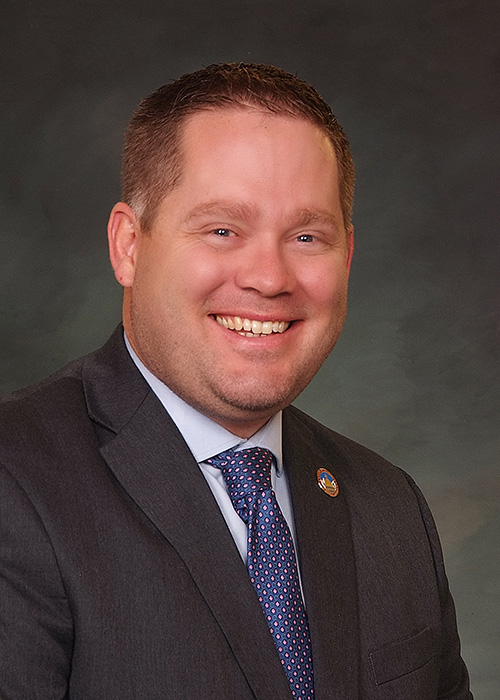
Sen. Kyle Mullica
Sponsored bills
The bill makes it a level 1 drug felony if a person sells, dispenses, distributes, or otherwise transfers any quantity of a controlled substance or any material, compound, mixture, or preparation that contains any amount of a schedule I or II controlled substance and the sale, dispensing, distribution, or transfer is the proximate cause of the death of another person who used or consumed the controlled substance material, compound, mixture, or preparation. It is not a violation if the violation involves distribution or transfer of the controlled substance if the distribution or transfer is done without remuneration and is for the purpose of consuming all of the controlled substance with another person or persons at a time substantially contemporaneous with the transfer and the distribution or transfer involves not more than 4 grams of a schedule I or II controlled substance; not more than 2 grams of methamphetamine, heroin, ketamine, or cathinones; or not more than one gram of fentanyl, carfentanil, benzimidazole opiate, or an analog thereof. For a violation of unlawful distribution, manufacturing, dispensing, or sale of the material, compound, mixture, or preparation that weighs more than 225 grams and contains a schedule I or schedule II controlled substance; more than 112 grams and contains methamphetamine, heroin, ketamine, or cathinones; more than50 milligrams and contains flunitrazepam; or more than 50 grams and contains fentanyl, cargentanil, benzimidazole opiate, or an analog thereof that is not a level 1 drug felony, the bill requires, if the court sentences the defendant to incarceration, a mandatory minimum sentence of at least midpoint but no more than the maximum of the sentencing range. (Note: Italicized words indicate new material added to the original summary; dashes through words indicate deletions from the original summary.) (Note: This summary applies to the reengrossed version of this bill as introduced in the second house.)
On July 1, 2023, the state treasurer is required to transfer $10 million from the severance tax operational fund to the capital construction fund. The money is to be used by state-supported institutions of higher education in energy impacted counties for energy-related programs or projects. For fiscal year 2023-24, the act appropriates $6 million from the capital construction fund and $3,108,609 in cash funds from Colorado Mesa university institutional reserves and donations to expand the university's campus-wide geothermal exchange system. For fiscal year 2023-24, the act appropriates $4 million to Western Colorado university to provide additional teaching and laboratory space for the university's petroleum geology program and to generally allow for the expansion of the natural and environmental sciences department. APPROVED by Governor April 28, 2023 EFFECTIVE April 28, 2023 (Note: This summary applies to this bill as enacted.)
Current law allows a person who is 18 years of age or older to knowingly possess or purchase a firearm. The act increases the age to legally purchase a firearm to 21 years of age or older. The act makes the unlawful purchase of a firearm by a person who is less than 21 years of age a class 2 misdemeanor and makes it unlawful for a licensed or unlicensed gun dealer to facilitate such a sale. Exceptions include: The person is an active member of the United States armed forces; or The person is a peace officer or certified by the P.O.S.T. board. APPROVED by Governor April 28, 2023 EFFECTIVE August 7, 2023 NOTE: This act was passed without a safety clause and takes effect 90 days after sine die. (Note: This summary applies to this bill as enacted.)
The act grants the state historical society, also known as history Colorado, the authority to sell 3 properties that no longer fit within the mission of history Colorado. Specifically, the act grants history Colorado the authority to sell the following: The real property known as the McFarlane House in Central City; The real property known as the Pearce-McAllister Cottage in Denver; and The real property known as the Pueblo Museum Support Center, which was used as a storage facility by history Colorado until the artifacts housed at the facility were recently moved to a more northern storage facility for better access by history Colorado staff. The act specifies that the proceeds of the sales are to be credited to the state museum cash fund to be used in connection with the acquisition or construction of a consolidated collections care and storage facility or for controlled maintenance. APPROVED by Governor March 31, 2023 EFFECTIVE March 31, 2023 (Note: This summary applies to this bill as enacted.)
The bill implements recommendations from the dyslexia working group. The bill: Directs school districts, boards of cooperative services, charter schools, and institute charter schools (local education providers) to screen for students at risk of foundational literacy skill deficits; Directs local education providers to provide evidence-based supplemental instruction and intervention for children at risk of foundational literacy skill deficits; Requires local education providers to provide the public and parents information regarding which screening and interventions the local education provider uses for foundational literacy skill deficits; Requires the department of education to provide professional development for local education providers and the public in evidence-based best practices, including screening, supplemental instruction, and intervention; and Establishes an independent ombudsman office.(Note: This summary applies to this bill as introduced.)
With regard to referrals for placement in an assisted living residence (residence), the bill: Amends the definition of "referral agency" to specify that the term means an agency that receives a fee from a residence for providing referrals; Allows electronic documentation of an agreement between a referral agency and a prospective tenant (agreement); and Prohibits a referral agency from referring a prospective resident to more than a reasonable number of assisted living residences with the intent to deny another referral agency a referral fee. The bill adds that an agreement must include: The right not to be contacted by the referral agency; and The right to receive the referral agency's privacy policy.(Note: This summary applies to this bill as introduced.)
Sections 1 and 5 of the act authorize the director of the division of professions and occupations (division) in the department of regulatory agencies to appoint or employ individuals who are licensed or, if not licensed, who demonstrate substantial work experience in the electrical, plumbing, or construction industry to: Conduct compliance checks to ensure compliance with licensing and supervisor-to-apprentice ratio requirements applicable to electricians and plumbers on projects throughout the state; and Prioritize for compliance checks projects that provide or will provide critical needs to state residents. The act also: Specifies that only a homeowner performing work on the homeowner's home or a licensed master electrician or plumber who is either a registered electrical or plumbing contractor or directly employed by a registered electrical or plumbing contractor may apply for an electrical or a plumbing permit (sections 2 and 6); Prohibits a licensed master electrician or plumber who is not a registered electrical or plumbing contractor and who is working as an independent contractor from applying for an electrical or a plumbing permit (sections 2 and 6) and makes a violation of this prohibition specific grounds for discipline by the electrical or plumbing board, as applicable (sections 3 and 4); Requires the entity issuing the permit to verify that the applicant meets the qualifications to apply for the permit (sections 2 and 6); and Requires inspecting entity procedures to include a provision allowing the inspecting entity to request worker documentation indicating compliance with worker license requirements and the supervisor-to-apprentice ratio (sections 2 and 6). Section 7 of the act appropriates $191,991 for the 2022-23 state fiscal year from the division of professions and occupations cash fund to the department of regulatory agencies to implement the act, allocated as follows: $127,110 for use by the division for personal services, including 2.0 additional FTE; $45,847 for the division's operating expenses; and $19,034 for the purchase of vehicle lease services, which amount is reappropriated to the department of personnel to provide vehicle replacement lease/purchase services.(Note: This summary applies to this bill as enacted.)
The act creates the Colorado rare disease advisory council (council) in the department of public health and environment (department) to inform state agencies, the public, and the legislature about rare diseases and make recommendations concerning the needs of Coloradans living with rare diseases and their medical providers and caregivers. The council consists of 12 voting members and one nonvoting member representing the office of health equity in the department. The council's 12 voting members include, in part, a researcher, a geneticist, a physician, a professional nurse, a pharmacist, persons living with a rare disease, the parent of a child diagnosed with a rare disease, and representatives of the biotechnology or pharmaceutical industry and of a health insurer. Members of the council are appointed by the speaker and minority leader of the house of representatives and the president and minority leader of the senate. The appointing authorities shall make initial appointments to the council by October 1, 2022. The act specifies the powers of the council and the activities that the council must perform. The activities include, in part: Convening public meetings and soliciting public comment to assist with a state survey of the needs of individuals in the state living with rare diseases; Consulting with experts and developing policy recommendations to improve access to rare disease specialists, clinical trials, timely treatment, and affordable and comprehensive health care; Educating and making recommendations to state agencies and health insurers concerning issues relating to utilization management procedures for treatment of patients with rare diseases; Researching and identifying best practices regarding continuity of care for patients who transition from pediatric to adult care; and Establishing a publicly accessible web page or website to include research, diagnosis, treatment, and other educational materials for providers and patients relating to rare diseases. Unless the council determines that a facilitator is not needed, the council shall contract with a facilitator to provide assistance to the council in carrying out the council's activities. The facilitator's activities may include, in part, conducting meetings, organizing the work of the council, conducting research on issues addressed by the council, conducting public outreach and soliciting expert and public feedback, and publicizing council recommendations. The council and the facilitator may seek, accept, and expend gifts, grants, and donations for the council's activities. The general assembly may appropriate money for the council. The act includes provisions for council meetings, including the number of meetings, notice to the public, and requirements regarding open meetings and public access to council records. The council shall submit an initial report 12 months after the council is established and then report annually to the governor and the health committees of the general assembly concerning the council's activities, funding, and recommendations addressing the needs of people living with rare diseases. The council repeals September 1, 2032, unless extended through the sunset process. For the 2022-23 state fiscal year, the act appropriates $80,567 from the general fund to the department for administration and support to the council. The appropriation is based on the assumption that the department will require and additional 0.4 FTE. (Note: This summary applies to this bill as enacted.)