

An inmate who is serving a sentence to the department of corrections (DOC) for certain lower level criminal offenses, has not incurred a penal discipline violation within a specified time period, and is program compliant is currently eligible to earn 12 days of earned time per month. The act increases eligibility to 14 days per month. An inmate who is serving a sentence for, or who has been previously convicted of, certain higher level criminal offenses, including a felony offense listed in the 'Victim Rights Act', is currently eligible to earn 10 days of earned time per month. The act increases eligibility to 12 days per month. An inmate who completes a milestone or phase of a behavioral health program in an area related to recovery from a condition that contributed to the inmate's underlying offense may be awarded up to 150 days of earned time. The DOC is directed to enact policy changes to incentivize inmates to pursue activities that award earned time. The act creates a working group to make recommendations for a capacity management plan (plan) for the DOC with input from impacted groups. The plan must be informed by strategies to assess prison programming and clinical care, inmate release processes, services for successful release outcomes, prison population management, and prison capacity changes. Members of the house of representatives judiciary committee, the senate judiciary committee, and the joint budget committee may submit in writing to the chair of the working group a request to prioritize specific issues or provide other relevant information. The working group shall submit an interim and a final report to the general assembly, the DOC's certified employee organization, and the governor's office.(Note: This summary applies to this bill as enacted.)
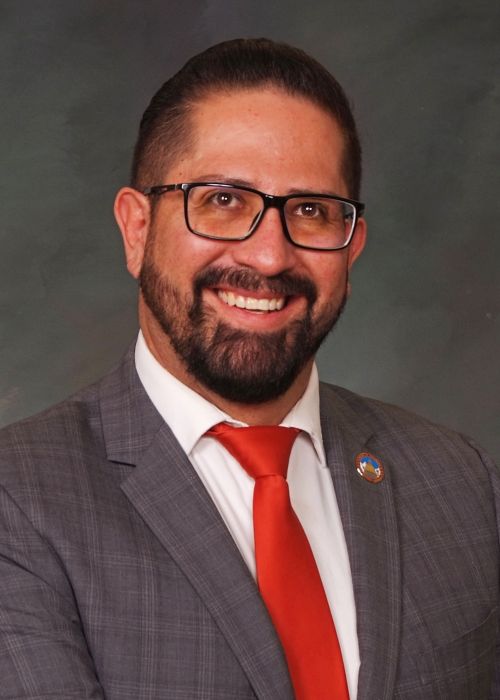
Rep. Matt Martinez
Sponsored bills
Maddy summaryThis bill is a Senate Joint Resolution that formally recognizes the Colorado Mining Association for its 150th anniversary in 2026. It highlights the organization's historical significance and its role in supporting Colorado's mining industry, which contributes billions to the state's economy and supports tens of thousands of jobs. The resolution acknowledges the association's partnerships with state and federal agencies in promoting safety, environmental stewardship, and responsible mineral development. This measure does not change any laws or policies but serves as an official acknowledgment of the association's contributions to Colorado's history and economy.
The act declares emergency medical services as an essential service in the state and an integral part of the state's health-care infrastructure. The act also declares that emergency medical service providers, whether responding on duty or as a volunteer and regardless of location, provide essential services when providing emergency ambulance services and nonemergency ambulance services. The act also updates certain definitions related to emergency medical services, including the addition of a definition of 'out-of-hospital services', which term is defined to mean the furnishing of necessary health-care goods and services outside of a hospital setting but does not include prehospital setting transports. The act clarifies that an off-duty emergency medical service provider is not obligated to respond to the scene of a medical emergency or provide emergency medical services.(Note: This summary applies to this bill as enacted.)
Current law establishes a statewide integrated system of early childhood councils (councils) to improve and sustain the availability, accessibility, capacity, and quality of early childhood services. The act expands the powers, functions, and responsibilities of a council in implementing a comprehensive system of early childhood and family support programs and services (programs and services) within the council's community. Current law establishes local coordinating organizations (LCOs) to increase access to, coordinate, and allocate funding for programs and services through work with the families, program and service providers, and local governments in a community and with the department of early childhood (department). Effective July 1, 2026, the act repeals provisions authorizing the creation and operation of LCOs and transfers the LCO rights, powers, duties, functions, and obligations concerning supporting access to and delivery of programs and services to the councils (transfer). If the transfer requires the consolidation, reassignment, or material modification of the duties of a council or LCO, the department may authorize a one-time extension of the transition period for up to 3 years. Current law requires a council to develop a community strategic plan based upon an assessment of the early childhood needs in the council's designated service area (community strategic plan). The act requires a community strategic plan to address specified issues, including:Assisting families in applying for programs and services;Coordinating outreach efforts with other local entities and tribal agencies;Recruiting and coordinating providers to form a mixed delivery system that promotes family choice; andSupporting increased recruitment and retention of individuals in the early care and education workforce. The act requires a council, in partnership with the department, to create, review, and revise a scope of work that reflects the community strategic plan and accurately represents the programs and services within the community, meets families' needs, and aligns with available appropriations and the department's statewide strategic planning process. Associated accountability metrics must also be reviewed and revised to align with the scope of work. The act specifies a council's new obligations regarding improving access to high-quality programs and services, early childhood workforce development, data-sharing agreements, outreach for holistic family services, and auditing. The act establishes requirements for an agreement that sets forth the respective duties of a council and the department in implementing a community strategic plan (agreement). The act identifies the department's responsibilities for the coordinated distribution of public funding for programs and services; council training and technical assistance; dissemination of information about successful council strategies and innovations; and standards for communication, resolution of disputes, and contracting protocols. The act modifies the process for the department to approve or facilitate a waiver of the rules for the implementation of council projects. The act requires the department to implement an annual performance review process for each council and solicit community feedback about a council's performance at intervals ranging from 3 to 5 years. If the department determines that a council is not meeting the requirements of the scope of work and accountability metrics contained in the agreement, the department may require the council to implement a performance improvement plan. If a council fails to make substantial progress toward addressing the issues raised in the performance improvement plan, the department may terminate the council's agreement. The act makes substantive and technical conforming amendments to address the reallocation of responsibilities and functions from LCOs to councils, including administrative and funding provisions related to the Colorado child care assistance program and the Colorado universal preschool program.(Note: This summary applies to this bill as enacted.)
Maddy summaryThis bill establishes new educational requirements for individuals seeking to become licensed school counselors in Colorado. To qualify for an initial school counselor license, applicants must now hold a master's degree or higher specifically in school counseling from an accredited institution, with the program requiring at least 48 graduate semester credit hours. The legislation aims to ensure that school counselors entering the profession have comprehensive graduate-level preparation in counseling practices, student development, and strategies to support students facing behavioral and academic challenges. This change directly affects current and future school counselor candidates in Colorado who must meet these updated academic standards to obtain their professional license.
Beginning January 1, 2027, the act requires an agricultural employer to pay certain agricultural employees overtime pay for time worked in excess of 56 hours in a workweek. The act also increases penalties for an agricultural employer who commits wage theft and repeals the authority of the director of the division of labor standards and statistics to adopt rules concerning overtime pay for agricultural employees.(Note: This summary applies to this bill as enacted.)
The water quality control division (division) administers a program to test for and remediate water quality issues for mobile home parks (program). The program tests for water quality issues that pose a risk to not only health or safety but also the welfare of park residents. The act authorizes the division to require remediation of welfare-related water quality violations. One of the requirements of the program is for the park owner to certify that the park owner has made certain water-quality-related notices to park residents. The act authorizes the division to issue an order requiring the park owner to comply with the park resident notice certification requirement. Under the program, the park owner is prohibited from imposing the cost of compliance with certain remediation-related requirements on park residents. The act authorizes a park owner who is also a park resident to bear this cost. The program authorizes the division to issue orders requiring the park owner to perform additional water testing, perform temporary measures necessary to address acute health risks, make additional reports to the division, create a remediation plan, implement a remediation plan, or respond to the division in connection with a remediation plan. The act clarifies that a park owner may ask for a hearing only regarding the orders that concern remediation plans. The act also clarifies that:The division has authority to enforce the requirements of the program; andThe division has authority to issue cease-and-desist orders to address violations related to the program, regardless of whether the issues are related to water quality violations. The act also provides that:An additional monthly penalty of up to $5,000 for a continuing violation may be imposed for the first 30 days of noncompliance; andA park owner is not entitled to an administrative hearing to contest an imposed civil penalty but may seek judicial review.(Note: This summary applies to this bill as enacted.)
Existing law specifies that an individual must be a certified death investigator or forensic pathologist to be eligible to hold the office of county coroner in a county with a population greater than 150,000. The act changes this requirement to apply in a county with a population greater than 300,000. The act also requires a county coroner to disclose, on the coroner's website, their financial interest in businesses regulated by their office, including a mortuary, funeral home, crematory, embalming service, or other death-care business. A coroner who has disclosed a financial interest shall not participate in an official action that would directly and specifically affect the business in which the coroner has a financial interest. The act does not prohibit a coroner or candidate for coroner from operating a death-care business.(Note: This summary applies to this bill as enacted.)
The bill prohibits a government entity from accessing a database that reveals an individual's or a vehicle's historical location information, subject to certain exceptions. The bill prohibits a government entity from sharing historical location information with third parties or government agencies outside their jurisdiction, subject to certain exceptions, and makes historical location information not a public record for the purposes of the "Colorado Open Records Act".The bill requires a government entity that collects historical location information to adopt a policy to maintain compliance with the provisions of the regulatory scheme.An enforcement action is created for the attorney general to enforce the provisions of the bill. Historical location information obtained in violation of the prohibitions of the bill are inadmissible in trial.(Note: This summary applies to this bill as introduced.)
The bill regulates the manufacture, distribution, sale, and consumption of lawful tetrahydrocannabinol (THC) beverages. A 'lawful THC beverage' is defined as a nonalcoholic beverage product that is infused with THC derived from a legal source of hemp that contains no more than 10 milligrams of total THC per serving. The bill permits a person that is registered (registrant) with the department of public health and environment (CDPHE) as a hemp products manufacturer to manufacture lawful THC beverages if the registrant uses an approved source of hemp, complies with rules adopted by the CDPHE related to product labeling, production, and transportation, and sells the lawful THC beverages under certain circumstances. A registrant that manufactures a lawful THC beverage shall only sell the lawful THC beverage to a wholesaler that is licensed by the state licensing authority in the department of revenue (DOR). The bill prohibits manufacturers from selling lawful THC beverages directly to a retail licensee or directly to a consumer. The bill directs the CDPHE to adopt rules related to the labeling, packaging, and consumer notice requirements for lawful THC beverages on or before January 1, 2028. A manufacturer of a lawful THC beverage shall also adhere to the testing standards and requirements adopted by the CDPHE for hemp products. A person licensed by the state licensing authority in the DOR (licensee) may sell a lawful THC beverage to a consumer if the licensee obtains a lawful THC beverage permit. A licensee must apply to the state licensing authority for the lawful THC beverage permit, and, if the lawful THC beverage permit is granted, the licensee may sell a lawful THC beverage under the rules of their existing license and additional rules adopted by the DOR specific to the sale of a lawful THC beverage. A licensee shall not:Sell a lawful THC beverage to an individual under 21 years old;Sell a lawful THC beverage to an individual who is visibly intoxicated;Allow a lawful THC beverage to be removed from the premises if the beverage is sold for on-site consumption;Permit the use of marijuana or marijuana products on the premises; orMix a lawful THC beverage and an alcohol beverage in the same container. The bill prohibits the manufacture or sale of lawful THC beverages that are made from synthetic or semi-synthetic cannabinoids. The bill directs the DOR, in consultation with the CDPHE, to adopt rules related to the sale, transportation, inventory, recall, and seizure of lawful THC beverages. The bill permits a local government to prohibit the sale of lawful THC beverages within the local government's jurisdiction.(Note: This summary applies to this bill as introduced.)