

The act modifies the 'Uniform Election Code of 1992' (code) as follows:Regarding elections generally, includes in the definition of 'identification' for purposes of the code a division of youth services identification card or written correspondence from a county sheriff to the county clerk indicating that an elector is confined in a county jail or detention facility; repeals the definition of 'political party district'; modifies the definition of 'video security surveillance recording' to include a system in which continuous recording is triggered when motion is detected; modifies the definition of 'watcher' to prohibit a person from being selected as a watcher if the person has been convicted of certain election offenses or of committing or conspiracy to commit certain federal offenses; if the governor declares a disaster emergency due to the inability to strictly comply with the code, allows the secretary of state (secretary) to adopt rules for the proper administration of an election and requires the governor to establish an election emergency advisory group to advise the secretary and the governor regarding emergency orders or rules necessary to ensure the proper administration of an election; allows the secretary to provide access to, rather than transmit a complete copy of, all pertinent, updated elections laws to each county clerk and recorder (clerk); and requires each clerk to set operational hours for the clerk's office;Regarding the qualification and registration of electors; specifies information that all institutions of higher education, rather than just state institutions of higher education, must provide to students via email or signs concerning voting, voter eligibility, and registration, and requires the secretary to adopt rules further specifying the form and content of the emails and signs; requires the clerk to make printed affidavit forms available to correct an error in the elector's affiliation recorded in the statewide database; requires the secretary to ensure preregistrants who are 17 years and 6 months old can access their voter registration information and update that information using the state's online voter registration system; requires the statewide voter registration system to support the integration and use of geographic information system data to improve the accuracy, consistency, and reliability of voter registration records; modifies the language concerning preregistration of high school students; specifies that the principal of a public high school or their designee who assists in preregistration and registration to vote are high school liaisons, rather than deputy registrars, and eliminates certain filing requirements for registration or preregistration to vote; modifies how a clerk verifies identifiers provided by an elector who registers to vote in another county or another state; prohibits a clerk from canceling the registration record of an elector with multiple registrations unless there is a match in the county's registration records and the statewide voter registration database with respect to certain identifiers of the elector; and makes the secretary, rather than the clerk, responsible for canceling certain registrations pursuant to existing law, while still allowing the secretary to request assistance from the clerks;Regarding presidential electors, specifies that if a presidential or vice-presidential candidate dies or withdraws as a candidate after accepting the nomination of a political party but prior to the meeting of presidential electors, an elector's vote for the presidential candidate or vice-presidential candidate refers to the successor candidate nominated by the political party and clarifies that such vote is not a vote for a false slate of presidential electors;Regarding congressional vacancy elections, modifies notice, preparation, and conduct of elections; requires elections to be concurrent with a primary or coordinated election if the vacancy occurs between 150 and 90 days of such election; requires elections to be conducted according to provisions for general elections; modifies candidate nomination deadlines; clarifies the manner of nomination for an unaffiliated candidate; and specifies the arrangement of names on the ballot;Regarding access to the ballot by candidates, specifies the offices for which a candidate must fully meet the qualifications of the office and expands factors the secretary may consider in determining the qualifications to hold office to include other objective, verifiable requirements such as age, birth place, term limits, and political affiliation; repeals the ability for certificates of designation by assembly to be transmitted to the secretary by fax; specifies deadlines by which major and minor political parties must fill vacancies in their party nominations and by which vacancies in unaffiliated designations or nominations must be filled prior to a primary election and a general election, and clarifies that failure to fill a vacancy in nomination by such deadline results in that vacancy nomination remaining unfilled for that election; eliminates requirement for electors to include their county when signing a petition to nominate a candidate; allows a congressional vacancy election to be presented on the same ballot used in a presidential primary election if the elections are held on the same day; modifies the timeline for nomination of minor political party candidates; and maintains the requirement that a person file a written acceptance of nomination but eliminates the specification that the acceptance be provided by mail, fax, or hand delivery;Regarding notice and preparation of elections, clarifies that a voter service and polling center (VSPC) that experiences a shortage of supplies, including ballots, shall not close and may be required to remain open longer on election day; requires that each drop box must accept mail ballots for the 22-day period, rather than the 15-day period, prior to the day of an election; reduces the required period that a VSPC on a campus with 10,000 or more students must be open from 15 days to 10 days before an election; specifies that, in addition to existing designation by sign requirements, a VSPC on the campus of an institution of higher education must be identified and described in signs conspicuously posted at the student center and in an email sent to all enrolled students; repeals the requirement that the secretary deliver the certification of the ballot order and content to the clerk by registered mail; repeals a provision for the arrangement of names on ballots to be established by lot; adds an additional trigger for the secretary to notify clerks of the requirement to provide minority language sample ballots and in-person minority language ballots based on the release of data collected pursuant to section 203 of the federal 'Voting Rights Act of 1965' by the federal government; repeals a provision regarding the adoption and payment for voting machines; and requires the clerk of any county with 1,000 or more active electors to adopt an electronic or electromechanical voting system for use in all elections conducted by the county under the code and requires the clerk to oversee the management of such voting systems subject to the rules of the secretary; Regarding election judges, changes the age eligibility requirements for a student election judge from 16 to 15 and expands the methods for notice and acceptance of an election judge appointment;Regarding the conduct of elections, repeals the requirement that an election judge proclaim the polls are open or will be closed in 30 minutes on election day; modifies the 2-hour period that eligible electors are entitled to be absent from work to vote from only on election day to any day when VSPCs are open and specifies that an employer may deny this leave if the elector has 3 or more consecutive hours off the job while the polls are open; allows an elector to take printed or written materials of their choice into a VSPC as a resource for voting; creates new reporting requirements for counties with one or more VSPCs experiencing a wait time in excess of one hour, which wait time must be measured and recorded in accordance with rules adopted by the secretary and creates a requirement for a reporting county to include certain additional information in its next proposed election plan; repeals and reenacts, with changes, the required method of counting paper ballots by hand, requiring a team of 4 judges, audible reading of each ballot, and 2 separate accountings to be kept and compared and regular intervals, in accordance with any rules adopted by the secretary; recognizes that, in addition to a software or hardware malfunction, other significant issues may make counting ballots with electronic vote-tabulating equipment impracticable; and prohibits a designated election official from transferring custody or control of election records to a third party unless the transfer is authorized or required by the secretary of a court of competent jurisdiction;Regarding mail ballot elections, modifies the timeline for submission and approval of proposed election plans; allows the secretary to request modification of an election plan; requires the secretary to release no later than August 1 for each clerk's submitted election plan, specified information for each VSPC and each ballot drop-off location in the county for that election; modifies mail ballot delivery times; changes the enrolled-student threshold at an institution of higher education from 2,000 to 1,000 for purposes of requiring a drop box on campus and requires a drop box on the campus of private institutions of higher education in addition to state institutions; requires a clerk who fails to send a signature verification form within the 2-day deadline to send the signature verification by overnight mail or hand delivery; and requires a minimum number of hours for in-person voting at a county jail or detention center based on the number of beds available;Regarding challenges to registration, repeals and reenacts, with amendments, the process for a registered elector to protest the registration of another person, requires a $50 fee for each protest that is refunded if the protest is successful, and specifies the reasons that a protest may challenge a person's registration as incorrect;Regarding vacancies in office, in the case of a vacancy in the office of United States senator, requires the governor to appoint a person who is a member of the same political party as the former United States senator to fill a vacancy in that office; clarifies that a person appointed to fill a vacancy in a county office other than county commissioner serves only until the next general election, at which time the remainder of the vacant term, if any, is filled by election; and specifies that a county commissioner or general assembly vacancy may be filled at the next coordinated or general election; andRegarding election offenses, clarifies the offense of voter interference occurs when a person interferes with a voter within 100 feet of any building in which a polling or drop-off location is located or within 100 feet of a drop box; specifies that the offense of voter intimidation applies to any elector who is delivering up to 10 mail ballots to a drop box or drop-off-location; clarifies that the exemption for peace officers from the law prohibiting a person from carrying a firearm at a polling location does not apply if the firearm is used to intimidate electors; clarifies that offenses involving a false slate of presidential electors extends to lists of electors voting and votes for candidates for president and vice president of the United States, or their successors; and modifies enforcement and relief provisions in the case of a suit for election-related intimidation. In addition, the act:Modifies the law regarding initiatives and referendums to eliminate the requirement for an elector to include their county of residence as part of their signature on an initiative or referendum petition; extends the secretary's period for examination and validation of signatures on a petition from 30 to 60 days; and extends the secretary's period to issue a statement as to whether a petition has sufficient valid signatures from 30 to 60 days after the petition was filed; Modifies the definition of 'disaster' for the purpose of the 'Colorado Disaster Emergency Act' to include the occurrence or imminent threat of the inability to strictly comply with the code due to any natural cause or cause of human origin;Amends the 'Colorado Open Records Act' to specify that a designated election official is not required to cover or redact from a ballot any markings or messages voluntarily made by an elector; andSpecifies that oaths or affirmations for public office filed with the clerk are exempt from certain fees imposed by law. The act takes effect upon passage, except that the provisions regarding the time frame for mailing a mail ballot packet take effect July 1, 2026. For the 2026-27 state fiscal year, the act appropriates $10,000 from the department of state cash fund to the department of state for the implementation of the act.(Note: This summary applies to this bill as enacted.)
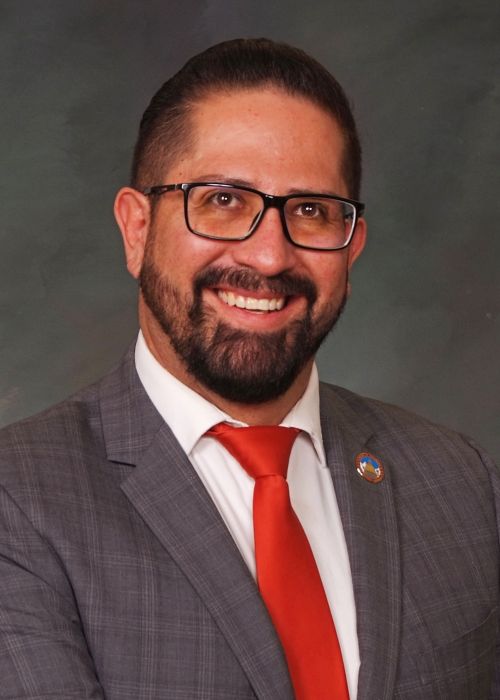
Rep. Matt Martinez
Sponsored bills
On or before December 31, 2027, the act requires the department of higher education (department) to establish thriving institution designations and, on or before January 1, 2027, to establish an advisory committee to provide input to the department on the outcome and recognition standards and continuous improvements set by the department to identify institutions of higher education (institutions) that meet the requirements for one or more thriving institution designations. The act requires the department, with input from the advisory committee, to:Identify institutions that meet the outcome and recognition standards to be designated as a thriving institution;Notify each institution that meets the outcome standards to be designated as a thriving institution and request the institution to respond within 10 calendar days with the institution's decision of whether to be recognized as a thriving institution;Post on the department's website the names of the institutions that earn a thriving institution designation and agree to be listed as a thriving institution; andNotify the general assembly of the names of the institutions that are recognized as thriving institutions.(Note: This summary applies to this bill as enacted.)
The act requires a volunteer lobbyist to register and file a registration statement attesting they are not being compensated. The act exempts volunteer lobbyists from registration fees. The act provides that the judicial department may designate one individual for the judicial department and one individual for each independent agency in the judicial department who may lobby on behalf of the judicial department or an independent agency in the judicial department (judicial lobbyist). A person designated by a principal executive department to be responsible for lobbying a state official or employee on behalf of the department (legislative liaison), a judicial lobbyist, or an individual who lobbies on behalf of the offices of the governor or lieutenant governor as a member of the governor's cabinet or as a personal staff employee in the offices of the governor or the lieutenant governor (governor's lobbyist) must register with the secretary of state annually. In addition to annually registering with the secretary of state, a legislative liaison, judicial lobbyist, or a governor's lobbyist must file a monthly disclosure statement with the secretary of state (disclosure statement). The act provides that a legislative liaison, judicial lobbyist, or a governor's lobbyist must indicate on the disclosure statement the bill number of any legislation for which they have lobbied or will lobby a covered official and their position regarding the legislation. The legislative liaison, judicial lobbyist, or a governor's lobbyist must update their position on the disclosure statement within 72 hours of a change in position. The act prohibits a statewide elected official or member of the general assembly from being a legislative liaison or governor's lobbyist for a period of 2 years following vacation of office. $91,000 is appropriated from the department of state cash fund to the department of state.(Note: This summary applies to this bill as enacted.)
The act appropriates the following amounts for the 2026-27 state fiscal year from the Colorado water conservation board (CWCB) construction fund to the CWCB or the division of water resources in the department of natural resources for the following projects:Continuation of the satellite monitoring system, $380,000 (section 1 of the act);Continuation of the floodplain map modernization program, $500,000 (section 2);Continuation of the weather modification permitting program, $500,000 (section 3);Continuation of the Colorado Mesonet project, $200,000 (section 5);Continuation of the water forecasting partnership project, $2,500,000 (section 6);Continuation of Colorado decision support system operation and maintenance, $750,000 (section 7);Support for water plan agency actions, $1,350,000 (section 9);Continuation of the Colorado watershed restoration and flood mitigation projects, $5,000,000 (section 10); andContinuation of the upper Colorado river commission planning, $750,000 (section 11). Section 4 directs the state treasurer to transfer up to $6,000,000 from the CWCB construction fund to the CWCB litigation fund on or before July 1, 2026. Section 8 restores the fish and wildlife resources fund balance by transferring $2,000,000 from the CWCB construction fund to the fish and wildlife resources fund. Section 12 authorizes the CWCB to make a loan in an amount of $151,500,000 from the severance tax perpetual base fund to the city of Fort Collins to support the Halligan water supply project. Section 13 authorizes the CWCB to make a loan in an amount of $20,166,670 from the severance tax perpetual base fund to the Lower Latham Reservoir Company for the Jurgens reservoir construction project. Section 14 appropriates $37,700,000 from the water plan implementation cash fund to the CWCB to award grants that will help implement the state water plan. Section 15 clarifies that the money that is currently in the turf replacement fund is appropriated for designated purposes to the CWCB until June 30, 2028. Any money remaining in the turf replacement fund on July 1, 2028, is transferred to the CWCB construction fund. Section 16 makes technical corrections so that money appropriated in 2025 is available to the department of natural resources executive director's office for the purpose of paying for a study by the Colorado water center at Colorado state university. Under current law, the CWCB may authorize loans up to $10 million from the CWCB construction fund or severance tax perpetual base fund without legislative authorization. The act increases that amount to $30 million (section 17).(Note: This summary applies to this bill as enacted.)
The act prohibits the Colorado lottery or any licensed lottery retailer from selling lottery tickets or instant scratch game tickets produced by the lottery for sale to the public on a credit basis.(Note: This summary applies to this bill as enacted.)
The act allows persons who are indigenous to receive compensation for traditional Native American healing ceremonies and practices and related expenses under the 'Colorado Crime Victim Compensation Act', which includes:Traditional counseling and healing from an elder or spiritual healer;Traditional ceremonial practices;Ceremonial burials, including clothing for the deceased, meals, and other related expenses;Child care during burial ceremonies;Reimbursement for honoraria provided in connection with ceremonial services; andReasonable travel expenses related to the traditional Native American healing ceremonies and practices.(Note: This summary applies to this bill as enacted.)
The act changes the purpose of the small business recovery and resiliency loan program (program) from supporting small businesses recovering from the economic crisis caused by COVID-19 to supporting Colorado's small businesses regardless of COVID-19 impacts. The act provides that money in the small business recovery and resiliency fund (fund) may be matched by participants in the program at a ratio of $1 of fund money for every $1 of money from other sources. Once the money from the fund is matched by other sources and comprises a tranche, the act specifies that the money from the tranche may be used for loans or to purchase participation interest in loans for businesses as determined by the program oversight board (board), including working capital and the purchase of equipment. The act allows a deferral of principal and interest payments on a loan made through the program for circumstances of hardship and repeals the requirement that the hardship must be caused by the COVID-19 pandemic or ongoing economic conditions. The act repeals a requirement that money from the fund must be proportionally reserved for applications from eligible borrowers located in a county based on the county's metrics related to small businesses, as determined by the board, for an initial period of time and that the money must be allocated to a county. Instead, the act requires each tranche of loan funding to be used to fund businesses across the state over the duration of the program and to maintain targets and support businesses located in rural counties and businesses owned by women, minorities, or veterans. The program will track the distribution of capital to counties. The act requires the state treasurer to transfer $5 million from the fund to the Colorado startup loan program fund on June 30, 2026.(Note: This summary applies to this bill as enacted.)
In 2022, the general assembly enacted, and the governor subsequently signed into law, House Bill 22-1358 ('Concerning measures to eliminate the presence of lead in the drinking water of certain facilities where children are present, and, in connection therewith, making an appropriation'), which required child care centers, family child care homes, and each public school that serves any of grades preschool through eighth grade to:Test its drinking water sources by having a state-certified laboratory measure the lead content of water drawn from each drinking water source; andSatisfy other requirements concerning the provision of safe drinking water. House Bill 22-1358 also created the school and child care clean drinking water fund (fund) to help schools, child care centers, and family child care homes comply with House Bill 22-1358. House Bill 22-1358 included a repeal date of June 30, 2026, for its provisions. The act extends the provisions, with amendments, until June 30, 2029. The act also adds high schools (i.e., schools that serve grades 9 to 12) to the scope of House Bill 22-1358, which means that high schools may receive grants from the fund and must satisfy certain requirements on or before dates specified in the act. The act requires the department to adopt rules establishing how a child care center shall demonstrate compliance with the requirements concerning the testing for the presence of lead in drinking water.(Note: This summary applies to this bill as enacted.)
The act prohibits using an automated driving system to drive a commercial motor vehicle unless an individual who holds a commercial driver's license is in the vehicle, monitors the vehicle's driving, and intervenes, if necessary, to avoid illegal or unsafe driving. The individual must be in the driver's seat if hazardous materials are being transported. The penalty is $1,000 for a first offense, is $2,000 for a second offense, and doubles for each subsequent offense. The act does not apply to a light-duty vehicle or a truck-mounted attenuator. The prohibition is repealed September 1, 2031. The chief of the Colorado state patrol will analyze the act's effects on commercial vehicle safety on highways. By November 1, 2030, the chief of the Colorado state patrol will issue a report to the relevant committees of the house of representatives and senate. The report must make recommendations as whether to continue the prohibition and, if continued, any recommended legislation to improve the prohibition. For the 2026-27 state fiscal year, $14,357 is appropriated to the department of revenue from the Colorado DRIVES vehicle services account in the highway users tax fund to implement the act.(Note: This summary applies to this bill as enacted.)
The act extends for an additional 10 years the availability of the state income tax credit allowed to a taxpayer who makes a qualifying monetary contribution to promote child care in the state equal to 50% of the total value of the contribution, not to exceed $100,000, through income tax years commencing prior to January 1, 2038.(Note: This summary applies to this bill as enacted.)