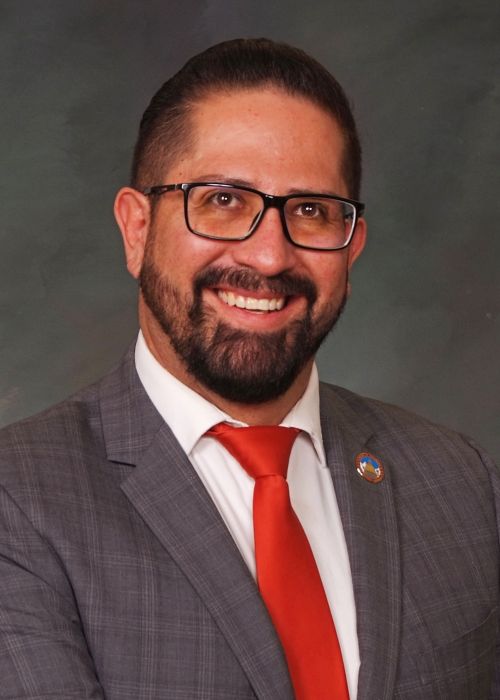
Photo of Matt Martinez
D Colorado House · District 62 On the 2026 ballot

Rep. Matt Martinez

Compare
Total votes
3,565
all sessions
Attendance
99%
37 missed
Near the chamber average
With party
96%
of cast votes
Near the chamber average
Bipartisan score
2%
crosses aisle rarely
Near the chamber average
Sponsored
288
bills & resolutions
Near the chamber average
Committees
5
assignments
288 bills and resolutions

Sponsored bills

Total
288
Primary
105
Co-sponsor
183
This page
288
matching current filters
Co-sponsor HJR 25-1002
Passed · Colorado House · Co-sponsor
State of the Judiciary

Maddy summaryThis procedural joint resolution (HJR 25-1002) schedules a ceremonial session for January 10, 2025, where Colorado's House and Senate will hear a message from Chief Justice Monica M. Marquez of the Colorado Supreme Court. It directs the appointment of a six-member committee (three from each chamber) to escort the Chief Justice to the session. The bill has no substantive policy impact - it solely establishes a formal procedure for this annual judicial communication event. It directly affects the legislative leadership and the Chief Justice's office by outlining the process for this specific ceremonial meeting.

Passed Jan 14, 2025 1 co-sponsor
Co-sponsor HR 25-1002
Passed · Colorado House · Co-sponsor
House Officers & Employees

Maddy summaryThis bill (HR 25-1002) is a procedural measure concerning House officers and employees. The provided context includes no bill text, summary, or specific provisions describing its content or effects. Without the actual text or a substantive description of the bill's requirements, mechanisms, or who it directly affects, a factual summary cannot be generated. The recent actions (introduced, passed, signed) only confirm procedural steps, not the bill's policy content.

Passed Jan 13, 2025 1 co-sponsor
Primary HB 24-1461
Signed into law · Colorado House · Lead sponsor
Exemption for College Program Completion Earned Time

Under existing law, the department of corrections may, for an inmate who was sentenced for a nonviolent felony offense, deduct earned time from the inmate's sentence for each accredited degree or other credential awarded by an institution of higher education to the inmate while the inmate is incarcerated or on parole (degree or credential earned time). The act exempts degree or credential earned time from the statutory limit on earned time. APPROVED by Governor June 5, 2024 EFFECTIVE August 7, 2024(Note: This summary applies to this bill as enacted.)

Signed into law Jun 5, 2024 0 co-sponsors
Primary HB 24-1111
Signed into law · Colorado House · Lead sponsor
Adopt Cosmetology Licensure Compact

The act adopts the cosmetology licensure compact (compact) to facilitate the interstate practice and regulation of cosmetology. With the adoption of the compact, a cosmetologist who holds an active, unencumbered license to practice in the cosmetologist's home state may apply to the cosmetologist's home state for a multistate license. If a cosmetologist is granted a multistate license under the compact, the cosmetologist is authorized to practice cosmetology in the applicant's home state, as well as in each state that is a member of the compact. The cosmetologist must comply with the rules of the licensing authority and the scope of practice laws of the state in which the cosmetologist provides services. If the cosmetologist moves to a new home state, the cosmetologist must apply to the new home state for reissuance of a multistate license. Under the compact, active military members and their spouses may designate a home state where the individual is currently licensed in good standing to practice cosmetology and may retain their home state designation for purposes of the multistate license during any period when that individual or the individual's spouse is on active duty assignment. The compact requires a state that is a member of the compact (member state) to report adverse actions taken by a member state's licensing authority or other regulatory body, including actions taken against a cosmetologist's individual license or authorization to practice, such as revocation, suspension, or any other encumbrance on a license affecting the cosmetologist's ability to practice. The compact authorizes the cosmetology licensure compact commission (commission) to develop and maintain a coordinated database and reporting system to include information relating to a cosmetologist's multistate license and any adverse actions reported against a cosmetologist. The compact specifies the authority of the home state to act with respect to the multistate license issued by the home state, as well as the authority of a remote state to act with respect to the licensee. The compact creates the administrative structure for the compact, including granting the powers necessary to establish and operate the commission, which includes one delegate from each member state that is the administrator of the state licensing authority in the member state or the administrator's designee. Among other powers, the commission may adopt rules and bylaws, establish an executive committee, hire employees, and establish an office. The compact includes provisions relating to the conduct of the commission's meetings and its rule-making authority. The compact authorizes the commission to levy and collect an annual assessment from each member state and to impose fees on licensees of a member state for granting and renewing a multistate license. The compact includes provisions governing disputes among member states and between the commission and a member state, enforcement provisions, and withdrawal of member states from the compact. The compact is effective for member states once the seventh state has adopted the compact. For the 2024-25 state fiscal year, $104,620 is appropriated from the division of professions and occupations cash fund to the department of regulatory agencies for use by the division of professions and occupations to implement the act. APPROVED by Governor June 4, 2024 EFFECTIVE August 7, 2024(Note: This summary applies to this bill as enacted.)


Signed into law Jun 4, 2024 0 co-sponsors
Primary HB 24-1278
Signed into law · Colorado House · Lead sponsor
Sunset Concurrent Enrollment Advisory Board

The act repeals the concurrent enrollment advisory board (advisory board) on September 1, 2027. Prior to the repeal, the department of regulatory agencies will conduct a sunset review and make recommendations concerning its continuation. The act requires the advisory board to work with the department of education, department of higher education, and the community college system that supports the enrollment of first-generation students, low-income students, and students of color in concurrent enrollment programs. APPROVED by Governor June 3, 2024 EFFECTIVE September 1, 2024(Note: This summary applies to this bill as enacted.)
Signed into law Jun 3, 2024 0 co-sponsors
Primary HB 24-1002
Signed into law · Colorado House · Lead sponsor
Social Work Licensure Compact

The act enacts the "Social Work Licensure Compact" (compact). The compact is designed to: Eliminate the necessity for social workers to obtain licenses from multiple states by providing for the mutual recognition of licenses from other states that have signed the compact (member states); Facilitate the exchange of licensure and disciplinary information among member states; Authorize member states to hold a regulated social worker accountable for abiding by a member state's laws, regulations, and applicable professional standards in the member state in which the client is located at the time care is rendered; and Allow for the use of telehealth to facilitate increased access to regulated social work services. The act authorizes the state board of social work examiners (board) to promulgate rules and to facilitate Colorado's participation in the compact, including notifying the social work licensure compact commission (commission) established by the compact of any adverse action taken by the board against a Colorado regulated social worker. The commission includes a delegate from each member state and has the powers and duties set forth in the act. The compact becomes effective on the date the compact is enacted in the seventh member state. For the 2024-25 state fiscal year, the act appropriates $78,750 from the division of professions and occupations cash fund to the department of regulatory agencies for use by the division of professions and occupations to implement the act. APPROVED by Governor June 3, 2024 EFFECTIVE August 7, 2024(Note: This summary applies to this bill as enacted.)

Signed into law Jun 3, 2024 0 co-sponsors
Primary HB 24-1369
Signed into law · Colorado House · Lead sponsor
Colorado Agriculture Special License Plate

The act creates the Colorado agriculture license plate. In addition to the normal fees for a license plate, a person must pay an additional one-time fee in the amount of $25, which money is credited to the highway users tax fund. To implement the act, $15,775 is appropriated to the department of revenue from the Colorado DRIVES vehicle services account in the highway users tax fund and $17,431 is appropriated from the license plate cash fund to the department of revenue for use by the division of motor vehicles. APPROVED by Governor June 3, 2024 EFFECTIVE August 7, 2024(Note: This summary applies to this bill as enacted.)

Signed into law Jun 3, 2024 0 co-sponsors
Primary SB 24-183
Signed into law · Colorado Senate · Lead sponsor
Mobile Home Taxation Task Force

The act suspends the statutory process for the distraint sale of a mobile home to collect delinquent property tax and creates a task force to make recommendations for statutory changes in order to bring state law into compliance with the United States supreme court's recent decision affirming a property owner's constitutional right to the value of their property in excess of their tax debt. The task force on mobile home ownership and taxation (task force), created in the division of housing of the department of local affairs (division), consists of the following 17 members: 4 members from the general assembly; A current or former county treasurer; A current or former county assessor; Either a current or former county clerk or an individual who has expertise related to mobile home policy; 3 individual mobile home owners; A county commissioner from an urban county; A county commissioner from a rural county; A representative from a trade association that represents the mobile home industry; A representative of an advocacy group for affordable housing including mobile homes; A representative of the division; A representative of the department of revenue; and A representative of the banking industry. In addition to recommending changes to the statute governing the distraint sale of mobile homes to ensure that any sale proceeds in excess of the owner's tax debt are paid to the owner, the task force is also charged with studying and making recommendations related to the valuation for assessment, titling, and taxation of mobile homes. The division shall consult with the task force regarding its collaborative effort with the office of information technology to develop the initial scope of work for a system for titling and registering mobile homes, including tiny homes. The task force is required to: Convene by June 15, 2024; Meet at least once a month during the 2024 legislative interim, or more often as directed by the chairperson; and Submit a report with its findings and recommendations for legislation concerning mobile home ownership and taxation to the legislative oversight committee concerning tax policy on or before October 1, 2024. The task force is repealed, effective January 1, 2025. The act appropriates $53,995 from the general fund to the department of local affairs for use by the division in implementing the act. APPROVED by Governor May 31, 2024 EFFECTIVE May 31, 2024(Note: This summary applies to this bill as enacted.)

Signed into law May 31, 2024 0 co-sponsors
Primary SB 24-168
Signed into law · Colorado Senate · Lead sponsor
Remote Monitoring Services for Medicaid Members

Beginning July 1, 2025, the act requires the department of health care policy and financing (state department) to provide reimbursement to certain medicaid members (member) for the use of telehealth remote monitoring for outpatient services. The department shall initiate a stakeholder process to determine the billing structure prior to providing reimbursement. The act creates the telehealth remote monitoring grant program to provide grants to outpatient health-care facilities located in a designated rural county or designated provider shortage area to assist with the costs of providing telehealth remote monitoring for outpatient clinical services. The state department may award up to five grants worth $100,000 each. Beginning November 1, 2025, the act requires the state department to provide coverage for continuous glucose monitors to medicaid medical and pharmacy benefit members. For the 2024-25 state fiscal year, the act appropriates $34,128 to the department of health care policy and financing to implement this act. APPROVED by Governor May 29, 2024 EFFECTIVE August 7, 2024(Note: This summary applies to this bill as enacted.)

Signed into law May 29, 2024 0 co-sponsors
Primary HB 24-1249
Signed into law · Colorado House · Lead sponsor
Tax Credit Agricultural Stewardship Practices

The act establishes a refundable state income tax credit for active qualified stewardship practices on a farm or ranch for income tax years beginning on or after January 1, 2026, but before January 1, 2031. A qualified taxpayer may earn a state income tax credit equal to: At least $5 and no more than $75 per acre of land covered by one qualified stewardship practice, up to a maximum credit of $150,000 in one income tax year. At least $10 and no more than $100 per acre of land covered by 2 qualified stewardship practices, up to a maximum credit of $200,000 in one income tax year. At least $15 and no more than $150 per acre of land covered by at least 3 qualified stewardship practices, up to a maximum of $300,000 per income tax year. The department of agriculture may issue rules to implement the tax credit, including specifying requirements for implementing and demonstrating qualified stewardship practices. Before issuing any rules, the commissioner of the department of agriculture shall initiate a public stakeholder process to advise the commissioner about the requirements for implementing and demonstrating qualified stewardship practices. To claim the credit, a qualified taxpayer must apply to the department of agriculture for a tax credit certificate. The department of agriculture will evaluate the application and issue the certificate if the taxpayer qualifies for the tax credit. If a tax credit certificate is issued, the qualified taxpayer must attach it to the taxpayer's income tax return and submit it to the department of revenue. The aggregate amount of tax credits issued in one calendar year cannot exceed $3 million. After certificates have been issued for credits that exceed an aggregate of $3 million for all qualified taxpayers during a calendar year, any claims that exceed the amount allowed are placed on a wait list and a certificate is issued for use of the credit in the next income tax year. No more than $2 million in claims shall be placed on the wait list in any given calendar year. Only one tax credit certificate may be issued per qualified taxpayer in an income tax year, and the qualified taxpayer claiming the credit may only receive the tax credit for up to 3 income tax years. No credit may be earned if the qualified taxpayer has received another tax credit, a tax deduction, or a grant related to agricultural land health from any source during the income tax year for which the tax credit is sought. The act appropriates $17,117 to the department of agriculture from the general fund for the 2024-25 state fiscal year for use by the agricultural services division (division) to implement the act. APPROVED by Governor May 24, 2024 EFFECTIVE August 7, 2024(Note: This summary applies to this bill as enacted.)

Signed into law May 24, 2024 0 co-sponsors
Showing 251 to 260 of 288 bills
Previous 1 25 26 27 29 Next