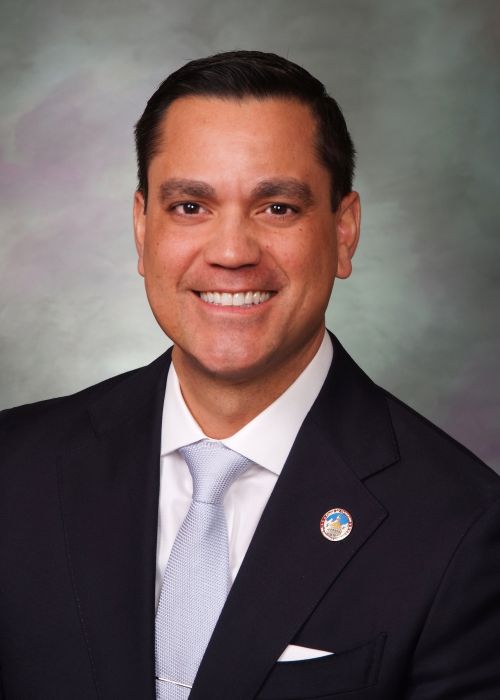
Photo of Sean Camacho
D Colorado House · District 6

Rep. Sean Camacho

Compare
Total votes
1,710
all sessions
Attendance
99%
20 missed
Near the chamber average
With party
98%
of cast votes
Higher than 80% of chamber peers
Bipartisan score
1%
crosses aisle rarely
Lower than 76% of chamber peers
Sponsored
359
bills & resolutions
Near the chamber average
Committees
4
assignments
359 bills and resolutions

Sponsored bills

Total
359
Primary
53
Co-sponsor
306
This page
359
matching current filters
Co-sponsor SB 25-005
Vetoed · Colorado Senate · Co-sponsor
Worker Protection Collective Bargaining

The act eliminates the requirement for a second election to negotiate a union security agreement clause in the collective bargaining process. VETOED by Governor 5/16/2025(Note: This summary applies to this bill as enacted.)

Vetoed May 16, 2025 1 co-sponsor
Co-sponsor HB 25-1296
Signed into law · Colorado House · Co-sponsor
Tax Expenditure Adjustment

The act adjusts several state tax expenditures as follows: Section 2 of the act allows an individual to present a copy of their federal tax return to be exempted from the medical marijuana registry application fee; Section 3 requires insurance companies, when submitting certain filings with the division of insurance, to submit the total annual dollar amount of premiums collected or contracted for on policies or contracts of insurance covering property or risks in Colorado during the previous calendar year from entities that are exempt from taxation; Section 4 ensures that the valuation for assessment for qualified-senior primary residence real property is reduced for the property tax years commencing on January 1, 2025, and January 1, 2026; Section 6 adds the amount of any overtime compensation excluded or deducted from a taxpayer's federal gross income to that taxpayer's federal taxable income for purposes of determining the taxpayer's state taxable income; Section 7 expands the definition of local government to include counties for purposes of the alternative transportation options tax credit; Section 8 modifies the tax credit for qualified costs incurred in preservation of historic structures by removing the 5% increase in the percentage of rehabilitation expenses incurred in a rehabilitation in a disaster area for the rehabilitation of a commercial structure that are applicable for the tax credit; Section 9 extends the tax credit for monetary contributions to promote child care, so that the tax credit is available through income tax years commencing before January 1, 2030, rather than January 1, 2026; Section 10 limits the existing business personal property tax credit so that a taxpayer may only claim the tax deduction for income tax years commencing before January 1, 2026; Section 12 clarifies and modifies definitions for the qualified care worker tax credit; Section 13 allows the executive director of the department of revenue to direct employers who make payments of compensation other than wages to withhold an amount that approximates an employee's income tax due to the state from that employee's compensation; Section 14 expands the definition of agricultural commodities to include products regulated under article 10 of title 44 for purposes of the pesticides, fertilizers, and spray adjuvants wholesale sales tax exemption; Section 15 ensures that, beginning July 1, 2025, interstate telephone and telegraph services are subject to state sales tax; Section 16 exempts the sale of medical marijuana to an individual who presents a valid electronic benefits transfer card or certain other identification from sales tax; and Section 17 modifies the enterprise zone tax credit for income tax years beginning January 1, 2026, by limiting the total amount of the credit that may be claimed to $2 million, providing an exemption process for that limit, and prohibiting certain taxpayers from claiming that credit.(Note: This summary applies to this bill as enacted.)

Signed into law May 16, 2025 1 co-sponsor
Co-sponsor HB 25-1065
Vetoed · Colorado House · Co-sponsor
Jury Duty Opt-Out for Certain People

The act allows a person who is 72 years of age or older to choose to temporarily or permanently opt out of jury service. The judge or jury commissioner may require documentation in support of the opt-out of jury service. For the 2025-26 state fiscal year, the act appropriates $10,066 from the general fund to the judicial department for use by the state courts to implement the act. VETOED by Governor May 16, 2025(Note: This summary applies to this bill as enacted.)

Vetoed May 16, 2025 1 co-sponsor
Co-sponsor HB 25-1312
Signed into law · Colorado House · Co-sponsor
Legal Protections for Transgender Individuals

Section 1 of the act specifies that the short title of the Act is the "Kelly Loving Act". Sections 2 through 5 provide that, if at any point following the issuance of a license to marry or a civil union license, a party to the marriage or civil union presents the issuing county clerk and recorder with appropriate documentation of that party's name change and requests the issuance of a new license to marry or civil union license, the county clerk shall issue a new license to marry or civil union license that reflects the party's name change. After a new license to marry or civil union license is issued, the effective date of the marriage or civil union remains the date listed on the original license to marry or civil union license. Section 6 provides that, if a local education provider, an educator, or a contractor chooses to enact or enforce a policy related to names, that policy must be inclusive of all reasons that a student might adopt a name that differs from the student's legal name. Section 7 requires a dress code adopted by a school district board of education or by an institute charter school board for a charter school authorized by the charter school institute must allow each student to choose from any of the options provided in the dress code policy. Section 8 defines the term "chosen name" for purposes of the "Colorado Anti-discrimination Act" as a name that an individual requests to be known as in connection to the individual's disability, race, creed, color, religion, sex, sexual orientation, gender identity, gender expression, marital status, familial status, national origin, or ancestry, so long as the name does not contain offensive language and the individual is not requesting the name for frivolous purposes. Section 8 also includes "chosen name and how the individual chooses to be expressed" as forms of gender expression for purposes of the "Colorado Anti-discrimination Act." Section 10 repeals a provision of law that limited the state registrar to amending a gender designation for an individual's birth certificate only 1 time upon the individual's request without the submission of a court order. Sections 11, 12 and 13 change the number of times that the department of revenue may amend a sex designation on an individual's driver's license, identification card, or identification document upon the individual's request from 1 to 3. (Note: This summary applies to this bill as enacted.)

Signed into law May 16, 2025 1 co-sponsor
Co-sponsor HB 25-1321
Signed into law · Colorado House · Co-sponsor
Support Against Adverse Federal Action

The act appropriates $4 million from the "Infrastructure Investment and Jobs Act" cash fund (fund) to the office of the governor (office) for state fiscal year 2025-26, with roll-forward authority in state fiscal year 2026-27 for any money remaining in the fund after state fiscal year 2025-26. The act authorizes the office to accept gifts, grants, or donations for crediting to the fund to implement the act. The act authorizes the office, in the governor's discretion, to hire and employ personnel or retain contractors for purposes related to federal government actions that impact federal disbursements, grants, contracts, or money received by or transferred to the state. The office may also reimburse the department of law for costs associated with special assistant attorneys general who are contracted for the purposes of providing legal services: To state officers or employees related to legal proceedings, inquiries, hearings, or investigations initiated, pursued, or threatened by the federal government; or For the criminal defense of state officers or employees in legal actions arising out of their official acts or decisions. The office may also incur other expenditures covered by the fund that are consistent with the purposes of the act, as determined by the governor, including expenditures to preserve and protect state sovereignty or federal funding streams that benefit the state. (Note: This summary applies to this bill as enacted.)

Signed into law May 16, 2025 1 co-sponsor
Co-sponsor SB 25-130
Signed into law · Colorado Senate · Co-sponsor
Providing Emergency Medical Services

The act requires hospitals, freestanding emergency departments, and licensed health-care facilities that hold themselves out to the public as providing emergency care (facility) to provide emergency medical services to a person who presents to the facility when the person requests or a request is made on the person's behalf for emergency medical services. For each person who presents to a facility and requests emergency medical services or for each request made on the person's behalf for emergency medical services, the act requires the facility to input into a central log whether the person refused treatment or was denied treatment; whether no treatment was required; or whether the person was transferred, admitted and treated, stabilized and transferred, or discharged. The act prohibits a facility from: Denying or discriminating in providing emergency medical services to a patient for a discriminatory or unlawful reason; Penalizing or taking adverse action against a health-care provider for refusing to transfer a patient with an emergency medical condition that has not been stabilized; Delaying providing emergency medical services to a person in order to inquire about the person's ability to pay for the services; and Transferring or discharging a patient with an emergency medical condition unless certain conditions are met. A facility or health-care provider does not violate the act's requirements if certain conditions are met. The act authorizes the department of public health and environment to investigate a facility that negligently violates the requirements of the act. A physician who negligently violates the act engages in unprofessional conduct and is subject to professional discipline. If a civil monetary penalty is imposed, the act requires the maximum civil monetary penalty to be reduced by any civil monetary penalty imposed pursuant to the federal "Emergency Medical Treatment and Active Labor Act" for the same violation. The act appropriates $82,768 from the health facilities general licensure cash fund to the department of public health and environment for use by the health facilities and emergency medical services division. (Note: This summary applies to this bill as enacted.)

Signed into law May 14, 2025 1 co-sponsor
Co-sponsor HB 25-1127
Failed · Colorado House · Co-sponsor
Register & Drive Surplus Military Vehicles

Current law requires a motor vehicle to be designed for operation on a highway to be covered by the "Uniform Motor Vehicle Law", which governs driver's licenses, registrations, and traffic regulation. The bill authorizes the owner of a surplus military vehicle to register the vehicle and be issued a license plate. If the vehicle is registered, it may be driven on the road but must comply with the registration provisions. The driver's license provisions and the traffic regulations apply to these vehicles.(Note: This summary applies to this bill as introduced.)

Failed May 13, 2025 1 co-sponsor
Co-sponsor SB 25-169
Signed into law · Colorado Senate · Co-sponsor
Restaurant Meals Program

No later than January 1, 2026, the act requires the department of human services to submit an application to the United States department of agriculture food and nutrition service to implement a restaurant meals program that allows eligible supplemental nutrition assistance program recipients to purchase hot or prepared foods at participating restaurants. (Note: This summary applies to this bill as enacted.)

Signed into law May 13, 2025 1 co-sponsor
Co-sponsor SB 25-001
Signed into law · Colorado Senate · Co-sponsor
Colorado Voting Rights Act

The act creates the Colorado Voting Rights Act (state voting rights act) and modifies certain election-related statutes in the following areas: Tribal voting; Ensuring voter access to methods of selecting candidates for the general election; Restrictions on electioneering and election-related activity near voting locations; Election and voting notices in facilities serving individuals with disabilities; Recounts; Election-related language access; and Election-related data collection. Creation of the state voting rights act. The act creates the state voting rights act, which prohibits political subdivisions from: Engaging in voter suppression by taking any action that results in, will result in, or is intended to result in a material disparity between electors who are members of a protected race, color, or language minority group or other minority reporting group (protected class members) and other eligible electors in regard to voter participation, access to voting opportunities, or the opportunity or ability to participate in the political process; Engaging in voter dilution by enacting or employing any method of election that has the effect of, or is motivated in part by the intention of, disparately impairing the opportunity or ability of protected class members to elect the candidates of their choice or otherwise influence the outcome of elections as a result of diluting the vote of protected class members ; Implementing, imposing, or enforcing a voting qualification or another prerequisite to voting based on an individual's actual or perceived gender identity, gender expression, or sexual orientation; or Implementing, imposing, or enforcing an additional voting qualification or another prerequisite to voting based on an individual's confinement to a local jail, other than those eligibility qualifications that already exist. An aggrieved individual or organization (aggrieved person) may file a civil suit alleging voter suppression; voter dilution; an unlawful voting prerequisite based on gender identity, gender expression, or sexual orientation; or an unlawful voting prerequisite based on confinement to a local jail. The attorney general may investigate potential violations of the act and may file suit to enforce the act or may intervene in an aggrieved individual's or organization's civil suit. Except under specific circumstances, before filing suit, an aggrieved person or the attorney general must send a notification letter describing the alleged violation of the act to the political subdivision. The political subdivision is given 60 or 180 days to adopt a resolution providing for a solution to the alleged violation. Tribal voting. The act clarifies that an identification card, which need not contain a photograph, that is issued by the federal bureau of Indian affairs, Indian health service, or any other federal agency that issues identification certifying tribal membership and that includes an address in Colorado constitutes a valid identification for registration purposes and, upon request of a tribal council, requires a county to establish a drop box, rather than a drop-off location as was previously the case, within the boundaries of a federal reservation. Ensuring voter access to methods of selecting candidates for a general election. The act requires each major political party to ensure that any future alternative process by which a party may select candidates for a general election allows voters not able to attend in person to participate to the same extent as those voting in person, including requiring a process for individuals to vote that does not require in-person voting. Restrictions on electioneering and election-related activity near voting locations. The act clarifies that the restrictions on electioneering and election-related activity conducted within 100 feet of a polling location or drop-off location also apply to drop boxes. Election and voting notices in facilities serving individuals with disabilities. The act imposes a requirement on specified care facilities that provide services primarily to individuals with disabilities to publicly display, in each building in which they serve clients, notices related to voting during the 30 days preceding a general or coordinated election. Recounts. Before a recount, a canvass board has been required to test at least one ballot scanner with a group of 10 test ballots marked by at least 2 canvass board members of different party affiliations. The act changes this process so that each canvass board member, other than the clerk, must separately mark their own group of 10 test ballots. The act also clarifies the duties of a canvass board and a county clerk and recorder in conducting a recount. Election-related language access. The act expands existing requirements for the creation of multilingual ballots from only applying to qualifying counties to also applying to qualifying municipalities. The county clerk and recorder for a county that meets certain requirements for the population or percentage of the voting-age population within the relevant jurisdiction who are minority language speakers and who speak English less than very well has been required to provide multilingual ballots. The act requires a municipal clerk to provide multilingual ballot access if the municipality has a population of at least 3,000 and the municipality exists partially or wholly within a county covered by the existing multilingual ballot requirements. Election-related data collection. The act requires the secretary of state to collect, maintain, and make publicly available data related to elections, including demographics, election results, and voting information. After each election, political subdivisions are required to submit election-related information to the secretary of state. The department of local affairs is also required to annually provide certain demographic information to the secretary of state. The act also changes current law from allowing a custodian of records to deny the right of inspection of certain records and information maintained by the department of revenue to requiring the denial of such inspection. For the 2025-26 fiscal year, $75,432 is appropriated from the department of state cash fund to the department of state for use by the elections division for implementation of the act. The act applies to elections and election-related activities occurring on or after January 1, 2026. (Note: This summary applies to this bill as enacted.)


Signed into law May 12, 2025 1 co-sponsor
Co-sponsor SB 25-050
Signed into law · Colorado Senate · Co-sponsor
Racial Classifications on Government Forms

The act requires a form issued by the state or a local government that requests that the individual completing the form disclose the individual's race or ethnicity to include, in addition to spaces for any other racial or ethnic categories required by the federal office of management and budget, a space to indicate if the individual's race or ethnicity is Middle Eastern, North African, or South Asian. The state and local governments are exempt from the act's requirements if: The demographic data collected in the form is reported by the state or a local government to the federal government; and The federal government rejects or will reject the demographic data reported by the state or a local government because it includes Middle Eastern, North African, or South Asian as a primary demographic category. When exercising the exemption, the state and local governments shall include Middle Eastern, North African, or South Asian as a demographic subcategory of the nonspecific racial category on the form. (Note: This summary applies to this bill as enacted.)
Signed into law May 12, 2025 1 co-sponsor
Showing 251 to 260 of 359 bills
Previous 1 … 25 26 27 … 36 Next