

In current law, a person who is a member of the Colorado National Guard who is accepted for enrollment at a designated institution of higher education (member) has all their tuition costs waived. All tuition waiver costs are currently funded by the state from money in the Colorado National Guard tuition fund. The act changes the funding mechanism of the Colorado National Guard tuition waiver program by requiring each designated institution of higher education to waive the remaining balance of a member's tuition cost in excess of the amount of any private, state, or federal financial assistance received. The act requires the department of military and veterans affairs to reimburse each institution for 50% of the cost of tuition waived by the institution and requires the general assembly to appropriate money to the Colorado National Guard tuition fund to cover the reimbursement.(Note: This summary applies to this bill as enacted.)
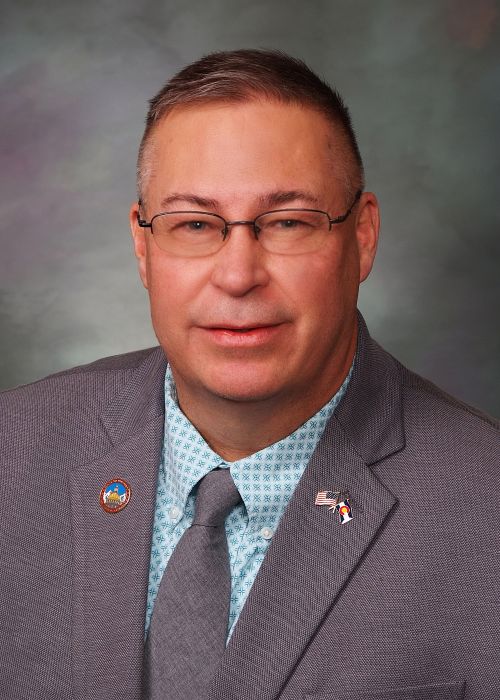
Rep. Chris Richardson
Sponsored bills
The act extends the availability of the conservation easement tax credit from income tax year 2031 through income tax year 2036. The act also prohibits the division of conservation from issuing any additional credit certificates or amending previously issued credit certificates as a result of the additional authority granted by the act for a donation made prior to the effective date of the act.(Note: This summary applies to this bill as enacted.)
The act requires the Colorado bureau of investigation to transmit a list of missing children to the Colorado department of education (department) instead of each school district and requires the department to notify the bureau if the department's list of enrolled students includes information about a missing child. The act repeals the requirement for a school district, board of cooperative services, district charter school, or institute charter school to have paper and pencil assessment policies for state-administered assessments in public schools. The act allows a school district or a charter school network with 1,200 students or fewer to submit a single plan to satisfy school district, school network, or school accreditation plan requirements. The act prohibits the department from representing as mandatory a voluntary data collection request to a school district, the state charter school institute, or a public school and prohibits the department from conditioning any benefit unrelated to a specific grant on the completion of a voluntary data collection request.(Note: This summary applies to this bill as enacted.)
The act requires a volunteer lobbyist to register and file a registration statement attesting they are not being compensated. The act exempts volunteer lobbyists from registration fees. The act provides that the judicial department may designate one individual for the judicial department and one individual for each independent agency in the judicial department who may lobby on behalf of the judicial department or an independent agency in the judicial department (judicial lobbyist). A person designated by a principal executive department to be responsible for lobbying a state official or employee on behalf of the department (legislative liaison), a judicial lobbyist, or an individual who lobbies on behalf of the offices of the governor or lieutenant governor as a member of the governor's cabinet or as a personal staff employee in the offices of the governor or the lieutenant governor (governor's lobbyist) must register with the secretary of state annually. In addition to annually registering with the secretary of state, a legislative liaison, judicial lobbyist, or a governor's lobbyist must file a monthly disclosure statement with the secretary of state (disclosure statement). The act provides that a legislative liaison, judicial lobbyist, or a governor's lobbyist must indicate on the disclosure statement the bill number of any legislation for which they have lobbied or will lobby a covered official and their position regarding the legislation. The legislative liaison, judicial lobbyist, or a governor's lobbyist must update their position on the disclosure statement within 72 hours of a change in position. The act prohibits a statewide elected official or member of the general assembly from being a legislative liaison or governor's lobbyist for a period of 2 years following vacation of office. $91,000 is appropriated from the department of state cash fund to the department of state.(Note: This summary applies to this bill as enacted.)
The act updates county enforcement authority in connection with:Providing for and compelling the removal of rubbish, including trash, junk, and garbage, from property within the county;Providing for and compelling the removal of weeds and brush from property within the county;Providing for and compelling the removal or securing of any building or structure in the county, with specified exceptions, that, due to its condition, presents a substantial danger or hazard to the public health, safety, or welfare; andThe unlawful erection, construction, reconstruction, alteration, or use of any building or structure in the county or the use of any land in the county in violation of a zoning resolution or ordinance adopted by the board of county commissioners. For the removal actions described above, the act requires county ordinances to include provisions for applying for and exercising an administrative entry and seizure warrant. The act also allows counties to assess the reasonable costs of removal, including a 10% fee for inspection and incidental costs, as a lien against the property. The act modifies the civil penalties that a court may impose and the factors that a court must consider in determining the appropriate civil penalty when a property owner violates a county ordinance or building code regarding the removal of rubbish or weeds and brush from property within the county, the removal or securing of a building or structure in the county, or the unlawful erection, construction, reconstruction, alteration, or use of a building or structure in the county.(Note: This summary applies to this bill as enacted.)
Maddy summaryHB 1307 extends the Colorado Medical Board's existence until September 1, 2035 (replacing a prior 2026 sunset date) and implements several specific changes to medical licensing. It creates a new "administrative license" for physicians performing non-patient work (like research design or quality management) starting January 1, 2027, exempting them from continuing medical education requirements. The bill also exempts natural medicine facilitators (with a specific license) from needing a medical license to facilitate certain services, and modifies renewal rules for foreign teaching physicians and board procedures. These changes directly affect physicians seeking administrative roles, natural medicine facilitators, and the Medical Board’s operational structure.
The act requires a school district that is considering submitting to its voters a ballot question concerning capital construction to solicit proposals from its charter schools about their capital construction needs. The act specifies the solicitation process requirements and requires the school district to notify a charter school that submitted a proposal whether the school district will include the charter school's capital construction needs in the school district's ballot question or questions. If the school district decides not to include the charter school's capital construction needs in the ballot question, the notification must include the school district's reasons for the exclusion and must include an opportunity for the charter school to address issues raised by the school district. If the school district and charter school mutually agree to the content of the charter school's proposal, a school district that voluntarily submits to its voters a ballot question for the charter school's capital construction needs is not required to comply with the required solicitation process.(Note: This summary applies to this bill as enacted.)
The act prohibits using an automated driving system to drive a commercial motor vehicle unless an individual who holds a commercial driver's license is in the vehicle, monitors the vehicle's driving, and intervenes, if necessary, to avoid illegal or unsafe driving. The individual must be in the driver's seat if hazardous materials are being transported. The penalty is $1,000 for a first offense, is $2,000 for a second offense, and doubles for each subsequent offense. The act does not apply to a light-duty vehicle or a truck-mounted attenuator. The prohibition is repealed September 1, 2031. The chief of the Colorado state patrol will analyze the act's effects on commercial vehicle safety on highways. By November 1, 2030, the chief of the Colorado state patrol will issue a report to the relevant committees of the house of representatives and senate. The report must make recommendations as whether to continue the prohibition and, if continued, any recommended legislation to improve the prohibition. For the 2026-27 state fiscal year, $14,357 is appropriated to the department of revenue from the Colorado DRIVES vehicle services account in the highway users tax fund to implement the act.(Note: This summary applies to this bill as enacted.)
The act clarifies the conduct by which a person can commit criminally negligent homicide to include proximately causing the death of another person while operating or driving a motor vehicle with criminal negligence. The act repeals the class 1 misdemeanor traffic offense of a person being the proximate cause of death to another person while driving a motor vehicle, while clarifying it can be charged as a class 5 felony elsewhere in statute.(Note: This summary applies to this bill as enacted.)
The act requires a court to sentence a defendant convicted of second degree assault by strangulation in an enhanced range as a crime of violence subject to mandatory incarceration if the defendant has previously been convicted of second degree assault by strangulation. A previous conviction must be set forth in the complaint, indictment, or information for the present act.(Note: This summary applies to this bill as enacted.)