

The act directs the division of brand inspection (division) in the department of agriculture and the state board of stock inspection commissioners in the department of agriculture to receive reports of lost or stolen livestock. On or before December 31, 2026, the division shall implement procedures that:Facilitate efficient coordination with law enforcement, including procedures to ensure that reports of stolen livestock are provided to relevant law enforcement within 24 hours after the division receives a report of stolen livestock; andEnsure that the public is notified of lost or stolen livestock. The procedures implemented by the division may vary by geographic region depending on the needs of the region.(Note: This summary applies to this bill as enacted.)
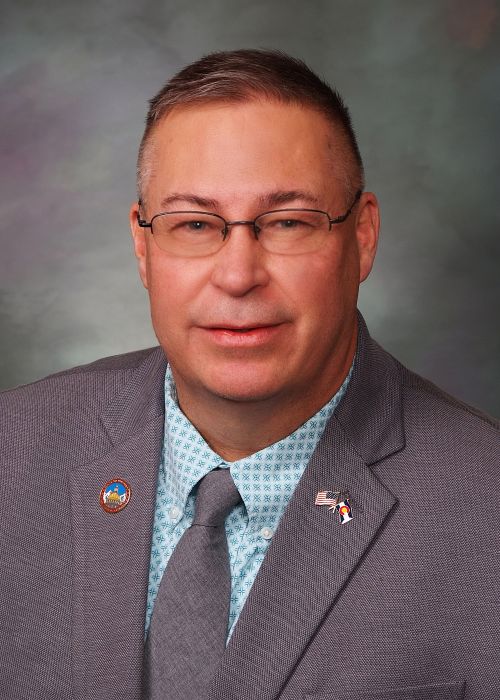
Rep. Chris Richardson
Sponsored bills
The act requires a minor who is under 18 years old to have written permission of the minor's parent or legal guardian to obtain an instruction permit to drive a motorcycle. The act does not apply to emancipated minors.(Note: This summary applies to this bill as enacted.)
Maddy summaryThis bill establishes a joint committee of five legislators to inform the Governor that the current legislative session is about to end. The committee, composed of three House members and two Senate members, will also ask the Governor if he has any final messages for the assembly. Although the bill was introduced in 2026, it was ultimately not passed as the Senate laid it on the table. Its primary function is a procedural step to ensure proper communication between the legislature and the executive branch at the conclusion of a session.
The act:Allows the department of public health and environment (department) to expend money from the community impact cash fund to provide grants for municipal solid waste landfill methane emission reduction projects;Requires the environmental justice advisory board to prioritize a grant request from a local government that owns or operates a municipal solid waste landfill over a grant request from a private entity that owns or operates a municipal solid waste landfill;Requires an entity that receives money from the department to use the money as supplemental funding only; andAmends the definition of 'disproportionately impacted community'.(Note: This summary applies to this bill as enacted.)
Existing law requires a county or municipality to publish legal notices in a physical print newspaper. The act requires a newspaper to also publish these notices online, either on its own website or by providing a link on its website to a location where the full text of the notice is available, such as the statewide public notice website. Legal notices published online must be free to access and cannot be kept behind a paywall or subscription. The act also requires the statewide public notice website to include a list of newspapers that meet the requirements to publish legal notices.(Note: This summary applies to this bill as enacted.)
The bill creates the fallen firefighter special license plate. An applicant becomes eligible to use the plate by providing a certificate to the department of revenue (department) confirming that the applicant has made a donation to a nonprofit organization (organization) designated by the department based on the organization's provision of services to the families of firefighters who have died in the line of duty.In addition to the normal fees for a license plate, a person must pay 2 additional one-time fees in the amount of $25, one of which is credited to the highway users tax fund and the other to the Colorado DRIVES vehicle services account.(Note: This summary applies to this bill as introduced.)
The act declares emergency medical services as an essential service in the state and an integral part of the state's health-care infrastructure. The act also declares that emergency medical service providers, whether responding on duty or as a volunteer and regardless of location, provide essential services when providing emergency ambulance services and nonemergency ambulance services. The act also updates certain definitions related to emergency medical services, including the addition of a definition of 'out-of-hospital services', which term is defined to mean the furnishing of necessary health-care goods and services outside of a hospital setting but does not include prehospital setting transports. The act clarifies that an off-duty emergency medical service provider is not obligated to respond to the scene of a medical emergency or provide emergency medical services.(Note: This summary applies to this bill as enacted.)
Beginning January 1, 2027, the act requires an agricultural employer to pay certain agricultural employees overtime pay for time worked in excess of 56 hours in a workweek. The act also increases penalties for an agricultural employer who commits wage theft and repeals the authority of the director of the division of labor standards and statistics to adopt rules concerning overtime pay for agricultural employees.(Note: This summary applies to this bill as enacted.)
The act modifies the 'Colorado Public Trustee Act' to:Set the salary of the public trustee in counties where the county treasurer serves as the public trustee to a fixed amount of $12,500 annually to be paid monthly from the county general fund as part of the county's standard payroll process. On a quarterly basis, the public trustee is required to reimburse the county general fund for the monthly salaries from the fees collected by the public trustee or from the public trustee special reserve account.Eliminate the requirement that a public trustee make and file a full statement of all transactions of the office of the public trustee to the board of county commissioners under oath;Repeal the requirement that a public trustee appointed by the governor be subject to the state 'Procurement Code' for any purchase of more than $20,000;Repeal the definition of 'certified copy' and references thereto;Define 'nonmaterial misstatement' as a minor or inconsequential error, inaccuracy, or omission that does not significantly affect the understanding, validity, or enforceability of a document;Clarify the date by which the public trustee or sheriff conducting a foreclosure (officer) must mail the combined notice of sale, right to cure, and right to redeem to persons on an amended mailing list;Clarify that a junior lienor is entitled to cure the default if the junior lienor files with the officer;Specify that an unclaimed remaining amount for which a property is sold at a foreclosure sale that is in excess of the bid amount must either be transferred to the state treasurer for disposition in accordance with the 'Revised Uniform Unclaimed Property Act' or held by the county treasurer pursuant to the terms of a county resolution regarding unclaimed funds;Add a requirement regarding redemption that specifies that if a lien is assigned, the holder's rights are valid only if the assignment of the lien is duly recorded at least 15 calendar days prior to the date of sale; andSpecify the conditions under which an omitted party's interest may be terminated.(Note: This summary applies to this bill as enacted.)
The act expands the ways in which individuals may become eligible for certification as a certified public accountant (CPA) in Colorado by creating 3 new education and experience pathways that may satisfy the requirements for CPA certification. The pathways become available for applicants beginning on January 1, 2027. The 3 pathways are:Obtaining a baccalaureate degree, completing 2 years of accounting-related work experience, completing a professional ethics course, and passing the written CPA exam;Obtaining a baccalaureate degree, completing 30 additional semester hours, completing one year of accounting-related work experience, completing a professional ethics course, and passing the written CPA exam; andObtaining a post-baccalaureate degree, completing one year of accounting-related work experience, completing a professional ethics course, and passing the written CPA exam. For each pathway, an applicant's work experience must:Meet the requirements set by the Colorado state board of accountancy (board) by rule;Include any type of service or advice representing certain accounting-related skills needed to serve the public at the time of initial certification; andBe verified by an actively licensed CPA who meets board requirements. Section 2 of the act conforms statutory provisions relating to an applicant's eligibility to sit for a CPA examination with the pathways to certification created by the act. Section 2 also reinforces that, regardless of an applicant's eligibility to sit for an exam, the applicant must complete one of the specified pathways in order to obtain a CPA certificate. Section 4 establishes that an individual CPA who is licensed or certified in good standing in another state or jurisdiction of the United States and whose principle place of business is located in another state or jurisdiction of the United States (out-of-state CPA) has all the same practice privileges as Colorado certificate holders, without the need to obtain a Colorado certificate, if the individual was required at their initial licensure or certification in the other state or jurisdiction of the United States to pass the uniform CPA examination and obtain a baccalaureate degree conferred by an accredited college or university. Additionally, the act continues the practice privileges of out-of-state CPAs who held practice privileges in Colorado as of December 31, 2024. Finally, the conferral of practice privileges upon out-of-state CPAs must be conducted in conformity with rules adopted by the board; except that the board shall not require an out-of-state CPA to provide a notice, fee, or other submission as a condition of exercising such practice privileges in Colorado.(Note: This summary applies to this bill as enacted.)