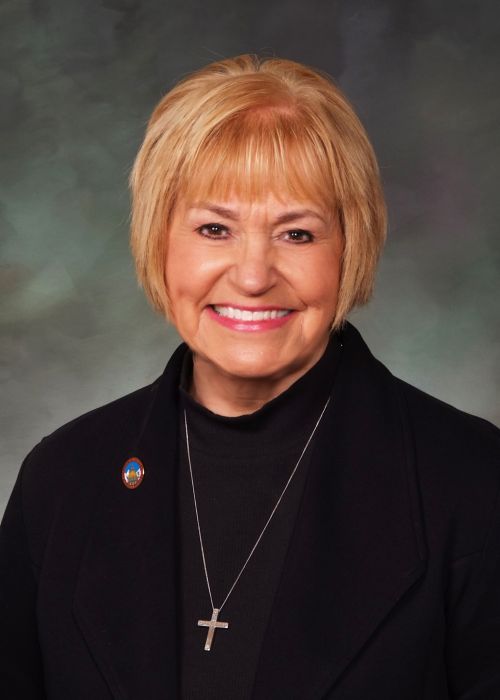
Photo of Janice Rich
R Colorado House · District 55

Rep. Janice Rich

Compare
Total votes
1,953
all sessions
Attendance
98%
35 missed
Near the chamber average
With party
88%
of cast votes
Lower than 77% of chamber peers
Bipartisan score
7%
crosses aisle rarely
Higher than 75% of chamber peers
Sponsored
49
bills & resolutions
Near the chamber average
Committees
0
assignments
49 bills and resolutions

Sponsored bills

Total
49
Primary
49
Co-sponsor
0
This page
49
matching current filters
Primary HB 19-1295
Signed into law · Colorado House · Lead sponsor
County Treasurers To Serve As Public Trustees

County - county treasurer to serve as public trustee. Public trustees for Class 2 counties (Adams, Arapahoe, Boulder, Douglas, El Paso, Jefferson, Larimer, Mesa, Pueblo, and Weld) are currently appointed by the governor. Commencing July 1, 2020, the act specifies that the county treasurer for each Class 2 county will serve as the public trustee for the county. The county treasurer is required to create a transition plan for assuming the new duties of the public trustee. The county treasurer is authorized to consider incorporating staff of the appointed trustee's office, including the prior public trustee, into the treasurer's office.(Note: This summary applies to this bill as enacted.) Read More

Signed into law May 29, 2019 0 co-sponsors
Primary HB 19-1299
Signed into law · Colorado House · Lead sponsor
Local Government Retirement Plan Contribution Rates

County, municipality, and other political subdivisions - retirement benefits plan or system for elected or appointed officers and employees - contribution rates. For any county, municipality, or other political subdivision (local government) or group of local governments that has established and maintains a plan or system (plan) of retirement benefits for its elected or appointed officers and its employees, the minimum contribution rate of participants in the plan is changed to 3% of the participant's basic salary or wage. In addition, the contribution rate of the local government and the contribution rate of the participant do not have to be the same, as was previously required, as long as the contribution rate for each is at least 3% of the participant's salary or wage.(Note: This summary applies to this bill as enacted.) Read More

Signed into law May 17, 2019 0 co-sponsors
Primary HB 19-1168
Signed into law · Colorado House · Lead sponsor
State Innovation Waiver Reinsurance Program

Reinsurance program - creation - payments for high-cost insurance claims - program contingent on federal waiver or funding approval - special fees - premium tax revenues - other funding sources - cash fund created - appropriation - repeal. The act authorizes the commissioner of insurance to apply to the secretary of the United States department of health and human services for a state innovation waiver, federal funding, or both, to allow the state to implement and operate a two-year reinsurance program to assist health insurers in paying high-cost insurance claims. The state cannot implement the program absent waiver or funding approval from the secretary. The program is established as an enterprise for purposes of section 20 of article X of the state constitution so long as the program satisfies enterprise status requirements. The commissioner is to establish payment parameters at levels to effectuate targeted insurance premium reductions. The payment parameters include: The attachment point, above which claims costs are eligible for reinsurance payments; The coinsurance rate at which the program will reimburse carriers for claims above the attachment point; and The reinsurance cap, above which claims costs are no longer eligible for reinsurance payments from the program. The commissioner is authorized to assess special fees against hospitals and, under specified circumstances, against health insurers to provide funding for the program. Additionally, the program is to receive money from the following sources to operate the program: Federal pass-through funding or other federal funds made available for the program; For the 2020-21 and 2021-22 fiscal years, an amount of premium tax revenues collected under current law that exceeds the amount collected in calendar year 2019; $15 million in 2020 and $40 million in 2021 from the general fund, contingent on the passage of House Bill 19-1245; and Any money the general assembly appropriates to the program fund. The act creates the reinsurance program cash fund and continuously appropriates the money in the fund to the division of insurance to operate the program. The commissioner is also authorized to seek, accept, and expend gifts, grants, or donations from private or public sources. The program repeals on September 1, 2023, unless the federal government denies the waiver or funding request, in which case the program repeals upon that denial. $785,904 is appropriated to the department of regulatory agencies for use by the division of insurance to implement the act. (Note: This summary applies to this bill as enacted.) Read More

Signed into law May 17, 2019 0 co-sponsors
Primary SB 19-250
Passed · Colorado Senate · Lead sponsor
Limit Tiered Rates Electric Utilities

Current law allows heat, light, gas, water, power, and telephone utilities to establish a graduated scale of charges known as tiered rates. The bill directs the legislative investor-owned utility review interim study committee to study the effects of tiered electric rates and allows the committee to hold 4 meetings during the 2019 interim. (Note: This summary applies to the reengrossed version of this bill as introduced in the second house.) Read More

Passed May 3, 2019 0 co-sponsors
Primary SB 19-076
Signed into law · Colorado Senate · Lead sponsor
CDOT Colorado Department Of Transportation Consulting Engineer Contracts

Consulting engineer contracts for transportation projects - study by efficiency and accountability committee - report. The act requires the efficiency and accountability committee of the department of transportation (CDOT) to study and report to the executive director of CDOT and the transportation commission its findings and any recommendations regarding the following issues relating to consulting engineer contracts for CDOT projects: Implementation of fixed bid procurement in lieu of bids based on hourly charges; The quality assurance process; The revolving door of retired CDOT employees going to work for consultants; Incentives for closing out project contracts, early project completion, and timely problem resolution; and Project staffing and implementation of a work plan for consistent CDOT and consultant construction project administration. CDOT must annually report to its legislative oversight committees, as part of its annual "State Measurement for Accountable, Responsive, and Transparent (SMART) Government Act" hearing, regarding the findings and any recommendations reported by the efficiency and accountability committee and the position of CDOT with respect to the findings and any recommendations. (Note: This summary applies to this bill as enacted.) Read More

Signed into law Apr 12, 2019 0 co-sponsors
Primary HB 19-1035
Signed into law · Colorado House · Lead sponsor
Remove Fee Cap Electrical Inspection Local Government Higher Education

Electricians - local inspection fees - limitations. The act repeals the prohibition against local governments and state institutions of higher education charging more than 15% more than the state charges to perform an inspection of electrical work, and instead subjects the inspection fee to a $120 cap that is adjusted annually for inflation with a potential additional 8% tiered charge based on the size or valuation of the inspected improvement. Specified provisions of the act are contingent upon House Bill 19-1172 becoming law. (Note: This summary applies to this bill as enacted.) Read More

Signed into law Apr 10, 2019 0 co-sponsors
Primary HB 19-1052
Signed into law · Colorado House · Lead sponsor
Early Childhood Development Special District

Early childhood development service districts - creation - powers and duties. The act authorizes the creation of early childhood development service districts (districts) to provide services for children from birth through 8 years of age. Early childhood development services are defined to include early care and educational, health, mental health, and developmental services, including prevention and intervention. Districts are authorized to seek voter approval to levy property taxes and sales and use taxes in the district to generate revenues to provide early childhood development services. The district must be organized pursuant to the "Special District Act" as modified by the act. All eligible electors in the proposed district, rather than only property owners, are able to vote on the organization of the district and related ballot issues. The service plan for a proposed district is not required to be submitted to the planning commission for each county in which the special district is proposed to be located, and instead is submitted directly to the board of county commissioners (board) for such counties. In addition, the board is not allowed accept or act upon the request of a person owning property in the proposed service area to have his or her property excluded from the special district. The court conducting a hearing for the petition is also directed to not accept or act upon such a petition to exclude property from the district. The districts are governed by the "Special District Act"; except that they are not subject to provisions concerning the inclusion or exclusion of property, procedures for the levy and collection of taxes, the certification and notice of special district taxes for general obligation indebtedness, property tax reduction agreements, and public improvement contracts. A district is authorized to contract with or work with another district or other provider of early childhood development services to provide services throughout the district. (Note: This summary applies to this bill as enacted.) Read More

Signed into law Apr 3, 2019 0 co-sponsors
Primary HB 19-1062
Signed into law · Colorado House · Lead sponsor
Grand Junction Regional Center Campus

Grand Junction regional center campus - department of human services - authority to either list all or a portion of the campus for sale or transfer. Current law requires the department of human services to list the Grand Junction regional center campus for sale. The act gives the department of human services other options by authorizing the department to either list all or a portion of the Grand Junction regional center campus for sale or to enter into a contract to transfer all or a portion of the campus to a state institution of higher education, to a local government, or to a state agency interested in its acquisition. Such transfer would, according to current statute, be required to be reviewed by the capital development committee.(Note: This summary applies to this bill as enacted.) Read More

Signed into law Mar 7, 2019 0 co-sponsors
Primary SB 19-130
In committee · Colorado Senate · Lead sponsor
Sales Tax Administration

The United States Supreme Court, on June 21, 2018, decided South Dakota v. Wayfair, Inc., et al. , overruling 2 previous United States Supreme Court cases that stood for the rule that a state could not require an out-of-state retailer to collect sales tax if the retailer lacked physical presence in the state. Because of the Wayfair decision, states can require retailers without physical presence in the state to collect sales tax on purchases made by in-state customers so long as the sales tax system in the state is not too burdensome for the out-of-state retailer. The bill simplifies the state sales tax system for retailers without physical presence by: Not requiring retailers without physical presence that only transact limited business in Colorado to collect sales tax; Specifying that only the state's sales tax base, not a local sales tax base, will apply to all sales made by retailers without physical presence; Requiring that the department of revenue (department) be responsible for all state and local sales tax administration and return processing, including the establishment of a single form for returns; Specifying that a central audit bureau is the sole entity within the state that is responsible for auditing retailers without physical presence and specifying that the central audit bureau be developed by the department in coordination with local taxing jurisdictions; Establishing that sales are taxed based on where the goods are delivered (destination sourcing) for all sales made by retailers without physical presence in the state, including local taxing jurisdictions, but specifying that destination sourcing is not required for sales made by Colorado retailers; Requiring the department to provide information to retailers without physical presence that indicates the taxability of products and services along with any product and service exemptions from sales tax in the state; Requiring the department to provide retailers without physical presence a sales tax rate database and a database of local taxing jurisdiction boundaries; Requiring the department to make available free-of-charge software that calculates sales taxes due on each transaction at the time the transaction is completed, files sales tax returns, and updates to reflect any tax rate changes for the state or any local taxing jurisdiction; Allowing the department to contract with one or more certified software providers without regard to the procurement code to provide the software or provide access to the software; Allowing a retailer to elect to collect and remit sales tax on its own, without using the services of a certified software provider, or allowing a retailer to elect to use the services of a certified software provider; Specifying that, in providing the software free of charge, the contracts negotiated between the department and the certified software providers must provide that all or a portion of the vendor fee may not be retained by the retailer electing to utilize the services of a certified software provider but will instead be retained by the certified software provider as payment for its services; Requiring the department to establish certification procedures for persons to be approved as certified software providers; and Providing the required relief of liability for errors to retailers without physical presence and other retailers utilizing the software. The bill allows local taxing jurisdictions governed by a home rule charter to opt in by passing an ordinance, resolution, or accepting the state's administration and distribution of its local sales tax on sales made by retailers without physical presence that is collected and remitted by such sellers in accordance with the bill. (Note: This summary applies to this bill as introduced.) Read More


In committee Feb 12, 2019 0 co-sponsors
Showing 41 to 49 of 49 bills
Previous 1 3 4 5