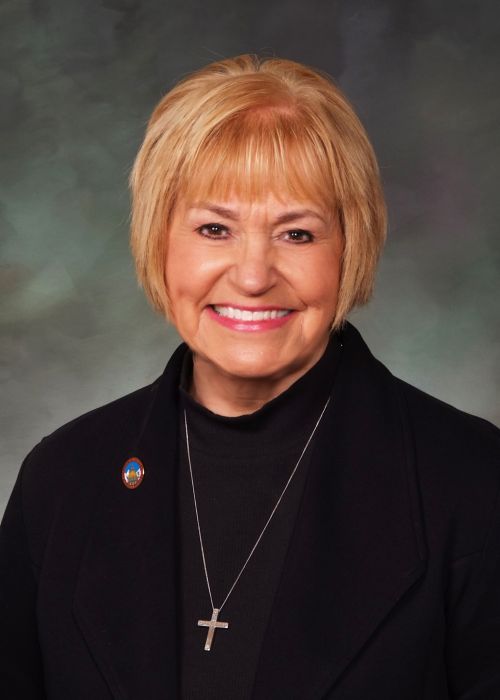
Photo of Janice Rich
R Colorado House · District 55

Rep. Janice Rich

Compare
Total votes
1,953
all sessions
Attendance
98%
35 missed
Near the chamber average
With party
88%
of cast votes
Lower than 77% of chamber peers
Bipartisan score
7%
crosses aisle rarely
Higher than 75% of chamber peers
Sponsored
49
bills & resolutions
Near the chamber average
Committees
0
assignments
49 bills and resolutions

Sponsored bills

Total
49
Primary
49
Co-sponsor
0
This page
49
matching current filters
Primary HB 22-1410
Signed into law · Colorado House · Lead sponsor
Remote Work Employees Of Supervised Lenders

The act permits and specifies the conditions for employees of supervised lenders to work from remote locations. Additionally, the act repeals the requirement that an applicant for registration as a debt-management services provider include with the application the results of a state and national criminal history record check for any agent of the applicant. (Note: This summary applies to this bill as enacted.)

Signed into law Jun 7, 2022 0 co-sponsors
Primary HB 22-1315
Signed into law · Colorado House · Lead sponsor
Colorado 2-1-1 Collaborative Funding

For state fiscal years 2021-22 and 2022-23, $1,000,000 is annually appropriated from the general fund to the department of human services for use by administration and finance for grants for operational expenses related to the Colorado 2-1-1 collaborative. For the 2022-23 state fiscal year, an additional $55,645 is appropriated from the general fund to the department for use by administration and finance for the 2-1-1 collaborative based on the assumption that the department will require an additional 0.9 FTE. (Note: This summary applies to this bill as enacted.)

Signed into law Jun 3, 2022 0 co-sponsors
Primary HB 22-1223
Signed into law · Colorado House · Lead sponsor
Mobile Home Property Tax Sale Notice And Exemption

The act creates a property tax exemption for mobile homes, which includes manufactured homes, that have an actual value of $28,000 or less. The act also eliminates the requirement that a county treasurer publish a notice in a newspaper of a sale of a mobile home, which includes a manufactured home, due to property taxes owed if: A distraint warrant has been delivered to the owner of the mobile home or to his or her agent; and The county treasurer publishes a notice of the sale on the treasurer's website. The act appropriates $833,193 from the general fund for the state share of districts' total program funding to offset the reduction in property tax revenue to school districts as a result of the property tax exemption. (Note: This summary applies to this bill as enacted.)

Signed into law Jun 2, 2022 0 co-sponsors
Primary SB 22-172
Signed into law · Colorado Senate · Lead sponsor
Colorado Rural Health-care Workforce Initiative

The act establishes the Colorado rural health-care workforce initiative (initiative) to expand the number of health-care professionals practicing in Colorado's rural or frontier counties. As part of the initiative, an institution of higher education (institution) is authorized to establish and operate a health-care professionals rural track within any health-care professional education program offered by the institution. A rural track must set aside seats in its health-care professional education program for students who express an interest in studying and working in a rural or frontier county, offer didactic curriculum related to practicing the health-care discipline in rural or frontier counties, place students in rural or frontier counties for hands-on instruction and training, and award scholarships to students in the rural track. In order to receive a scholarship, a student must commit to working as a health-care professional in a rural or frontier county for 2 years after completing education and training. The rural office at the university of Colorado's school of medicine (rural program office) provides technical assistance to the institutions operating a rural track regarding recruiting and admitting students committed to working in rural areas and identifying rural or frontier counties in which students may be placed for clinical training. The rural program office also facilitates, arranges, or advises an institution about arranging housing for students placed in a rural or frontier county. The rural program office must provide, without charge, to institutions operating a rural track, didactic curriculum related to practicing in rural or frontier counties. The act requires the rural program office to annually evaluate the effectiveness of the initiative and report to the general assembly's education committees about the initiative. The act requires the department of higher education (department) to enter into limited purpose fee-for-service contracts to provide funding for the rural program office to carry out its duties related to the initiative. The department is also required to enter into limited purpose fee-for-service contracts with institution governing boards to operate a rural track in programs specified in the act. The department is required to allocate money to Colorado mountain college to establish a rural track in its nursing program. The act appropriates $1,200,000 to the department from the general fund for fee-for-service contracts and allocations for the initiative. (Note: This summary applies to this bill as enacted.)

Signed into law Jun 1, 2022 0 co-sponsors
Primary HB 22-1083
Signed into law · Colorado House · Lead sponsor
Colorado Homeless Contribution Income Tax Credit

The act repeals an existing income tax credit available to taxpayers who make contributions to enterprise zone administrators to promote temporary, emergency, or transitional housing programs for persons experiencing homelessness (repealed credit) and replaces the repealed credit with a credit that is available in the entire state (new credit). Instead of having enterprise zone administrators and the office of economic development administer the new credit, as was how the old credit was administered, the act places that responsibility on the division of housing in the department of local affairs. A taxpayer may claim the new credit when permissible contributions are made not only to an approved project, but also to an approved nonprofit organization providing certain qualifying activities. The amount of the new credit remains the same as the amount of the repealed credit for each contribution; except that, for contributions made in an underserved, rural county, the amount is 30% rather than 25% and is capped at $750,000 in contributions per income tax year for the nonprofit organization, and, if the nonprofit organization also administers one or more approved projects, is capped at an additional $750,000 per income tax year. The new credit's availability is limited to 4 years, and, as was the case for the repealed credit, any credit in excess of a taxpayer's liability for the income tax year for which the credit is claimed may be carried forward for up to 5 years. (Note: This summary applies to this bill as enacted.)

Signed into law May 31, 2022 0 co-sponsors
Primary SB 22-144
Signed into law · Colorado Senate · Lead sponsor
Public And Nonprofit Entities Rideshare Contracts

Under Colorado law, the public utilities commission (PUC) regulates transportation network companies, which are commonly known as ridesharing companies, and the services they provide to ensure that the services are provided in a safe manner and that the drivers are financially responsible. Prior to the act, ridesharing companies were exempt from regulation if they provided services to a school, a school district, the federal government, a state, a political subdivision of a state, or a tax-exempt entity. The act removes this exemption. The act also requires ridesharing companies that provide school-related services and are paid by a school or school district to: Enter into a contract that includes safety provisions for student transportation; Use a technology-enabled integrated solution that provides end-to-end visibility using the global positioning system for the transportation network company, the student's legal guardian, and the person that scheduled the ride; Ensure that each driver providing the service receives training in mandatory reporting requirements, safe driving practices, first aid and cardiopulmonary resuscitation, education on special considerations for transporting students with disabilities, emergency preparedness, and safe pick-up and drop-off procedures; and Not use a driver who has been convicted of or pled guilty or nolo contendere to certain offenses. The PUC is required to coordinate with the department of education to promulgate rules implementing minimum safety standards for transportation network companies when providing services provided under a contract with a school or school district. A ridesharing company must notify the commission, the school or school district, and the student's legal guardian of any safety or security incidents that involve providing services for students to or from a school, school-related activities, or school-sanctioned activities. The commission is directed to promulgate rules implementing this requirement. In addition, the rules must require a ridesharing company to report information related to driver background checks, insurance coverage, and data reporting, consistent with the type of service provided, as it relates to service for students. The PUC must review and, if necessary, update the rules once every three years. (Note: This summary applies to this bill as enacted.)


Signed into law May 27, 2022 0 co-sponsors
Primary HB 22-1350
Signed into law · Colorado House · Lead sponsor
Regional Talent Development Initiative Grant Program

The act establishes the regional talent development initiative grant program (grant program) in the office of economic development (office) to fund talent development initiatives across the state that meet regional labor market needs and specified grant program goals, including initiatives that meet workforce development needs in regions as they recover from the negative economic impacts of the COVID-19 pandemic. The office, a state agency designated by the office, or a third party with whom the office contracts is to serve as the administrator of the grant program (program administrator). The office is directed to appoint a steering committee of 5 to 8 business, civic, education, and nonprofit professionals (steering committee), including at least one member representing a rural area of the state, one member representing a 2-year institution of higher education, and one member representing a 4-year institution of higher education. The steering committee will support the program administrator in: Developing a grant application process; Establishing grant application selection and prioritization criteria; and Appointing a selection committee to review grant applications and make grant award recommendations. The office, in collaboration with the departments of labor and employment, higher education, and education and the steering committee, is to identify regions throughout the state to inform the selection of grant applications. The office is to publish a report on the grant program by November 1, 2023, and by each November 1 through November 1, 2027. The act creates the regional talent development initiative grant program fund (grant program fund) and directs the state treasurer to transfer $91 million from the workers, employers, and workforce centers cash fund (cash fund) to the grant program fund as follows: $89,123,184 from federal money in the cash fund that the state received pursuant to the "American Rescue Plan Act of 2021"; and $1,876,816 from money in the cash fund that originated from the general fund. The money in the grant program fund is continuously appropriated to the office for the grant program and related costs. The grant program repeals on July 1, 2028. The act also directs the state treasurer to transfer $32,373,184 from the money in the cash fund that originated from the general fund back to the general fund. (Note: This summary applies to this bill as enacted.)
Signed into law May 26, 2022 0 co-sponsors
Primary SB 22-106
Signed into law · Colorado Senate · Lead sponsor
Conflict Of Interest In Public Behavioral Health

On or before January 1, 2023, the act requires each managed care entity, administrative service organization, and managed service organization that has 25% or more ownership by providers of behavioral health services to comply with certain conflict of interest policies in order to promote transparency and accountability. The act appropriates $42,658 from the general fund to the department of health care policy and financing to implement the act. (Note: This summary applies to this bill as enacted.)

Signed into law May 20, 2022 0 co-sponsors
Primary HB 22-1126
Failed · Colorado House · Lead sponsor
Eligible Educator Classroom Expenses Tax Credit

For 5 income tax years beginning in 2022, the bill creates a refundable state income tax credit for a Colorado teacher or classroom paraprofessional (eligible educator) for their classroom expenses. An eligible educator cannot claim the credit for an expense that the educator claims as a federal educator expense deduction for purposes of the educator's federal income tax, and the maximum amount of the credit per income tax year is $500.(Note: This summary applies to this bill as introduced.)

Failed May 12, 2022 0 co-sponsors
Primary HB 22-1108
Signed into law · Colorado House · Lead sponsor
Include Vendor Name In Web-based Info System

The act requires the state revenue and expenditure web-based system (web-based system), which is a free, searchable, web-based system that provides public access to information about state and county revenue and expenditures, to include, without redaction, the name of the vendor paid in connection with each expenditure included in the system; except that the web-based system is not required to include the legal name of the vendor if the state agency has determined that the public interest is best served by excluding the legal name of the vendor or that including the legal name of the vendor is otherwise prohibited by law. In addition, the act changes the responsibility for managing the web-based system from the chief information officer in the office of information technology to the department of personnel. (Note: This summary applies to this bill as enacted.)

Signed into law Apr 18, 2022 0 co-sponsors
Showing 1 to 10 of 49 bills
1 2 3 5 Next