

The act creates the work-based learning consortium pilot program (pilot program) in the department of higher education (department). The purpose of the 3-year pilot program is to: Demonstrate the value of work-based learning in postsecondary curricula by studying the impact of industry-sponsored projects on course objectives and learning outcomes; Promote the adoption of work-based learning in higher education by working with faculty at institutions of higher education (institutions) that participate in the pilot program (participating institutions) to embed project-based learning opportunities into credit-bearing programs; Provide broader access to collegiate work-based learning for students; Measure the impact of work-based learning on participating students; and Learn how institutions can increase the value of postsecondary education through career exposure and preparedness. Pending the receipt of sufficient funds, the department shall convene a consortium (consortium) of representatives from participating institutions, the commission on higher education (commission), the department of labor and employment, the department of education, and a subject matter expert with experience implementing work-based learning. The consortium shall: Work with each participating institution's faculty to embed industry-sponsored projects in course curriculum that meet the work-based learning quality standards; Work with the department to determine the impact of industry-sponsored projects; Work with a third-party platform to connect faculty from participating institutions to employers for the purpose of developing high-quality, project-based learning opportunities for classroom instruction; Advise the commission on strategies to improve student access to high-quality, work-based learning opportunities for students based on participating faculty members' experience embedding industry-sponsored projects into curriculum; Develop best practices for institutions to expand access to work-based learning in the classroom through industry-sponsored projects; and Develop findings and recommendations. Subject to available appropriations, at the end of the pilot program, the act requires the consortium to complete and submit a report to the education committees of the house of representatives and the senate, or their successor committees. The report must include: A description of the consortium's findings and recommendations; Details on the consortium's impacts on participating institutions and the effects of creating additional work-based learning activities on students, faculty, and employers; and Recommendations for statutory changes, financial resources, department policy changes, and policy changes in institutions that are necessary to improve successful work-based learning opportunities for students in institutions. The department may seek, accept, and expend gifts, grants, or donations from private or public sources for the pilot program. The department shall transmit all gifts, grants, or donations to the state treasurer, who shall credit the money to the higher education work-based learning consortium fund (fund). If, by June 30, 2028, the money in the fund has never reached or exceeded $2 million dollars, the state treasurer shall return each grantor's or donor's gift, grant, or donation. On or before November 1, 2026, the commission shall recommend a list of terms used by institutions related to work-based learning to the Colorado workforce development council for inclusion in the talent development glossary (glossary). The purpose of the list of terms is to: Augment the glossary so that collegiate work-based learning activities are accurately reflected in statewide efforts to promote work-based learning; and Demonstrate to institutions relevant opportunities to participate in statewide efforts to promote work-based learning. On or before July 1, 2026, the commission shall work with institutions, the Colorado workforce development council, the department of education, the consortium, nonprofit organizations, industry associations, and businesses to develop recommendations on how to best embed work-based learning opportunities into current degree pathways. On or before December 31, 2026, the department shall work with institutions to identify which work-based learning activities are measurable and how to best report work-based learning activities. Institutions that are eligible for the work-study program may use work-study program money to cover the costs of work-based learning credits for students who are required to complete credit-bearing work-based learning requirements to graduate from an institution. The office of economic development (office) administers the universal high school scholarship program (program). The act allows the office to spend unexpended or unencumbered money appropriated in the 2023-24 state fiscal year through the 2025-26 state fiscal year without further appropriation. The act requires that expenditures for the administrative costs of the program not exceed $1.5 million. The act extends the date for the state treasurer to transfer all unexpended and unencumbered money in the universal high school scholarship cash fund from December 30, 2026, to June 30, 2027. (Note: This summary applies to this bill as enacted.)
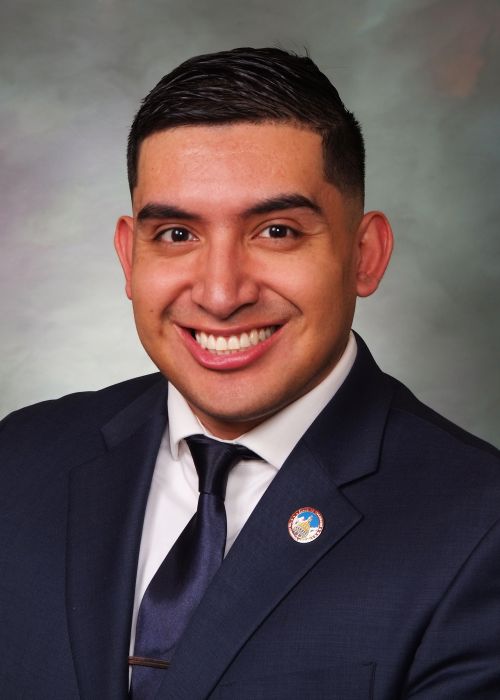
Rep. Ryan Gonzalez
Sponsored bills
For ground ambulance services (ambulance services), the act: Allows a political subdivision or an ambulance service providing ambulance services on behalf of the political subdivision to submit to the division of insurance (division) the established rates for the ambulance services, if the rates meet specified conditions; Requires the division to publish reimbursement rates on the division's public-facing website; Establishes reimbursement rates for ambulance services that are out of network; and Prohibits an out-of-network ambulance service from billing an individual covered under a health insurance coverage plan (covered person) any outstanding balance for a covered service not paid for by an insurance carrier, except for any coinsurance, deductible, or copayment amount required to be paid by the covered person. If a covered person makes a payment for an out-of-network ambulance service, the payment must be applied to the covered person's in-network deductibles and in-network out-of-pocket maximum amounts. For the 2025-26 state fiscal year, $38,149 is appropriated from the division of insurance cash fund to the department of regulatory agencies for use by the division to implement the act. VETOED by Governor 5/29/2025(Note: This summary applies to this bill as enacted.)
The act allows enrolled members of the Southern Ute Indian Tribe and enrolled members of the Ute Mountain Ute Tribe to enter state parks without having to pay an entrance fee. By June 1, 2026, the division of parks and wildlife (division) in the department of natural resources (department) shall build on existing efforts to conduct outreach to and engagement with the Southern Ute Indian Tribe, the Ute Mountain Ute Tribe, other tribal governments, American Indian communities, and Indigenous communities about opportunities related to state parks that are managed by the division. In January 2026 and January 2027, the department shall include, as part of its presentation during its "SMART Act" hearing, information concerning the division's outreach and engagement about opportunities related to state parks. (Note: This summary applies to this bill as enacted.)
The act requires the state board of education (board) to adopt high school health education standards regarding drug overdose risks, identification of a drug overdose event, and drug overdose prevention and response. The act authorizes the board to seek, accept, and expend gifts, grants, or donations for the purpose of adopting these standards. The board must adopt the standards on or before July 1, 2028, if, the board receives by July 1, 2026, $20,000 from gifts, grants, or donations to adopt the standards. If sufficient money is not received, the board is required to adopt the standards on or before July 1, 2032, pursuant to the general standards schedule. Under current law, a school district, the state charter school institute (institute), or the governing board of a nonpublic school may adopt and implement a policy allowing an employee or agent of the school to furnish an opioid antagonist to any individual, including a student, but only if the student has received appropriate school-sponsored training. The act repeals the required condition that a student must receive appropriate school-sponsored training. The act authorizes a school district, the institute, a public school, or a nonpublic school to seek, accept, and expend gifts, grants, or donations for purposes related to acquiring, maintaining, and providing training for administering opioid antagonists. (Note: This summary applies to this bill as enacted.)
Current law states that an employer shall not interfere with an agricultural worker's reasonable access to key service providers (KSP) at any location when the worker is not performing compensable work and with respect to health-care providers at any time. The act exempts an employer's property from this provision; except that the act prohibits an employer from interfering with a worker's access to KSP through remote channels on the employer's property. The act also removes language referring to health-care providers. Current law states that the division of labor standards and statistics (division) may adopt rules regarding additional times that an employer may not interfere with a worker's reasonable access to KSP. The act clarifies that such rules must apply only to locations other than the employer's property. Lastly, the act states the division shall not adopt rules that: Infringe upon an employer's private property rights; or Conflict with the common law rights of an individual to access private property in a time of emergency.(Note: This summary applies to this bill as enacted.)
The act makes changes to requirements for preventive care coverage by health insurers for breast cancer screening, including: Relocating in statute the high-risk breast cancer screening requirements; Defining and specifying criteria for the use of diagnostic breast examinations and supplemental breast examinations; and Clarifying that, in addition to regular breast cancer screening, diagnostic and supplemental breast examinations that are medically necessary and conducted within nationally recognized screening guidelines do not require cost sharing by the patient.(Note: This summary applies to this bill as enacted.)
The act creates the provider stabilization fund for use by Colorado department of health care policy and financing (department) to distribute provider stabilization payments to safety net providers who provide services to low-income, uninsured individuals on a sliding-fee schedule or at no cost. Provider stabilization payments will be distributed to eligible safety net providers based on the proportion of low-income, uninsured individuals that an individual provider serves in comparison to the total number of low-income, uninsured individuals served by all eligible safety net providers. The state treasurer is directed to make an interest-free loan of interest earnings on the principal in the unclaimed property trust fund (UPTF) and, if the interest earnings are insufficient, from the principal of the UPTF as well, to the provider stabilization fund as follows: $25 million for the 2025-26 state fiscal year; $20 million for the 2026-27 state fiscal year; and $15 million for each of the 2027-28, 2028-29, and 2029-30 state fiscal years. The act specifies that the loan from the UPTF to the provider stabilization fund is an interfund loan that is not classified as revenue, is booked as an interfund receivable or payable, is not state fiscal year spending or state revenues, and does not count against the state fiscal year spending limit or the excess state revenues cap. The department is directed to repay the loan by January 1, 2045, but in any year in which state revenues do not exceed the limit on state fiscal year spending, the department must present to the joint budget committee a proposal to repay all or a portion of the loan at an earlier time, and to the extent possible, the general assembly must prioritize repaying the loan starting in the 2030-31 state fiscal year or sooner if funds are available. The provider stabilization fund also consists of any money the general assembly appropriates, transfers, or credits to the fund and any gifts, grants, or donations the department may receive for the fund. The act directs the department to leverage money in the provider stabilization fund to obtain federal matching money. The act establishes a provider stabilization fund advisory board (advisory board) to assist the department in implementing and administering the provider stabilization fund. The department, with assistance from the advisory board, is required to submit an annual report on the provider stabilization fund to specified committees, the governor, and the medical services board in the department. The advisory board is scheduled for repeal on September 1, 2031, and is subject to a sunset review by the department of regulatory agencies before the repeal. The act appropriates $25,000,000 from the provider stabilization fund to the department to implement the act, allocated as follows: $138,505 for personal services to administer the act, including 2.0 FTE; $15,900 for operating expenses; and $24,845,595 for provider stabilization payments to eligible safety net providers.(Note: This summary applies to this bill as enacted.)
Infusion pharmacies supply medicaid members with parenteral nutrition, which provides patients with essential nutrients through an intravenous infusion. The act requires the state department of health care policy and financing (state department) to create specific professional dispensing fees for the preparation and dispensing of parenteral nutrition (fees) to encourage an adequate level of market participation among infusion pharmacies that serve medicaid members. During the year beginning January 1, 2026, the fees must not exceed 30% of infusion pharmacy administrative costs for the preparation and dispensing of parenteral nutrition. The state department shall seek federal authorization, as necessary, to implement the fees. The act requires the state department to annually report on the adequacy of the infusion pharmacy network that supplies parenteral nutrition to medicaid members. For the 2025-26 state fiscal year, the act appropriates $54,832 to the state department from the general fund. The state department may use the appropriation for medical and long-term care services for medicaid-eligible individuals. The general assembly anticipates that the state department will receive an equal amount in federal funds to implement the act. (Note: This summary applies to this bill as enacted.)
The act exempts an assisted living residence that has not undergone new construction or major renovations from complying with the facility guideline institute guidelines. The department of health care policy and financing (state department) must establish a process for reviewing and updating the general billing manual on an annual basis and ensure that the general billing manual includes all necessary CPT codes or links to the state department's list of CPT codes. The act allows the Colorado healthcare affordability and sustainability enterprise to receive public funds. Beginning January 1, 2026, for claims that must be reprocessed as a result of updating the provider rates, the act requires a managed care organization to issue payment to a contracted provider within one year after the provider rate is updated. The state department must notify the managed care organizations of changes to the provider rates within 60 days of changing the provider rates. The act requires the state department to include in each new contract with, or renewal of a contract with, a managed care entity (MCE) a provision requiring the MCE to submit to the state department, on an annual basis, the amount the MCE is paid and the MCE's medical loss ratio. The state department is required to publish this information, as well as historical medical loss ratio data for each MCE, and publish on an annual basis audit findings regarding an MCE's most recently completed medical loss ratio audit on the state department's website. The act prohibits the state department from imposing signature requirements on a physician or practitioner certifying a medicaid member's (member) plan of care that involves physical therapy, occupational therapy, or speech therapy. The act requires that for members receiving home- and community-based services, if a service the member receives is discontinued or no longer a covered service, the state department must confirm the timeline for the continuity of treatment with the federal centers for medicare and medicaid during the transition period of the benefit or service being discontinued and must communicate that timeline to the member impacted by the benefit or service being discontinued. (Note: This summary applies to this bill as enacted.)
The act prevents a pharmacy benefit manager (PBM) from prohibiting a rural independent pharmacy from using a private courier or a delivery service to deliver a prescription drug to a patient. A PBM is required to reimburse a rural independent pharmacy for a prescription drug in an amount not less than the national average drug acquisition cost for the dispensed prescription drug ingredients, plus pay a dispensing fee. When a PBM conducts an audit of a rural independent pharmacy and the audit results in a recoupment of more than $1,000 or a penalty of more than $1,000, the PBM must: Electronically notify the rural independent pharmacy of the rural independent pharmacy's rights to appeal at least 30 days before the recoupment of funds; If the rural independent pharmacy does not respond to the electronic notification within 30 days after the electronic notification, again electronically notify the rural independent pharmacy of the rural independent pharmacy's rights to appeal at least 30 days before the recoupment of funds; and If the rural independent pharmacy does not respond to the second electronic notification within 30 days after the second electronic notification, serve process on the rural independent pharmacy notifying of the rural independent pharmacy's rights to appeal at least 30 days before the recoupment of funds. The act allows a rural independent pharmacy to operate without being under the direct charge of a pharmacist if the initial interpretation and final evaluation of the prescription is done by a state-licensed pharmacist in person or remotely. (Note: This summary applies to this bill as enacted.)