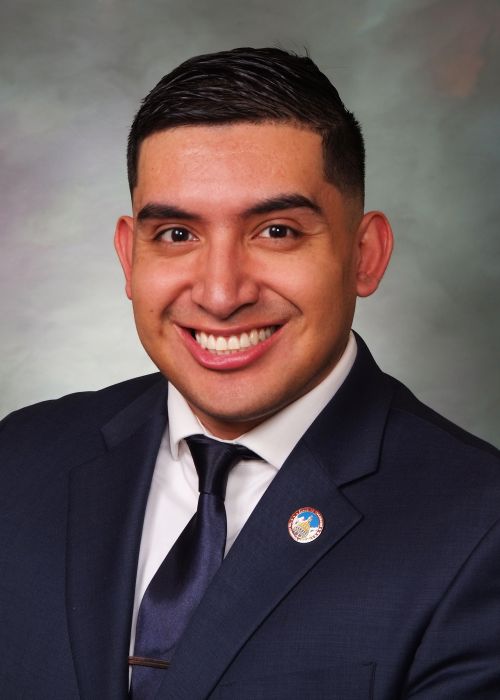
Photo of Ryan Gonzalez
R Colorado House · District 50 On the 2026 ballot

Rep. Ryan Gonzalez

Compare
Total votes
1,715
all sessions
Attendance
93%
104 missed
Lower than 88% of chamber peers
With party
87%
of cast votes
Lower than 94% of chamber peers
Bipartisan score
8%
crosses aisle rarely
Higher than 95% of chamber peers
Sponsored
259
bills & resolutions
Near the chamber average
Committees
2
assignments
259 bills and resolutions

Sponsored bills

Total
259
Primary
29
Co-sponsor
230
This page
259
matching current filters
Co-sponsor SB 25-036
Signed into law · Colorado Senate · Co-sponsor
State Patrol Bonding Exception

The act creates an exception to the requirement that a member of the Colorado state patrol be bonded by a surety company or insured with third-party crime insurance if the Colorado state patrol is self-insured with the Colorado state office of risk management and is eligible to be compensated from the state self-insured property fund. (Note: This summary applies to this bill as enacted.)

Signed into law Jun 4, 2025 1 co-sponsor
Co-sponsor HB 25-1061
Signed into law · Colorado House · Co-sponsor
Community Schoolyards Grant Program

The act creates the community schoolyards grant program (grant program) in the division of local government (division) within the department of local affairs (department). The grant program is a 2-part grant program that includes: The planning and design grant program (planning program), which awards up to $150,000 to each grant recipient selected by the division for the planning and design of a community schoolyard; and The capital construction and improvement grant program (construction program), which awards up to $850,000 to each grant recipient selected by the division for the capital construction of a community schoolyard. The purpose of the grant program is to address inequities in underserved and underfunded schools and communities, specifically communities socially or economically affected by the development, processing, or energy conversion of minerals and mineral fuels subject to taxation, by: Making community schoolyards accessible to the broader community outside of school hours; Improving physical activity and mental health opportunities for students and community members; and Incorporating natural landscapes, natural playgrounds, and recreational spaces that promote adaptation; sustainability; resilience; and hands-on learning across subject matters, including science, technology, engineering, arts, and mathematics. On or before January 15, 2026, the division shall implement a timeline for the planning program and the construction program (programs), which must include, at a minimum: Announcing each of the programs; Accepting applications from eligible applicants for each of the programs; Selecting the grant recipients for each of the programs; Distributing grant money to the grant recipients for each of the programs; and Establishing reporting timelines and requirements for each of the programs. On or before January 15, 2028, the division shall compile a report summarizing the grant recipient reports from the programs. The division shall submit the report to the education committees of the house of representatives and senate; the house of representatives transportation, housing, and local government committee; and the senate local government and housing committee, or their successor committees. For the 2025-26 and 2026-27 state fiscal years, the department shall use $4 million from the local government mineral impact fund or the local government severance tax fund for the grant program. The division may use up to 5% of the funds it receives for the grant program to pay for the direct and indirect costs of administering the grant program. The division may adopt rules to carry out the purposes of the grant program. The grant program is repealed, effective January 1, 2030. For the 2025-26 state fiscal year, $50,000 is appropriated to the department for use by the division from the reappropriated funds from the local government mineral impact fund and the local government severance tax fund. (Note: This summary applies to this bill as enacted.)

Signed into law Jun 4, 2025 1 co-sponsor
Co-sponsor HB 25-1209
Signed into law · Colorado House · Co-sponsor
Marijuana Regulation Streamline

Current law states that rules adopted by the marijuana enforcement division (division) may include certain subjects. The act states that: Rules concerning record keeping may include certain information and must include certain other information; and The rules may require medical marijuana products manufacturers or retail marijuana products manufacturers to use an approved licensed premises and approved equipment to manufacture and prepare products not infused with regulated marijuana for the purpose of quality control and research and development in the formulation of regulated marijuana products. If a license holder is required to maintain books and records in the seed-to-sale inventory tracking system, the license holder need not maintain duplicate copies of the books and records. If a license holder violates regulatory requirements, the division may require the license holder to maintain additional records. The act states that the division may adopt rules concerning identification cards for controlling beneficial owners, passive beneficial owners, or individuals who handle or transport regulated marijuana on behalf of license holders. Current law requires all applicants for an employee identification card to obtain a fingerprint-based criminal history check. The act requires only controlling beneficial owners and passive beneficial owners to obtain a fingerprint-based criminal history record check, and other employees must merely obtain a name-based judicial record check. The act requires that rules adopted by the division concerning video recording requirements must include rules to address specific aspects of such surveillance. The act authorizes the division to notify license holders by digital communication of their license expiration date. Current law authorizes marijuana cultivation facilities and marijuana products manufacturers to provide research and development units (R-and-D units) to managers and sets standards for the practice. The act reforms these standards with regard to labeling, testing, packaging, and tracking. The act also prohibits a facility or manufacturer from committing certain acts involving R-and-D units and requires the division to adopt rules concerning the issuance of R-and-D units to occupational licensees. The act repeals provisions that prohibit a person from: Having a controlling beneficial ownership, passive beneficial ownership, or indirect financial interest in a license that was not disclosed; Having day-to-day operational control over the business if the person isn't a Colorado resident; and Engaging in transfer of ownership without prior approval. The act authorizes the division to set and collect a fee to fulfill requests for copies of a license application. Current law requires a person that accepts a court appointment as a receiver, personal representative, executor, administrator, guardian, conservator, trustee, or any other similarly situated person for a medical marijuana business to notify the state and local licensing authorities of the appointment and apply for a finding of suitability. Current law also prohibits a person from possessing, operating, managing, or controlling a medical marijuana business on behalf of another except by court appointment . The act applies these laws to retail marijuana businesses. The act provides that on July 1, 2025, and July 1, 2026, the state treasurer will transfer $300,000 from the general fund to the marijuana entrepreneur fund. The appropriation to the division from the marijuana cash fund in the annual general appropriation act for the 2025-26 state fiscal year is decreased by $25,883 if certain conditions apply. The appropriation to the Colorado bureau of investigation from the Colorado bureau of investigation identification unit fund made in the annual general appropriation act for the 2025-26 state fiscal year is decreased by $252,645 if certain conditions apply. (Note: This summary applies to this bill as enacted.)


Signed into law Jun 3, 2025 1 co-sponsor
Co-sponsor HB 25-1289
Signed into law · Colorado House · Co-sponsor
Metropolitan District Leases & Property Tax Exemptions

The act requires a metropolitan district that is a party to a lease or rental agreement that was effective as of January 1, 2025, or later and was filed with the county assessor's office in support of a claim for a property tax exemption based on the use of the property for purposes of the metropolitan district to file with the county assessor's office a statement (statement) describing: The metropolitan district's use of the leased property; The metropolitan district's authority to use the leased property for the metropolitan district's purposes; Any use of the leased property by a private person for private purposes; and Any disclosure filed by a member of the board of directors of the metropolitan district in accordance with certain laws that govern disclosures of conflicts of interest. If the statement includes a disclosure that relates to the leased property and is filed by a member of the board of directors of the metropolitan district in accordance with certain laws that govern disclosures of conflicts of interest, the county assessor shall, within 14 days of receipt of the statement, submit the statement to the metropolitan district's governing body. Within 63 days of receipt of the statement, the governing body shall issue a written decision including findings of fact and a conclusion as to whether the leased property is used for a public purpose. If the governing body concludes that the leased property is not used for a public purpose, the leased property is not exempt from taxation, and the county assessor shall implement the governing body's decision. The decision of the governing body is not subject to appeal and does not give rise to any private right of action. The act clarifies that a leasehold interest in real or personal property that is owned by a private person and that has been leased to the state or a political subdivision of the state, the use and possession of which has been leased back to a private person for private purposes, is taxable to the owner. (Note: This summary applies to this bill as enacted.)
Signed into law Jun 3, 2025 1 co-sponsor
Co-sponsor SB 25-147
Signed into law · Colorado Senate · Co-sponsor
Modify Board Management Public Employees' Retirement Association

Section 1 of the act defines the board of trustees of the public employees' retirement association (board) as a local public body for purposes of the open meetings law. Section 2 limits the terms of both elected and appointed members of the board to not more than 2 consecutive 4-year terms; except that the state treasurer is not subject to the 2-term limit. A former trustee who has served 2 consecutive terms may be reelected or reappointed to the board after not serving on the board for a period of at least one term. Section 2 also clarifies how such term limits apply in the case of a vacancy appointment. Section 3 requires the board, on and after January 1, 2025, to conduct its meetings in accordance with the open meetings law as a local public body and requires the board to post and regularly maintain and update the public employees' retirement association's (association) website with information including: The notice with specific agenda information, if available, for the board's next public meeting; The policy for and process by which a member of the public may participate in any public meeting of the board; A link or other means of public access to the records of past public meetings of the board; and The official email address of the board. Section 3 also requires that, on or before January 1, 2026, and on or before January 1 of each calendar year thereafter, the board post certain financial information of the association on the association's website. Section 4 clarifies that, while the board may delegate any of its responsibilities, duties, and powers to the executive director of the association or other designated agents, the board retains authority and responsibility for the management of the association and all its statutory duties and powers through a specified existing administrative process. (Note: This summary applies to this bill as enacted.)

Signed into law Jun 3, 2025 1 co-sponsor
Co-sponsor HB 25-1031
Signed into law · Colorado House · Co-sponsor
Law Enforcement Whistleblower Protection

The act creates a civil cause of action for a peace officer if the peace officer reports or discloses conduct that is in violation of, or the peace officer reasonably believes is in violation of, any law or policy and the report or disclosure is a contributing factor in the employer of the peace officer's decision to take adverse employment action against the peace officer. A peace officer may seek the following damages: Reinstatement; Back pay with interest; Any other equitable relief the court deems appropriate; Compensatory damages for other pecuniary losses, emotional pain and suffering, inconvenience, mental anguish, loss of enjoyment of life, and other nonpecuniary losses; and Reasonable attorney fees and costs. The act creates an affirmative defense to the action if the peace officer's employer would have taken the action that forms the basis of the suit against the peace officer based on a legitimate nonretaliatory basis. The action is not subject to the "Colorado Governmental Immunity Act". The statute of limitations to bring the action is 2 years. The act does not apply to an employee who provides false information or who does not follow internal reporting and administrative procedures related to whistleblower conduct. All law enforcement agencies shall provide a training to employees or a workplace posting, or both, regarding the requirements of the act. (Note: This summary applies to this bill as enacted.)

Signed into law Jun 3, 2025 1 co-sponsor
Co-sponsor SB 25-165
Signed into law · Colorado Senate · Co-sponsor
Licensure of Electricians

The act amends a definition and adds new definitions under the electricians' practice act. Existing law requires an applicant for a journeyman electrician's license or a residential wireman's license to provide evidence of having certain minimum years of apprenticeship experience, accredited training, or practical experience. For the purpose of these requirements, the act allows an applicant for a journeyman electrician's license to have a minimum of 8,000 hours over a period of at least 4 years of certain apprenticeship or practical experience and an applicant for a residential wireman's license to have a minimum of 4,000 hours over a period of at least 2 years of certain practical experience. The act also changes the time frame for which an applicant for a journeyman electrician's license must complete at least 288 hours of training in safety, the national electrical code and its applications, and any other training required by the state electrical board (board) from the last 4 years to the last 8 years of the applicant's training, apprenticeship, or practical experience. Existing law allows an applicant for a journeyman electrician's license or a residential wireman's license to substitute for required practical experience evidence of academic training or practical experience in the electrical field. The act allows an applicant to also substitute evidence of training in photovoltaic systems installation. However, the act also states that the board may, but is no longer required to, provide work experience credit for academic training, military training, photovoltaic systems installation training, or substantially similar training. A contractor that is operating as of September 1, 2025, and that performs work as a photovoltaic installer pursuant with at least one North American Board of Certified Energy Practitioners (NABCEP) certified employee is required to register as a photovoltaic installer with the board on or before December 31, 2026. Existing law requires that, for all applicants seeking work experience credit toward licensure, the board give credit for electrical work that is not required to be performed by or under the supervision of a licensed electrician if the applicant can show that the experience or supervision is adequate. The act allows the board to give the credit, but it is not required to do so. Existing law allows for photovoltaic installations with a direct current design capacity of less than 300 kilowatts, the performance of all photovoltaic electrical work, the installation of photovoltaic modules, and the installation of photovoltaic module mounting equipment to be subject to on-site supervision by a certified photovoltaic energy practitioner designated by the NABCEP. The act requires that the photovoltaic energy practitioner is also working for a contractor that is not a registered electrical contractor; is registered with the department of regulatory agencies as a photovoltaic installer no later than December 31, 2026; is a business in good standing with the state; and employs a NABCEP PV installation professional. The act also: Defines "photovoltaic electrical work" as electrical work performed on a photovoltaic system that is covered electrical work in accordance with the national electrical code; Grants the board authority to regulate photovoltaic electrical work for installations of less than three hundred kilowatts and specifies that only an electrical contractor or a photovoltaic installer may perform or offer to perform such work; and Authorizes the board to charge a fee for photovoltaic installer registration.(Note: This summary applies to this bill as enacted.)

Signed into law Jun 3, 2025 1 co-sponsor
Primary SB 25-027
Signed into law · Colorado Senate · Lead sponsor
Trauma-Informed School Safety Practices

On or before September 1, 2025, the act requires the office of school safety (office) to convene and oversee a work group to develop best practices for the use of trauma-informed practices to conduct school safety drills. The act requires the work group to convene its first meeting no later than 56 days after the office receives $50,000 of gifts, grants, or donations for the purpose of the work group or receives an in-kind donation with a value of $50,000 as part of a public-private partnership agreement. No later than one year and one month after the office receives $50,000 of gifts, grants, or donations or receives an in-kind donation with a value of $50,000, the act requires the work group to develop recommendations to support schools in training school personnel on the use of trauma-informed practices in conducting school safety drills, how to best conduct school safety drills in a trauma-informed manner, and how to best respond to a school safety incident. The act requires that the work group be entirely funded by gifts, grants, and donations, including in-kind donations as part of a public-private partnership agreement. If by June 30, 2027, the work group has not received $50,000 in gifts, grants, or donations or an in-kind donation with a value of $50,000 as part of a public-private partnership agreement, the state treasurer must transfer any money received for purposes of the work group to the state education fund. (Note: This summary applies to this bill as enacted.)

Signed into law Jun 3, 2025 0 co-sponsors
Co-sponsor SB 25-304
Signed into law · Colorado Senate · Co-sponsor
Measures to Address Sexual Assault Kit Backlog

The act creates the Colorado sexual assault forensic medical evidence review board (board), consisting of the attorney general, or their designee, as board chair; the executive director of the Colorado district attorneys' council, or their designee; and various members appointed by the attorney general or the governor. The board's duties include reviewing and monitoring processes related to sexual assault response, making recommendations to improve sexual assault response, and submitting an annual report concerning its duties. The act creates a notification requirement under the "Victim Rights Act" that requires a law enforcement agency to notify a victim every 90 days when the law enforcement agency has not received the results of the forensic medical evidence DNA analysis from an accredited crime laboratory. The act requires an accredited crime laboratory to endeavor to analyze forensic medical evidence within 60 days after its receipt. The act expands public reporting requirements concerning forensic medical evidence and DNA evidence backlogs. For the 2025-26 state fiscal year, the act appropriates $112,365 from the general fund to the department of law for use by the administration division to implement the act. (Note: This summary applies to this bill as enacted.)

Signed into law Jun 3, 2025 1 co-sponsor
Co-sponsor HB 25-1083
Signed into law · Colorado House · Co-sponsor
Vehicle Transactions Deployed Military Families

If a service member's driver's license expires while they are serving on active duty outside of Colorado, the driver's license expiration date is extended for 3 years or until 90 days after the service member returns to the state. The act designates the service member's dependents as also subject to the extension of their driver's license expiration date. (Note: This summary applies to this bill as enacted.)

Signed into law Jun 3, 2025 1 co-sponsor
Showing 151 to 160 of 259 bills
Previous 1 … 15 16 17 … 26 Next