

Under current law, a local education provider is required to ensure that a preschool or kindergarten student receives an individualized readiness plan (plan). The act makes it optional for local education providers to provide plans to students who demonstrate proficiency on specified assessment domains and the kindergarten reading assessment, unless the student's parent requests a plan. Under current law, a local education provider is required to annually provide information concerning assessments to students' parents. The act requires this written notice to include:The results of the student's specified assessment domains and kindergarten reading assessment;If applicable, information explaining that because of the student's assessment results, the local education provider is not required, and does not intend, to provide a plan for the student; andLanguage indicating that the student's parent may request a plan. Under current law, the department of education is required to submit an annual report to the education committees of the house of representatives and the senate concerning specified educational accountability requirements. One of the reporting requirements concerns the level of school readiness demonstrated by students enrolled in kindergarten. The act requires the department to report this information on a statewide basis and to disaggregate the information based on specific characteristics.(Note: This summary applies to this bill as enacted.)
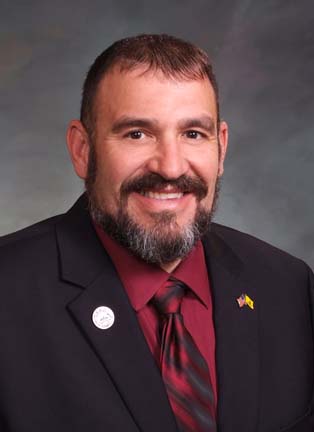
Rep. Ty Winter
Sponsored bills
The bill allows the speaker of the house of representatives, the minority leader of the house of representatives, the president of the senate, and the minority leader of the senate (legislative leadership) to each select up to 5 legislative measures to have a local government impact hearing during a regular legislative session. A local government impact hearing is a dedicated time that is at least one hour and not more than 2 hours at the beginning of a scheduled committee hearing for a legislative measure during which one or more local governments or organizations that represent local governments may present testimony to the committee regarding the potential effects of the legislative measure on local governments within the state. If a member of legislative leadership selects a legislative measure to have a local government impact hearing, the member must:Determine which committee of reference will hold the local government impact hearing if the legislative measure is assigned to more than one committee of reference; andNotify the chair of the applicable committee of reference and the staff of the legislative council that the legislative measure will have a local government impact hearing. If a member of the legislative leadership selects a legislative measure to have a local government impact hearing, the staff of the legislative council is required to include the local government impact hearing on the calendar as part of the regularly scheduled legislative hearing for the legislative measure in the applicable committee of reference. During the local government impact hearing, one or more local governments or statewide organizations that represents local governments may provide testimony regarding the impact of the legislative measure on local governments for the duration of the local government impact hearing without other limitations on the length of testimony. The bill requires the director of research of the legislative council to develop procedures for the implementation of local government impact hearings.(Note: This summary applies to this bill as introduced.)
The act requires the state board of veterinary medicine (board) to review and update the existing process by which an individual who has a license to practice veterinary medicine in another state may be licensed by endorsement to practice veterinary medicine in Colorado. The board shall adopt rules with the intent to expedite the licensure by endorsement process, including eliminating duplicative requirements and streamlining the pathway to licensure. The act clarifies that a veterinarian who administers, dispenses, distributes, or prescribes medicine to a patient in an emergency situation is not acting as a pharmacist or conducting the practice of pharmacy, and, as such, is not subject to discipline by the state board of pharmacy. The act relocates certain provisions specific to the practice of veterinary medicine from regulation by the state board of pharmacy to regulation under Colorado's veterinary practice act. Under current law, the board must approve a credentialing organization for the purpose of credentialing veterinary technicians, which credentialing organization must require the completion of an American Veterinary Medical Association accredited program for veterinary technicians. The act updates the requirement to require the completion of an accredited program for veterinary technicians offered by other associations. The act also establishes a veterinary prescription drug donation program. An owner of an animal may donate unused veterinary drugs that have been prescribed to the owner to a licensed veterinarian or an animal shelter. A licensed veterinarian may use any drugs accepted through donation if the veterinarian and drugs meet certain conditions.(Note: This summary applies to this bill as enacted.)
Under current law, a political party must ensure that any person, upon request, is able to participate in a precinct caucus or a party assembly with the use of a video conferencing platform or alternative means of participation. The failure of any political party to make a reasonable effort to comply with these accessibility requirements constitutes discrimination on the basis of disability in a place of public accommodation. The act clarifies that only a person who is otherwise eligible pursuant to statute to participate in a precinct caucus or a party assembly may request video conferencing or another alternative means of participation. The act also clarifies that a person who is subjected to a violation of a political party's duties regarding these accessibility requirements may file suit only against the central committee of the political party holding the caucus or assembly. An individual, including a member of the central committee of the political party or a volunteer for a political party, may not be held liable for a violation of these accessibility requirements. Upon a finding of a violation of these accessibility requirements, a court may require compliance with the applicable accessibility requirement and either actual monetary damages or a statutory fine of $3,500 for each violation.(Note: This summary applies to this bill as enacted.)
Maddy summaryThis bill designates April 9, 2026, as "Home Education Day" in Colorado to honor parents who educate their children at home. It does not change any laws or affect how education is administered but serves as a symbolic recognition of home schooling within the state. The resolution highlights the number of home-educated students in Colorado and the estimated financial savings to taxpayers associated with this educational choice. Ultimately, the measure is a ceremonial gesture that celebrates home educators without altering existing policies or regulations.
Maddy summaryThis Senate Joint Resolution formally recognizes the 43rd anniversary of the sister-state relationship between Colorado and Taiwan while expressing support for their ongoing trade and academic exchanges. The bill highlights recent cooperation in emerging technologies such as quantum computing and semiconductors, and it advocates for Taiwan's participation in international organizations like the World Health Organization and the United Nations. Additionally, the resolution commends Taiwan's democratic system and supports the signing of a U.S.-Taiwan agreement on avoiding double taxation. As a non-binding legislative statement, it does not alter laws or budgets but serves to publicly endorse these diplomatic and economic ties.
The concurrent resolution submits a constitutional amendment to the voters of the state at the 2026 general election that adds to the nonexclusive list of inalienable rights of all persons the right to direct the upbringing, education, and care of their children.(Note: This summary applies to this concurrent resolution as introduced.)
Under current law, the department of personnel and a statutorily created preservation trust committee oversee the Colorado veterans' monument preservation trust fund (trust fund). The act moves oversight of the trust fund to the state historical society (history Colorado) and repeals the preservation trust committee. The act also expands the allowable uses of the trust fund, which were previously restricted to maintaining and enhancing the Colorado veterans' monument and any fallen heroes memorials in Lincoln veterans' memorial park, to include the maintenance, enhancement, and repair of monuments and memorials both in Lincoln veterans' memorial park and on the state capitol building grounds. History Colorado may expend principal from the trust fund for these purposes once every 20 years beginning in state fiscal year 2027-28, subject to appropriation by the general assembly, and for unexpected necessary maintenance costs that are not covered by insurance. On or before December 31, 2026, and on or before each December 31 thereafter, history Colorado must submit a report to the state capitol building advisory committee (CBAC) that includes information on:History Colorado's plans to maintain, enhance, and repair monuments and memorials in Lincoln veterans' memorial park and on the state capitol building grounds; andThe actual and planned use of money in the trust fund. The act also requires the CBAC, before recommending a proposal for the placement of a memorial or an object of art on the state capitol building grounds to the capital development committee and the governor for approval, to ensure that the proposal includes funding sufficient to provide lifetime maintenance of the proposed memorial or object of art. Only a proposal that dedicates at least 5% of its total budget to maintenance includes funding sufficient to provide lifetime maintenance of the proposed object of art or memorial.(Note: This summary applies to this bill as enacted.)
Colorado law exempts the owner of a motor vehicle who is a member of the United States armed forces (member) from motor vehicle registration fees and sets the specific ownership tax at $1 while the member is serving outside the United States. This applies to personal motor vehicles and intrastate trucks, truck tractors, trailers, and semitrailers used to transport property. To qualify, the member must show the military order or evidence acceptable to the department of revenue (department) demonstrating that the member served outside the United States. The act repeals a requirement that the member sign an affidavit to qualify for the $1 specific ownership fee or to be exempt from the motor vehicle fee. Colorado law exempts members from paying late fees for failing to renew a registration for a vehicle if the member was serving outside the state when the registration period expired. The act sets the requirement to qualify for a late fee exception by requiring the member to show the military order or evidence acceptable to the department demonstrating that the member served outside of the state. The department will notify the member that the vehicle or motor vehicle must not be driven during deployment.(Note: This summary applies to this bill as enacted.)
The act increases the gross vehicle weight rating limit from less than 10,000 pounds to less than 16,000 pounds for a passenger vehicle for which the use of a child restraint system is required.(Note: This summary applies to this bill as enacted.)